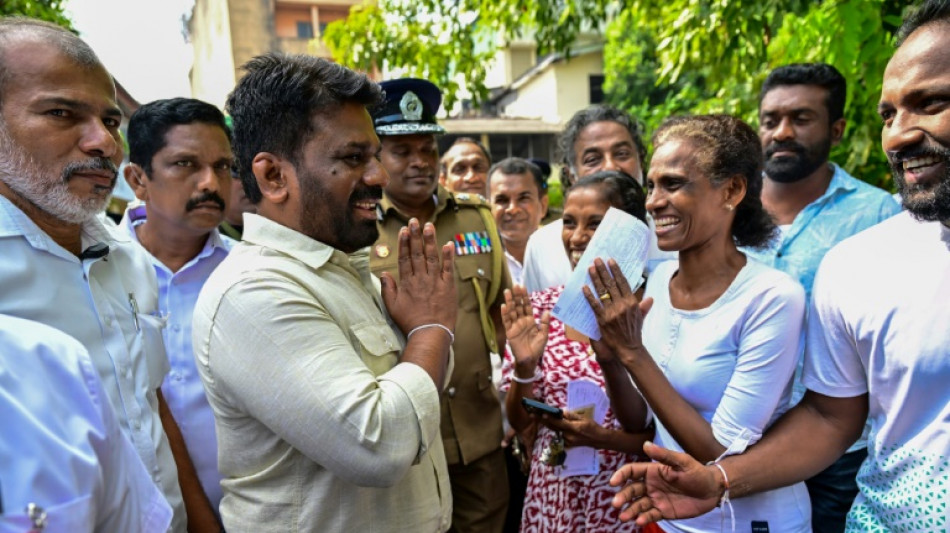
Landslide win for Sri Lanka president's leftist coalition in snap polls / Photo: Ishara S. KODIKARA - AFP

 UK actor Naomi Watts honoured at Spain film festival
 Japan emperor declares Asian Games open after turbulent build-up
 Asian Games open with unity message after troubled build-up
 Denmark hails 'binding' Greenland deal with Trump
 We don't want Games host Japan losing money, says Asian Olympic official
 Ed Sheeran returns to stage after Palestinian controversy

 Asian Games to open in Japan after troubled build-up
 Drone owners rush to offload devices ahead of Beijing ban
 Trump's beef policies irk Texas ranchers, testing their loyalty
 Nvidia, OpenAI CEOs to attend Xi dinner at White House
 Anthropic picks Accenture for in-house AI safety evaluation
 Balogun returns as Monaco beat Lens to continue strong Ligue 1 start
 'Pause' on overt repression in Venezuela, but reforms still needed: HRW
 Global stocks mixed as yen falls despite Bank of Japan rate hike
 Cuba hit with seventh major blackout of the year
 Murray out with concussion so Wentz will start for Vikings
 UN chief 'deeply regrets' US visa refusal to Abbas for annual meeting
 England quick Carse to face no charges over alleged nightclub assault
 Mancini brings nine newcomers into the first squad of his Italy comeback
 Czechs level Davis Cup tie against USA as South Korea eye Finals

 New France boss Zidane confirms Mbappe as captain after naming first squad
 California governor signs order to explore AI 'kill switch'
 Head leads run spree as Australia win Zimbabwe ODI series
 In-form Raphinha wants to finish career at Barcelona
 Warren Buffett steps down as Berkshire Hathaway chairman
Sri Lankan President Anura Kumara Dissanayake's leftist coalition won a landslide victory in snap legislative elections, results showed Friday, as voters repudiated establishment parties blamed for triggering an economic crisis.
Dissanayake, a self-avowed Marxist, swept September presidential elections on a promise to combat graft and recover stolen assets, two years after a slow-motion financial crash imposed widespread hardships on the island nation.
His decision to immediately call polls and secure parliamentary backing for his agenda was vindicated on Friday, with his National People's Power (NPP) coalition taking at least 123 seats in the 225-member assembly and on track to win many more.
The coalition had a monumental 62 percent of the vote among the more than three-quarters of ballots counted so far, while opposition leader Sajith Premadasa's party was well behind with only 18 percent.
"People voted to get rid of corruption and a corrupt system," IT professional Chanaka Rajapaksha, who supported the NPP in the polls, told AFP on Friday.
In a sign of the magnitude of support for Dissanayake, his party won the most votes in the northern district of Jaffna, dominated by the island's minority Tamil community, for the first time since independence from Britain in 1948.
Dissanayake, the 55-year-old son of a labourer, said he expected "a strong majority" in parliament to press ahead with his platform after casting his ballot in Thursday's poll.
"We believe that this is a crucial election that will mark a turning point in Sri Lanka," he said. "At this election, the NPP expects a mandate for a very strong majority in parliament."
Police said the nine-hour voting period passed without any incidents of violence, unlike most ballots of recent years, but three election workers including a police constable died due to illness while on duty.
Voter turnout was estimated at under 70 percent, less than in September presidential polls that saw nearly 80 percent of Sri Lanka's eligible voters cast a ballot.
Dissanayake had been an MP for nearly 25 years and was briefly an agriculture minister but his NPP coalition held just three seats in the outgoing assembly.
He stormed to the presidency after successfully distancing himself from establishment politicians blamed for steering the country to its 2022 economic crisis.
The financial crash was the worst in Buddhist-majority Sri Lanka's history as an independent nation, sparking months-long shortages of food, fuel and essential medicines.
The resulting public anger culminated in the storming of then-president Gotabaya Rajapaksa's compound, prompting his resignation and temporary exile.
Dissanayake's pledge to change a "corrupt" political culture has resonated with millions of Sri Lankans struggling to make ends meet following tax hikes and other austerity measures imposed to repair the nation's finances.
His JVP party, the main constituent in the NPP coalition, led two insurrections in 1971 and 1987 that resulted in at least 80,000 deaths.
But he was sworn in after September's presidential polls, described as one of the island nation's most peaceful elections.
- 'Investor confidence' -
Portraits of communist luminaries including Karl Marx, Vladimir Lenin, Friedrich Engels and Fidel Castro hang in Dissanayake's office in the capital.
Since his rise to popularity, however, he has softened some policies, saying he believes in an open economy and is not totally opposed to privatisation.
Dissanayake had campaigned on a pledge to renegotiate a controversial $2.9 billion International Monetary Fund (IMF) bailout secured by his predecessor.
But since taking office, he has resolved to maintain the existing agreement with the international lender.
The country's main private sector lobby, the Ceylon Chamber of Commerce, is tacitly supporting Dissanayake and his programme.
Sri Lanka's stock exchange has gained over 16 percent in the eight weeks since Dissanayake won the presidency.
- 'Opposition is dead' -
Poll monitors and analysts said Thursday's election had failed to generate the level of enthusiasm -- or violence -- seen at previous polls.
"The opposition is dead," political analyst Kusal Perera said before the vote. "The result of the election is a foregone conclusion."
The outgoing parliament was dominated by Mahinda and Gotabaya Rajapaksa, two brothers from a powerful political clan who have both served as president, but it has since splintered.
Neither Rajapaksa is contesting, but Mahinda's son Namal, a former sports minister, is seeking re-election.
E.AbuRizq--SF-PST