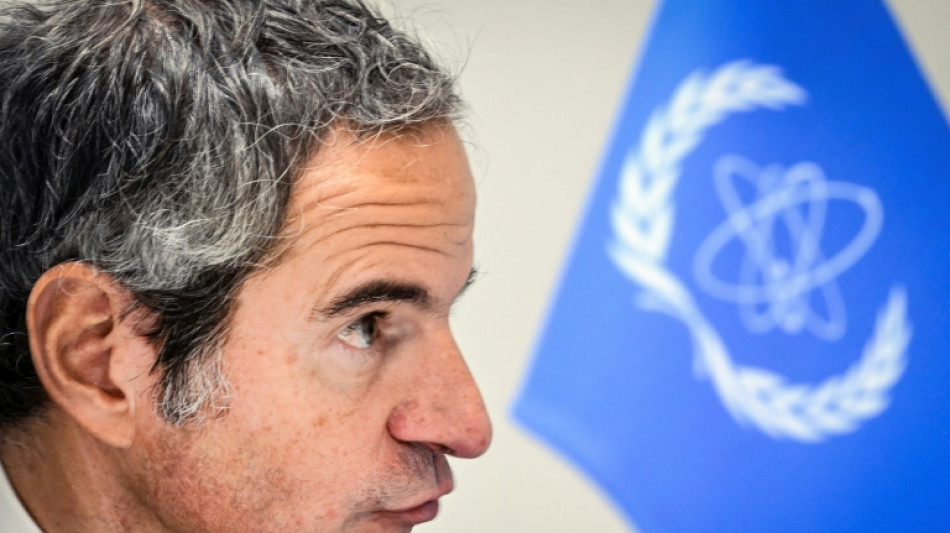
UN nuclear chief in Iran to 'reach diplomatic solutions' / Photo: Alexander NEMENOV - AFP

 UK actor Naomi Watts honoured at Spain film festival
 Japan emperor declares Asian Games open after turbulent build-up

 Asian Games open with unity message after troubled build-up
 Denmark hails 'binding' Greenland deal with Trump
 We don't want Games host Japan losing money, says Asian Olympic official
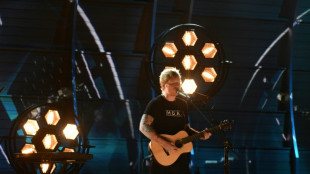 Ed Sheeran returns to stage after Palestinian controversy
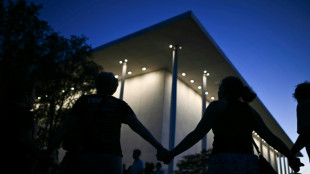
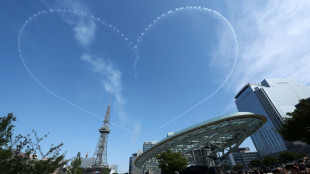 Asian Games to open in Japan after troubled build-up
 Drone owners rush to offload devices ahead of Beijing ban
 Trump's beef policies irk Texas ranchers, testing their loyalty
 Nvidia, OpenAI CEOs to attend Xi dinner at White House
 Anthropic picks Accenture for in-house AI safety evaluation
 Balogun returns as Monaco beat Lens to continue strong Ligue 1 start
 'Pause' on overt repression in Venezuela, but reforms still needed: HRW
 Global stocks mixed as yen falls despite Bank of Japan rate hike
 Cuba hit with seventh major blackout of the year
 Murray out with concussion so Wentz will start for Vikings
 UN chief 'deeply regrets' US visa refusal to Abbas for annual meeting
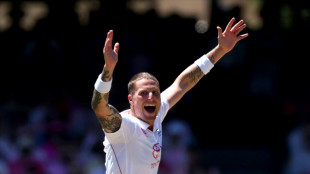 England quick Carse to face no charges over alleged nightclub assault
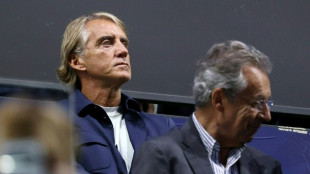 Mancini brings nine newcomers into the first squad of his Italy comeback
 Czechs level Davis Cup tie against USA as South Korea eye Finals
 New France boss Zidane confirms Mbappe as captain after naming first squad
 California governor signs order to explore AI 'kill switch'
 Head leads run spree as Australia win Zimbabwe ODI series
 In-form Raphinha wants to finish career at Barcelona
 Warren Buffett steps down as Berkshire Hathaway chairman
International Atomic Energy Agency chief Rafael Grossi was to hold talks with top Iranian officials Thursday on Tehran's nuclear programme, a week after Donald Trump's re-election as US president.
During his first term in the White House from 2017 to 2021, Trump was the architect of a policy called "maximum pressure" which levied against Tehran biting sanctions that had been lifted through a landmark nuclear agreement in 2015.
Grossi, who is the director general of the UN agency, arrived at Tehran airport on Wednesday evening and was greeted by Behrouz Kamalvandi, the spokesman for the Atomic Energy Organization of Iran (AEOI).
Grossi is set to meet Thursday in Tehran with AEOI chief Mohammad Eslami as well as Foreign Minister Abbas Araghchi, who was chief negotiator in the nuclear talks between Tehran and the major powers that resulted in the 2015 deal formally called the Joint Comprehensive Plan of Action or JCPOA.
The deal, reached after 21 months of negotiations between Iran and world powers, gave Tehran sanctions relief in exchange for curbs on its nuclear programme to guarantee that it could not develop a nuclear weapon -- something it has always denied wanting to do.
Three years later, then-president Trump unilaterally withdrew the United States from the agreement and reimposed heavy sanctions against Iran.
- Search for solutions -
A year later, Iran started to gradually roll back its commitments to the nuclear deal, which only allowed Tehran to enrich uranium to 3.65 percent purity.
The IAEA says Iran has considerably increased its reserves of enriched uranium to 60 percent, close to the 90 percent needed to develop an atomic bomb.
The head of the IAEA "will do what he can to prevent the situation going from bad to worse" given the significant differences between Tehran and Western capitals, analyst Ali Vaez, an Iran expert for the Crisis Group, a US-based think tank, told AFP.
"The one who left the agreement was not Iran, it was America," Iran's government spokeswoman Fatemeh Mohajerani said on Wednesday.
"Mr. Trump once tried the path of maximum pressure and saw that this path did not work."
Grossi's visit comes only two days after the defence minister of Iran's arch enemy Israel warned that the Islamic republic was "more exposed than ever to strikes on its nuclear facilities".
The two countries have exchanged missile fire in recent months in a context of high tensions in the Middle East due to the war waged by Israel in the Gaza Strip against Hamas and in Lebanon against Hezbollah, two militant groups allied with Iran.
Trump's return to the White House in January also raises fears of rising tensions between Iran and his country.
"The margins for manoeuvre are beginning to shrink," Grossi warned in an interview with AFP on Tuesday, adding that "it is imperative to find ways to reach diplomatic solutions".
- Religious decree -
Grossi has said that while Iran does not have any nuclear weapons at this this moment in time, it does have plenty of nuclear materials that could be used eventually to make a weapon.
Iranian President Masoud Pezeshkian, who came to office in July with hopes of improving ties with the West and having sanctions lifted, favours a revival of the nuclear deal.
But all efforts to get the nuclear agreement off life support have so far failed.
The IAEA chief has repeatedly called for more cooperation from Iran.
In recent years, Tehran has decreased its interaction with the UN agency by deactivating surveillance devices needed to monitor the nuclear programme and effectively barring its inspectors.
The foundations of Iran's nuclear programme date back to the late 1950s, when the United States signed a civil cooperation agreement with Iran's then Shah Mohammad Reza Pahlavi.
In 1970, Iran ratified the Non-Proliferation Treaty (NPT), which requires signatory states to declare and place their nuclear materials under the IAEA control.
But with Iran threatening to hit back at Israel for its latest missile strikes, some lawmakers in the Islamic republic have called on the government to revise its nuclear doctrine to pursue nuclear weapons.
The parliamentarians called on supreme leader Ayatollah Ali Khamenei, who wields ultimate authority in Iran, to reconsider his long-standing religious edict or fatwa banning nuclear weapons.
The Islamic republic has maintained its policy against acquiring nuclear weapons, insisting its nuclear activities are entirely peaceful.
I.Saadi--SF-PST