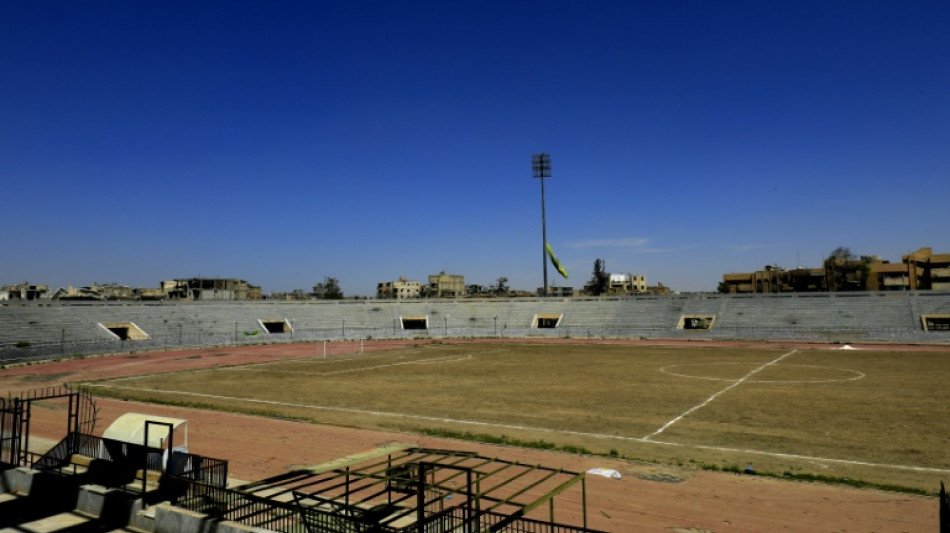
Syrians, Iraqis archive IS jail crimes in virtual museum / Photo: Delil souleiman - AFP

 Man City outgun Sunderland despite Brobbey hat-trick, Liverpool win at Bournemouth

 Top US, Chinese economic officials meet ahead of Trump-Xi summit
 Erdogan's LGBTQ crackdown 'first step of election campaign': activist
 Mass drone barrage on Moscow kills two

 82-year-old dies after beach fight in Greece over sun lounger

 US warns of rapid escalation in Mideast war

 Iran 'put hearts on the court' to win Asian Games basketball bronze

 School girl Yu helps China dominate in Asian Games swimming openers

 Drones hit Moscow as Russians go to the polls

 New England boss Fleming says 'wrong' to ask Stokes to end retirement

 تقرير حول منصّة شرطة دبي بـ«سوق السفر» تستقبل أكثر من 5 آلاف زائر
 تقرير حول إيطاليا: نجهز مهمة بحرية لحماية الملاحة في البحر الأحمر

 Russians vote on last day of parliamentary elections

 تقرير حول إغلاق باب الترشح لعضوية البرلمان الإماراتي للطفل في فصله التشريعي الثاني
 Hong Kong pays final respects to former city leader Tung

 Typhoon put people off Asian Games opening ceremony, official says

 IOC president impressed by 'beautiful' Asian Games wooden huts

 China's 13-year-old Yu cruises as Asian Games swimming begins

 AI 'warning shots' focus Beijing on national security risks

 Data centre command hub keeps AI up and running

 Philippine tribe in limbo over US-led tech hub

 Leo XIV, first US pope transcends his restrained style
 Singer Ed Sheeran says Gaza situation 'unjustifiable' following controversy
 In 'Tenzing', a Sherpa mountaineer gets his due
 حصيلة سيدات القادسية يكتسحن الترجي بـ14 هدفاً نظيفاً في الدوري الممتاز
After jihadists jailed him in 2014, Iraqi religious scholar Muhammad al-Attar said he would sometimes pull his prison blanket over his head to cry without other detainees noticing.
Islamic State group extremists arrested Attar, then 37, at his perfume shop in Mosul in June 2014 after overrunning the Iraqi city, hoping to convince the respected community leader to join them.
But the former preacher refused to pledge allegiance, and they threw him into prison where he was tortured.
In his group cell of at least 148 detainees at Mosul's Ahdath prison, at times "there was nothing left but to weep", Attar said.
But "I couldn't bear the thought of the younger men seeing me cry. They would have broken down."
So he hid under his blanket.
IS, also called ISIS, seized control of large parts of Syria and neighbouring Iraq and declared a so-called caliphate there in 2014, implementing its brutal interpretation of religion on inhabitants.
The militants banned smoking, mandated beards for men and head-to-toe coverings for women, publicly executed homosexuals and cut off the hands of thieves.
They threw perceived informants or "apostates" into prison or makeshift jails, many of whom never returned.
- 'Messages into the future' -
Attar's story is one of more than 500 testimonies that dozens of journalists, filmmakers and human rights activists in Syria and Iraq have collected since 2017 as part of an online archive called the ISIS Prisons Museum.
The website, which includes virtual visits of former jihadist detention centres and numerous tales about life inside them, became public this month.
The project is holding its first physical exhibition, including virtual reality tours, at the Paris headquarters of UNESCO, the UN's culture and education agency, until November 14.
Syrian journalist Amer Matar, 38, is director of the web-based museum.
"IS abducted my brother in 2013, and we started to look for him," he told AFP.
After US-backed forces started to expel jihadists from parts of Syria and Iraq in 2017, "I and my team got the chance to go inside certain former IS prisons," he said.
They found thousands of prison documents from the group whose caliphate was eventually defeated in 2019, but also detainee scratchings on the walls.
Etched inside the football stadium in the Syrian city of Raqa, for example, the team found prisoner names and Koranic verses, as well as lyrics from a 1996 television drama about peace eventually prevailing.
Inside one solitary cell, they discovered exercise instructions to keep fit in English.
Matar says he was detained twice at the start of the Syrian civil war, in a government jail for covering protests against President Bashar al-Assad.
"I too would write my name on the wall because I didn't know if I'd get out or if they'd kill me," he said.
"People usually write their names, cries for help or stories about someone who was killed," he added.
"They're messages into the future so that people can find someone."
- 'Ask us for evidence' -
Matar and his team decided to film the former prison sites and archive all the material within them before they disappeared.
"Many were homes, clinics, government buildings, schools or shops" that people were returning to and starting to repair, said Matar, who is now based in Germany.
They managed to capture 3D footage of around 50 former IS jails and 30 mass graves before they were transformed, he said.
In total they have documented 100 prison sites, interviewed more than 500 survivors and digitised over 70,000 IS documents.
Younes Qays, a 30-year-old journalist from Mosul, was in charge of data collection in Iraq.
"To hear and see the crimes inflicted on my people was really tough," he said, recounting being particularly shocked by the tale of a woman from the Yazidi minority who was raped 11 times in IS captivity.
Robin Yassin-Kassab, the website's English editor, said the project aimed to "gather information and cross-reference it" so it could be used in court.
"We want legal teams around the world to know that we exist so that they can come and ask us for evidence," he said.
Matar has not found his brother.
But within the coming year, he hopes to launch a sister website called Jawab, "Answer" in Arabic, to help others find out what happened to their loved ones.
H.Darwish--SF-PST