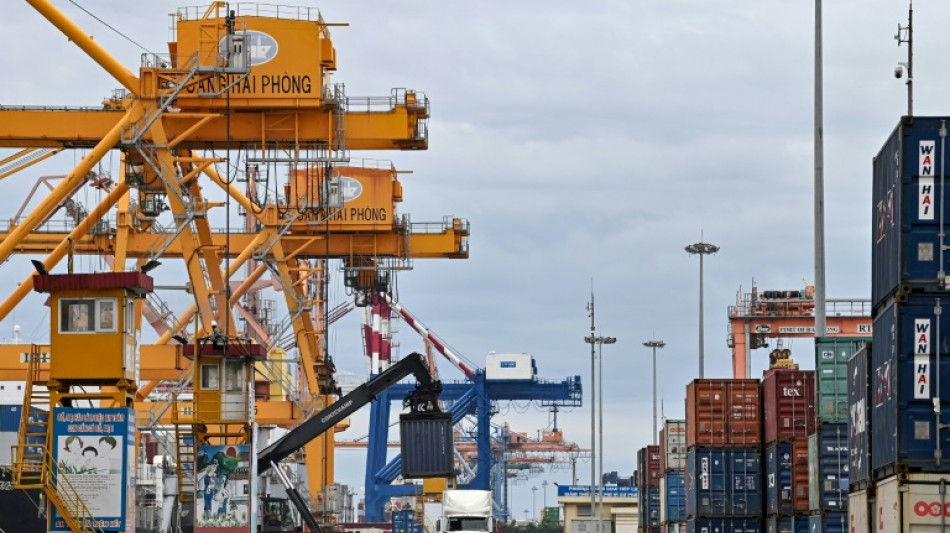
Asia, the world's economic engine, prepares for Trump shock / Photo: Nhac NGUYEN - AFP

 Man City outgun Sunderland despite Brobbey hat-trick, Liverpool win at Bournemouth

 Top US, Chinese economic officials meet ahead of Trump-Xi summit

 Erdogan's LGBTQ crackdown 'first step of election campaign': activist

 Mass drone barrage on Moscow kills two

 82-year-old dies after beach fight in Greece over sun lounger

 US warns of rapid escalation in Mideast war

 Iran 'put hearts on the court' to win Asian Games basketball bronze

 School girl Yu helps China dominate in Asian Games swimming openers

 Drones hit Moscow as Russians go to the polls

 New England boss Fleming says 'wrong' to ask Stokes to end retirement

 تقرير حول منصّة شرطة دبي بـ«سوق السفر» تستقبل أكثر من 5 آلاف زائر

 تقرير حول إيطاليا: نجهز مهمة بحرية لحماية الملاحة في البحر الأحمر

 Russians vote on last day of parliamentary elections
 تقرير حول إغلاق باب الترشح لعضوية البرلمان الإماراتي للطفل في فصله التشريعي الثاني

 Hong Kong pays final respects to former city leader Tung

 Typhoon put people off Asian Games opening ceremony, official says

 IOC president impressed by 'beautiful' Asian Games wooden huts

 China's 13-year-old Yu cruises as Asian Games swimming begins

 AI 'warning shots' focus Beijing on national security risks

 Data centre command hub keeps AI up and running

 Philippine tribe in limbo over US-led tech hub

 Leo XIV, first US pope transcends his restrained style

 Singer Ed Sheeran says Gaza situation 'unjustifiable' following controversy

 In 'Tenzing', a Sherpa mountaineer gets his due

 حصيلة سيدات القادسية يكتسحن الترجي بـ14 هدفاً نظيفاً في الدوري الممتاز

Some Asian countries stand to gain if US president-elect Donald Trump pushes ahead with his promised massive tariffs on China and triggers a new wave of factory relocations to the rest of the region.
But a trade war between the world's biggest economies would also destabilise markets everywhere, with Asia -- which contributes the largest share of global growth -- the most affected.
Trump, who won a crushing presidential victory this week, vowed during his campaign to slap 60 percent tariffs on all Chinese goods entering the United States in an attempt to balance trade between the two nations.
Analysts however question whether the new president will stick to such a high figure, and dispute the blow such tariffs could inflect on the Chinese economy, estimating GDP could be lowered by between 0.7 percent and 1.6 percent.
The cooling effect would also make waves throughout Southeast Asia, where production chains are closely linked to China and enjoy significant investment from Beijing.
"Lower US demand for Chinese goods due to higher tariffs on China will translate into lower demand for ASEAN exports, even if there aren't US tariffs levied directly onto those economies," said Adam Ahmad Samdin, of Oxford Economics.
Indonesia is particularly exposed through its strong exports of nickel and minerals, but China is also the top trading partner of Japan, Taiwan and South Korea.
In addition to China, Donald Trump has also warned of an increase of 10 to 20 percent on duties for all imports, as part of his protectionist policies and fixation that other countries take advantage of the US.
"The extent of these effects likely depends on the direct exposure of each economy to the US," said Samdin, who added that America accounts for a 39.1 percent share of Cambodian exports, 27.4 percent from Vietnam, 17 percent from Thailand and 15.4 percent from the Philippines.
- India to be targeted? -
Trump first slapped China with heavy tariffs in 2018 during his first administration, leading to the emergence of "connector countries", through which Chinese companies passed their products to avoid American taxes.
Those countries could be in the line of fire now.
"Vietnam's electronics exports to the US could also be targeted by Trump, in a bid to halt the diversion of Chinese electronic products to the US via Vietnam since 2018," said Lloyd Chan, a senior analyst at MUFG, Japan's largest bank.
"This is not inconceivable. Trade rewiring has notably gained traction in the region's electronics value chain."
"India could itself become a target of protectionist measures by the US due to the large share of Chinese components in Indian products," added Alexandra Hermann, an economist with Oxford Economics.
Trump could also impose higher tariffs on Indian goods in sectors such as "automobiles, textiles, pharmaceuticals and wines, which could make Indian exports less competitive in the US", said Ajay Srivastava of the New Delhi-based Global Trade Research Initiative.
A trade war would be dangerous for India, said Ajay Sahai, director of the Federation of Indian Export Organisations.
"Trump is a transactional person. He may target higher tariffs on certain items of Indian exports so he can negotiate for lower tariffs for US products in India," he told AFP.
- Supply chain rejig -
In the medium term, these negative effects could be counterbalanced by establishing factories outside China to escape the fallout.
The "China+1" strategy initiated during Donald Trump's first term saw production shifts to India, Malaysia, Thailand and Vietnam.
With its geographical position and cheap skilled labour, Vietnam has already been one of the main beneficiaries.
The country has notably received investments from Taiwanese Apple subcontractors Foxconn and Pegatron and South Korea's Samsung, becoming the second-largest exporter of smartphones in the world behind China.
"The likelihood increases that even more businesses will want to... have a second, or third, production base outside China," said Bruno Jaspaert, chairman of the European Chamber of Commerce in Vietnam.
Chinese firms themselves are investing massively from Vietnam to Indonesia in sectors including solar, batteries, electric vehicles and minerals.
"American companies and investors are very interested in opportunities in Vietnam and this will continue under the incoming Trump Administration," said Adam Sitkoff, executive director of the American Chamber of Commerce in Hanoi.
But whether it is low-end or high-tech production, China's competitive advantage in terms of price, scale and quality is difficult to reproduce, warns Nomura bank.
A reorganisation of production chains could lead to a "loss of efficiency" and increased prices, "with a negative impact on global growth", Thomas Helbling, deputy director of the IMF for Asia, recently explained to AFP.
Asian countries could therefore gain export market share but ultimately see their situation deteriorate amid weakening global demand.
N.AbuHussein--SF-PST