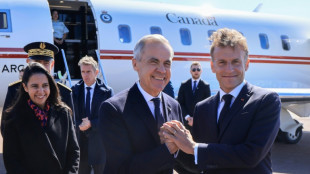
Facing Trump's return, EU confronts economic challenges / Photo: Ina FASSBENDER - AFP/File

 Man City outgun Sunderland despite Brobbey hat-trick, Liverpool win at Bournemouth

 Top US, Chinese economic officials meet ahead of Trump-Xi summit

 Erdogan's LGBTQ crackdown 'first step of election campaign': activist

 Mass drone barrage on Moscow kills two

 82-year-old dies after beach fight in Greece over sun lounger

 US warns of rapid escalation in Mideast war
 Iran 'put hearts on the court' to win Asian Games basketball bronze

 School girl Yu helps China dominate in Asian Games swimming openers

 Drones hit Moscow as Russians go to the polls

 New England boss Fleming says 'wrong' to ask Stokes to end retirement

 تقرير حول منصّة شرطة دبي بـ«سوق السفر» تستقبل أكثر من 5 آلاف زائر
 تقرير حول إيطاليا: نجهز مهمة بحرية لحماية الملاحة في البحر الأحمر

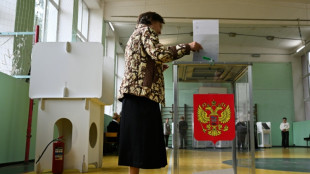 Russians vote on last day of parliamentary elections

 تقرير حول إغلاق باب الترشح لعضوية البرلمان الإماراتي للطفل في فصله التشريعي الثاني

 Hong Kong pays final respects to former city leader Tung

 Typhoon put people off Asian Games opening ceremony, official says

 IOC president impressed by 'beautiful' Asian Games wooden huts

 China's 13-year-old Yu cruises as Asian Games swimming begins

 AI 'warning shots' focus Beijing on national security risks

 Data centre command hub keeps AI up and running

 Philippine tribe in limbo over US-led tech hub
 Leo XIV, first US pope transcends his restrained style
 Singer Ed Sheeran says Gaza situation 'unjustifiable' following controversy

 In 'Tenzing', a Sherpa mountaineer gets his due
 حصيلة سيدات القادسية يكتسحن الترجي بـ14 هدفاً نظيفاً في الدوري الممتاز

Confronted with the return of Donald Trump, EU leaders on Friday are set to commit to deeply reform Europe's economy and tackle challenges highlighted by a blockbuster report.
Ex-European Central Bank head Mario Draghi was tasked last year with preparing the report that would steer the direction of the next five years of the EU's executive arm.
The big takeaway? Europe must invest up to 800 billion euros ($863 billion) more a year to avoid falling further behind the United States.
But with Germany mired in political turmoil, divergent national interests and bitter disagreements over how to face the challenges head on, there is no guarantee that the EU will be able to step up to the mark.
If the European Union does not take heed of his report's recommendations published in September, Draghi warned the 27-country bloc would face a "slow agony" of decline.
His report has taken on greater urgency, experts say, with Trump's resounding comeback in Tuesday's US election.
On the campaign trail, Trump repeatedly professed his love for tariffs and threatened to punish Europe for taking advantage of the United States with higher duties.
"The Draghi report itself, in a way, becomes even more interesting and urgent in relation to this outcome," said Ian Lesser, vice president at the German Marshall Fund of the United States think tank.
There is a lot in Draghi's 400-page tome for the leaders to digest before lunch.
Besides his call for more investment to improve economic output, Draghi controversially called for common borrowing -- an idea torpedoed by Germany -- as well as reforming the EU's approach to competition policy to encourage big spending.
Leaders' talks will "focus on funding, funding and funding", an EU diplomat said, but the ways to raise the money are "all open questions" in the months ahead.
- 'Decisive action' needed -
In a draft declaration seen by AFP, the leaders stress "the pressing need for decisive action" in which they back Draghi's proposals to deepen the single market, build the capital markets union that would better mobilise private capital as well as a trade policy that defends Europe's interests.
They also agree on "mobilising both public and private financing", adding they would explore "all instruments... to match our goals", a controversial inclusion that will likely spark long discussions.
Germany and other frugal northern European countries strongly reject taking on joint debt to finance investments despite the success of the pan-EU 800-billion-euro Covid recovery plan and Draghi's proposal, backed by France.
The Draghi report "can be a solid foundation for further work of the union", a senior EU official said.
There could be more public financing via the EU's own budget or turning to the bloc's own lender, the European Investment Bank.
The discussions come at a difficult time as many countries in the EU scramble to bring under control their debt and deficit which ballooned during the coronavirus pandemic.
But Friday's talks only kickstart the conversation and concrete proposals are expected to come months later, with implementing reforms set to take even longer.
EU states all agree on the poison hurting Europe but the antidote, despite being clearly laid out by Draghi and others, has always been harder for countries to accept.
The strong message from Draghi is to deepen the bloc's cooperation overall by forming a capital markets union and creating single markets for telecoms, defence and energy. But whether leaders will act is another question.
"I fear that the states will produce fine words but there will not be much behind them," said Sylvie Matelly, director of the Institut Jacques Delors think tank.
The leaders "can all agree that we need to invest massively, but how do we do it with Germans who are not determined to undertake a paradigm shift on debt?"
W.AbuLaban--SF-PST