The seven states that will decide the US presidency
/ Photo: DUSTIN FRANZ, Elijah Nouvelage - AFP/File

 Germany's far-right AfD celebrates another state election win

 Russia vows revenge for election-day attacks as poll shows ruling party win

 Spaun late shows snatches PGA Championship win

 Conceicao strikes as Juventus beat Atalanta

 Britain, Zverev-inspired Germany, Spain complete Davis Cup finals

 Man Utd salvage Fulham draw as pressure mounts on Carrick

 Spanish civil war drama 'The Black Ball' wins at Toronto festival

 Germany's Merz shaken by far-right and far-left gains in state votes

 Macron welcomes Canada's Carney to French Atlantic territory

 Fiorentina frustrate Napoli with Serie A draw, Como upset

 Five-star Man City top Premier League after Sunderland thriller

 Ukrainian drones hit Moscow on last day of Russian elections

 Multi-Asset Trading Venue Monochrome Exchange Announces IEO of Its Native Token, $MCR

 South Korea break Japan hearts to win Asian Games basketball gold

 Acosta takes first victory at Austrian MotoGP

 PSG president Nasser al-Khelaifi under investigation in France for conflict of interest

 China swim sensation, 13, sets Games record after Japan win early

 رئيس الدولة يجذب وفد شركة «إثارة».. أفضل منظم لسباقات الفورمولا 1 لعام 2025
 Myanmar win first Asian Games teqball gold as Spain great Puyol watches

 China's 13-year-old Yu scorches to first major gold at Asian Games

 Germans vote in elections threatening fresh blow to Merz

 قراءة في ألمانيا تجدد التزامها بسوق السياحة بدول مجلس التعاون الخليجي
 تقرير حول الإمارات تشارك في المؤتمر الرابع للجمعية الصينية للنقل الجوي في بكين

 US fears rapid escalation in Mideast after Houthis attack Riyadh

 Japan triathlete Hojo wins first gold of Asian Games

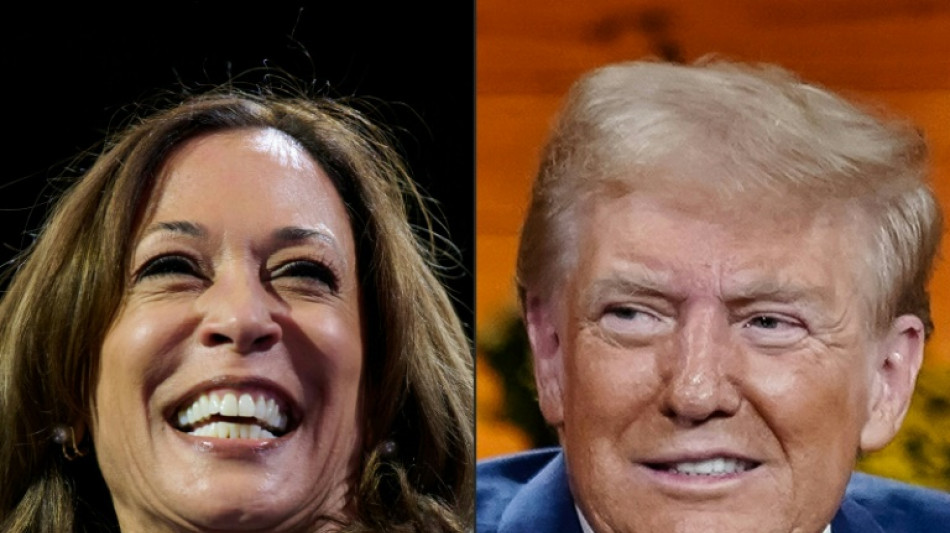
US Vice President Kamala Harris and former president Donald Trump are hurtling toward their November 5 election showdown, one of the closest contests in modern American history.
And in the handful of critical states framing the 2024 race, there is little daylight between the rivals with barely a week before Election Day.
Under the US Constitution, America's founding fathers established that each of the 50 states would hold its own vote for president.
Under the complex Electoral College system, each state has a certain number of "electors," based on population. Most states have a winner-take-all system that awards all electors to whoever wins the popular vote.
With candidates needing 270 of the 538 electoral votes to win, elections tend to be decided in the hotly contested "swing states" with a history of alternating between Republican and Democratic candidates.
This year, there are seven such battlegrounds, and every one is a toss-up within the margin of error. Here is a look:
- Pennsylvania (19 Electoral College votes) -
Pennsylvania was once reliably Democratic, but these days, they don't come much tighter than the Keystone State.
Republican Trump won the most populous battleground, with 13 million residents, by 0.7 percentage points in 2016. Joe Biden claimed it by 1.2 percentage points in 2020.
Known for its "Rust Belt" cities like Philadelphia and Pittsburgh, Pennsylvania has been blighted for decades by the steady decline of its industrial manufacturing base.
Trump and Harris have campaigned repeatedly in the eastern state, where the pair held their one and only presidential debate. Trump, who survived an assassination attempt at a July rally in Pennsylvania, is courting the rural white population and warning that migrants are overwhelming small towns.
Harris is touting recent infrastructure wins, and in Pittsburgh she outlined plans to invest $100 billion in manufacturing, a key issue for state residents.
- Georgia (16) -
This southeastern state was an election flashpoint at the end of Trump's first term, and the controversy simmers.
Prosecutors in Georgia indicted Trump in an election interference case after he called state officials urging them to "find" enough votes to overturn Biden's narrow 2020 victory.
But in a boost for Trump, the case is paused until after the election.
Biden was the first Democrat to win the Peach State since 1992. Demographic changes are likely to benefit Harris, who has courted minority voters across Georgia.
- North Carolina (16) -
The southeastern state has voted Democratic only once since 1980, but Harris believes it's back in play.
The population, now over 10 million, is expanding and growing more diverse, benefiting Democrats.
Complicating matters for Trump, a scandal involving the state's Republican gubernatorial candidate has infuriated party officials who worry it could sink Trump in a close race.
As in neighboring Georgia, one wild card is how the devastation from storm Helene, which recently laid waste to towns in western North Carolina, might impact the vote.
- Michigan (15) -
Trump flipped Michigan, a former Democratic stronghold, on his way to defeating Hillary Clinton in 2016.
Biden returned it to the blue column in 2020, buoyed by unionized workers and a large Black community.
But this time, Harris risks losing the support of a 200,000-strong Arab-American community that has denounced Biden's -- and by extension her -- handling of the Israel-Hamas war in Gaza.
- Arizona (11) -
The Grand Canyon state was among 2020's tightest races, with Biden triumphing by just 10,457 votes.
Trump hopes frustrations over the Biden-Harris administration's immigration policy will swing Arizona, which shares a border with Mexico, back in his favor.
Harris visited Arizona's border in September vowing to crack down on migration and work on reviving last year's bipartisan border bill, which she said Trump "tanked" for political purposes.
- Wisconsin (10) -
Clinton lost Wisconsin after giving the state a wide berth during the 2016 campaign.
As with Midwestern neighbor Michigan, it was a different story when Trump's opponent was Biden, who turned a 23,000-vote deficit into a winning margin of 21,000 for Democrats.
Trump considers it winnable, and his party held its summer national convention there.
While Trump led early against Biden, Harris has made the state race a nailbiter.
- Nevada (6) -
The Silver State, with a population of 3.1 million, hasn't voted Republican since 2004. Conservatives, buoyed by Trump's headway with Hispanic voters, are convinced they can flip the script.
Trump held a significant lead here against Biden.
But within weeks of becoming the Democratic nominee, Harris -- promoting her economic plans to help small businesses and combat inflation -- has erased that advantage in the western state, whose largest city Las Vegas is dominated by the hospitality industry.
L.AbuTayeh--SF-PST