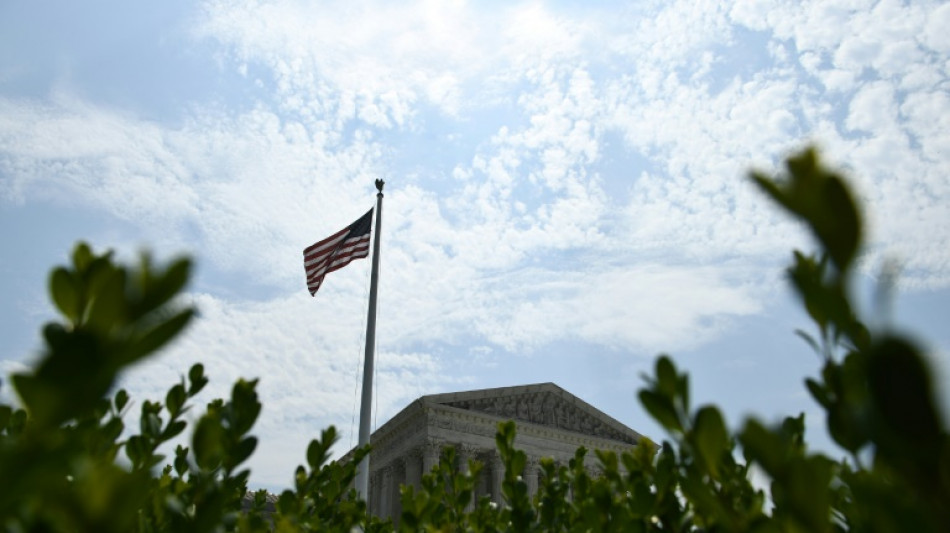
Win the vote but still lose? Behold America's Electoral College / Photo: Brendan Smialowski - AFP/File

 Germany's far-right AfD celebrates another state election win

 Russia vows revenge for election-day attacks as poll shows ruling party win

 Spaun late shows snatches PGA Championship win

 Conceicao strikes as Juventus beat Atalanta

 Britain, Zverev-inspired Germany, Spain complete Davis Cup finals

 Man Utd salvage Fulham draw as pressure mounts on Carrick

 Spanish civil war drama 'The Black Ball' wins at Toronto festival
 Germany's Merz shaken by far-right and far-left gains in state votes

 Macron welcomes Canada's Carney to French Atlantic territory

 Fiorentina frustrate Napoli with Serie A draw, Como upset

 Five-star Man City top Premier League after Sunderland thriller

 Ukrainian drones hit Moscow on last day of Russian elections

 Multi-Asset Trading Venue Monochrome Exchange Announces IEO of Its Native Token, $MCR

 South Korea break Japan hearts to win Asian Games basketball gold

 Acosta takes first victory at Austrian MotoGP

 PSG president Nasser al-Khelaifi under investigation in France for conflict of interest

 China swim sensation, 13, sets Games record after Japan win early

 رئيس الدولة يجذب وفد شركة «إثارة».. أفضل منظم لسباقات الفورمولا 1 لعام 2025
 Myanmar win first Asian Games teqball gold as Spain great Puyol watches

 China's 13-year-old Yu scorches to first major gold at Asian Games

 Germans vote in elections threatening fresh blow to Merz

 قراءة في ألمانيا تجدد التزامها بسوق السياحة بدول مجلس التعاون الخليجي
 تقرير حول الإمارات تشارك في المؤتمر الرابع للجمعية الصينية للنقل الجوي في بكين

 US fears rapid escalation in Mideast after Houthis attack Riyadh

 Japan triathlete Hojo wins first gold of Asian Games

When political outsider Donald Trump defied polls and expectations to defeat Hillary Clinton in the 2016 US presidential election, he described the victory as "beautiful."
Not everyone saw it that way -- considering that Democrat Clinton had received nearly three million more votes nationally than her Republican rival. Non-Americans were particularly perplexed that the second-highest vote-getter would be the one crowned president.
But Trump had done what the US system requires: win enough individual states, sometimes by very narrow margins, to surpass the 270 Electoral College votes necessary to win the White House.
Now, on the eve of the 2024 election showdown between Trump and Democrat Kamala Harris, the rules of this enigmatic and, to some, outmoded, system is coming back into focus.
- Why an Electoral College? -
The 538 members of the US Electoral College gather in their state's respective capitals after the quadrennial presidential election to designate the winner.
A presidential candidate must obtain an absolute majority of the "electors" -- or 270 of the 538 -- to win.
The system originated with the US Constitution in 1787, establishing the rules for indirect, single-round presidential elections.
The country's Founding Fathers saw the system as a compromise between direct presidential elections with universal suffrage, and an election by members of Congress -- an approach rejected as insufficiently democratic.
Because many states predictably lean Republican or Democratic, presidential candidates focus heavily on the handful of "swing" states on which the election will likely turn -- nearly ignoring some large states such as left-leaning California and right-leaning Texas.
Over the years, hundreds of amendments have been proposed to Congress in efforts to modify or abolish the Electoral College. None has succeeded.
Trump's 2016 victory rekindled debate. And if the 2024 race is the nail-biter that most polls predict, the Electoral College will surely return to the spotlight.
- Who are the 538 electors? -
Most are local elected officials or party leaders, but their names do not appear on ballots.
Each state has as many electors as it has members in the US House of Representatives (a number dependent on the state's population), plus the Senate (two in every state, regardless of size).
California, for example, has 54 electors; Texas has 40; and sparsely populated Alaska, Delaware, Vermont and Wyoming have only three each.
The US capital city, Washington, also gets three electors, despite having no voting members in Congress.
The Constitution leaves it to states to decide how their electors' votes should be cast. In every state but two (Nebraska and Maine, which award some electors by congressional district), the candidate winning the most votes theoretically is allotted all that state's electors.
- Controversial institution -
In November 2016, Trump won 306 electoral votes, well more than the 270 needed.
The extraordinary situation of losing the popular vote but winning the White House was not unprecedented.
Five presidents have risen to the office this way, the first being John Quincy Adams in 1824.
More recently, the 2000 election resulted in an epic Florida entanglement between Republican George W. Bush and Democrat Al Gore.
Gore won nearly 500,000 more votes nationwide, but when Florida -- ultimately following a US Supreme Court intervention -- was awarded to Bush, it pushed his Electoral College total to 271 and a hair's-breadth victory.
- True vote or simple formality? -
Nothing in the Constitution obliges electors to vote one way or another.
If some states required them to respect the popular vote and they failed to do so, they were subjected to a simple fine. But in July 2020, the Supreme Court ruled that states could impose punishments on such "faithless electors."
To date, faithless electors have never determined a US election outcome.
- Electoral College schedule -
Electors will gather in their state capitals on December 17 and cast votes for president and vice president. US law states they "meet and cast their vote on the first Tuesday after the second Wednesday in December."
On January 6, 2025, Congress will convene to certify the winner -- a nervously watched event this cycle, four years after a mob of Trump supporters attacked the US Capitol attempting to block certification.
But there is a difference. Last time, it was Republican vice president Mike Pence who, as president of the Senate, was responsible for overseeing the certification. Defying heavy pressure from Trump and the mob, he certified Biden's victory.
This time, the president of the Senate -- overseeing what normally would be the pro forma certification -- will be none other than today's vice president: Kamala Harris.
On January 20, the new president is to be sworn in.
D.Qudsi--SF-PST