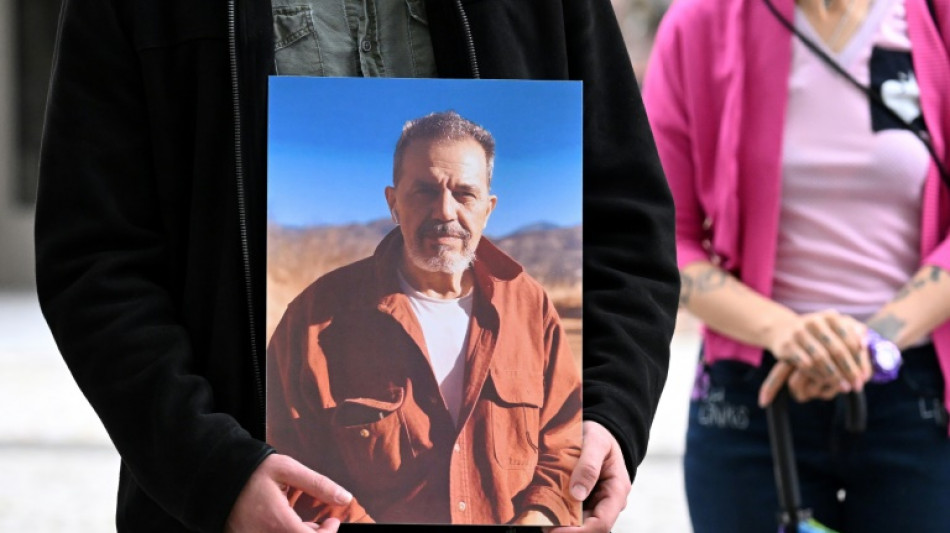
Family need 'proof' over fate of German Iran said executed: daughter / Photo: INA FASSBENDER - AFP/File

 تقديرات استخباراتية: إيران تنتج 50 صاروخاً شهرياً وتحافظ على ترسانتها رغم الضربات

 Radical Numerics develops offline AI tool to detect engineered pathogens

 Startup turns Chennai’s history and culture into an interactive world

 KZN Health Readiness Under Scrutiny as El Niño Forecast Intensifies

 Ohio Rep.-Elect Don Leonard Alleges Threats From Senior Democrats Over Speaker Vote

 एलेक्स बोडी और SCANDIC PAY: Mastercard और VISA कार्ड — भुगतान की नई पीढ़ी

 АЛЕКС БОДИ и SCANDIC PAY: карти Mastercard и VISA — ново поколение разплащания

 أليكس بودي وSCANDIC PAY: بطاقات Mastercard وVISA — جيل جديد من المدفوعات

 ALEX BODI 與 SCANDIC PAY:Mastercard 與 VISA 卡——新一代支付方式

 ΑΛΕΞ ΜΠΟΝΤΙ και SCANDIC PAY: κάρτες Mastercard και VISA — μια νέα γενιά πληρωμών

 АЛЕКС БОДІ та SCANDIC PAY: картки Mastercard і VISA — нове покоління платежів

 ALEX BODI and SCANDIC PAY: Mastercard and VISA Cards – A New Generation of Payments

 Everglades Restoration Accelerates Amid Calls for Clearer Success Metrics

 انخفاض طفيف على درجات الحرارة اليوم وغدًا ارتفاع آخر

The family of Jamshid Sharmahd, a German citizen who the Iranian judiciary said was executed in Iran last week, need proof that he was indeed put to death and are open to all possibilities over his fate, his daughter said.
Sharmahd, who was born in Iran but became a German citizen and was a permanent resident in the United States, was executed on October 28 on the charge of "corruption on earth", according to the Mizan Online news website of the Iranian judiciary.
But his US-based daughter, Gazelle Sharmahd, told AFP in a telephone interview the family had no evidence of his execution other than such reports and also had no indication of how his body could be brought home.
Jamshid Sharmahd, 69, was tried and convicted after he was in July 2020 abducted in the United Arab Emirates by Iranian agents and forcibly brought to Iran, according to the family and the UN Working Group on arbitrary detention in a 2022 report.
Iran does not recognise dual citizenship and announced Sharmahd's arrest after a "complex operation", without giving details.
As well as being a German citizen, Jamshid Sharmahd should also be considered a US national in line with a 2020 bill that passed the Senate, his daughter said, urging Berlin and Washington to do more to find out what happened to him and increase pressure on Tehran.
"We are still awaiting verification by the Germans and Americans on what has happened to their German-American hostage," she said.
- 'Many possibilities' -
"There are many possibilities of what could have happened. He could have been poisoned, he could have been injected with something, he could have died as a result of ill treatment in over 1,500 days of solitary confinement. He could have been hanged. He could be alive. We don't know."
Without evidence, "we cannot jump to conclusions," she said, emphasising that the German and American governments had also provided no further proof of the execution.
The case of Jamshid Sharmahd had long been shrouded in uncertainty.
There were never reports of fellow detainees having seen him, even though foreign passport holders are known to regularly cross paths in Tehran's Evin prison. During his captivity, he made a handful of phone calls to his family but was never allowed to reveal where he was being held.
Gazelle Sharmahd noted that her father's execution had been announced by Mizan Online late evening Iranian time, whereas executions in Iran almost always take place in the early morning and if confirmed by official media are announced shortly afterwards.
Its report, highly unusually, also did not reveal where he was put to death.
"It is now the responsibility of Germany and the United States to give deadlines to transfer the body to the family. If there is a corpse, he needs to be returned and brought back to us as soon as possible," Gazelle Sharmahd said.
- 'Complicit' in crimes -
In his trial, Sharmahd was accused of involvement in a bombing against a mosque in 2008 in the southern city of Shiraz that killed 14 people as well as espionage, claims rejected by the United Nations Working Group.
His family have long maintained that Sharmahd was innocent.
In the United States, Sharmahd helped develop a website for an opposition movement and hosted radio broadcasts critical of the Islamic republic authorities.
The family says Sharmahd, who was born in 1955 under imperial rule, has never held a passport issued by the Islamic republic.
The UN Working Group said his "arbitrary" arrest lacked a legal basis and was due solely to "his legitimate exercise of freedom of opinion and expression".
Amnesty International said the trial was "grossly unfair" and Iran had inflicted "unrelenting cruelties" on him and his family.
In response to the execution reported by Iran, Germany ordered the closure of Iranian consulates on its territory. The measure does not apply to Iran's Berlin embassy.
"We have repeatedly and unambiguously made it clear to Tehran that the execution of a German citizen will have serious consequences," said German Foreign Minister Annalena Baerbock.
But Gazelle Sharmahd said the step did not go far enough and criticised both the German and US administrations for inaction.
"That would have been the minimal response four years ago. Is it enough now? No. If we do not understand that we cannot have embassies, business or negotiations with the Islamic terrorists then I do not know what we are going to do," she said.
"Both governments (US and Germany) had plenty of chances to get my father out or at least have his death sentence revoked. They are complicit in the crimes against my father."
J.AbuHassan--SF-PST