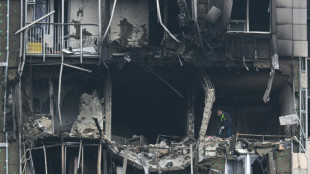
Drug-resistant superbugs: Ukraine's other wartime enemy / Photo: Genya SAVILOV - AFP

 Germany's far-right AfD celebrates another state election win

 Russia vows revenge for election-day attacks as poll shows ruling party win

 Spaun late shows snatches PGA Championship win

 Conceicao strikes as Juventus beat Atalanta
 Britain, Zverev-inspired Germany, Spain complete Davis Cup finals

 Man Utd salvage Fulham draw as pressure mounts on Carrick

 Spanish civil war drama 'The Black Ball' wins at Toronto festival

 Germany's Merz shaken by far-right and far-left gains in state votes

 Macron welcomes Canada's Carney to French Atlantic territory
 Fiorentina frustrate Napoli with Serie A draw, Como upset

 Five-star Man City top Premier League after Sunderland thriller
 Ukrainian drones hit Moscow on last day of Russian elections
 Multi-Asset Trading Venue Monochrome Exchange Announces IEO of Its Native Token, $MCR
 South Korea break Japan hearts to win Asian Games basketball gold

 Acosta takes first victory at Austrian MotoGP

 PSG president Nasser al-Khelaifi under investigation in France for conflict of interest

 China swim sensation, 13, sets Games record after Japan win early

 رئيس الدولة يجذب وفد شركة «إثارة».. أفضل منظم لسباقات الفورمولا 1 لعام 2025
 Myanmar win first Asian Games teqball gold as Spain great Puyol watches

 China's 13-year-old Yu scorches to first major gold at Asian Games

 Germans vote in elections threatening fresh blow to Merz

 قراءة في ألمانيا تجدد التزامها بسوق السياحة بدول مجلس التعاون الخليجي
 تقرير حول الإمارات تشارك في المؤتمر الرابع للجمعية الصينية للنقل الجوي في بكين

 US fears rapid escalation in Mideast after Houthis attack Riyadh

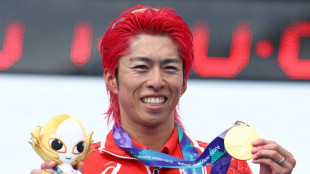 Japan triathlete Hojo wins first gold of Asian Games
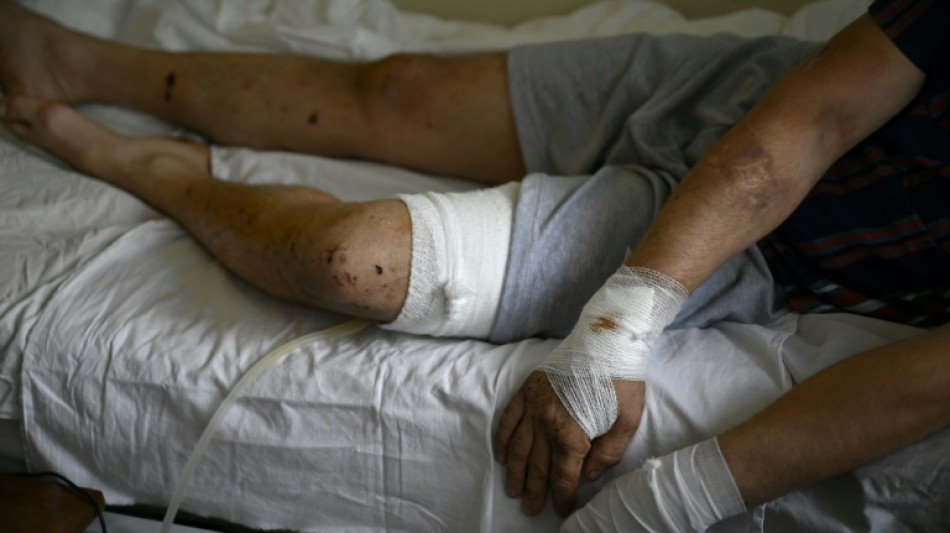
Ukrainian soldier Anton Sushko, severely wounded, thought he was finally safe when he spotted a rescue team after crawling for hours through the battlefield in eastern Ukraine.
"That's it, I thought, here are the guys... We made it. Wounded, but alive," the 40-year-old recalled from his hospital bed in Dnipro, southeastern Ukraine.
But Sushko wasn't out of danger yet.
By the time he escaped, a wound on his left leg had got infected with aggressive bacteria resistant to antibiotics, making it harder for doctors to treat him.
Thousands of other soldiers have, like him, come back from the front with wounds festering with multidrug resistant organisms, pointing to a little-understood cost of the war.
Bacteria have long developed resistance against medicines designed to fight them, rendering many drugs useless.
The process known as antimicrobial resistance (AMR) directly causes over a million deaths and contributes to five million deaths every year, according to the World Health Organization.
This has been accelerated by the massive use of antibiotics to treat humans, animals and food, including in Ukraine.
But Ukraine has seen a particular increase in antimicrobial resistance during the Russian invasion, according to WHO representative in Ukraine, Jarno Habicht.
"The ultimate cause why we see the rise of antimicrobial resistance is actually the ongoing war," he said.
- 'Dirty, rotting' -
Direct combat and aerial strikes have triggered a rise in patients suffering from traumatic wounds, who have overwhelmed understaffed hospitals.
The Dnipro Mechnikov Hospital, where soldier Sushko was being treated, saw its workload increase tenfold, said chief surgeon Sergiy Kosulnykov.
"Every blast is an open wound, and every open wound is an infection," Kosulnykov said, showing AFP slides of purulent lesions.
Explosive battlefield injuries rarely get treated in time as evacuations from the drone-infested front lines have become increasingly perilous.
By the time medical teams take a look, the wounds are often "dirty, rotting, with necrosed (dead) tissues and bones, and full of aggressive microbes that are difficult to fight," Kosulnykov said.
To save their patients' lives, teams often have no choice but to prescribe strong antibiotics.
And they rarely have time to wait for laboratory results determining the right antibiotics.
"It's impossible to imagine all of that without a growth in resistance," said Kosulnykov.
"The more we try to somehow kill a microbe, the more it defends itself."
The process sends doctors on a quest for ever stronger antibiotics to save the lives of patients, who cannot do much but hope a cure works.
- 'Not in vain' -
As he waited, Sushko tried to find sense to it all.
"I distract myself with music, I read literature to go deeper into the roots of our people, for my soul to grasp that our guys aren't giving their lives in vain," he said.
Racing to save his patients, Kosulnykov lamented the lack of tools and modern medication plaguing his department.
But he said that the hospital usually managed to procure the right medication when soldiers' lives hung in the balance.
Many uncertainties still remained.
One in particular puzzled Kosulnykov.
He estimated around 50 percent of wounded soldiers admitted in his service had developed antimicrobial resistance even before starting treatment.
"We ask 'Has he been in hospital before? Somewhere else?'," Kosulnykov recalled a frequent question.
"They come straight from the battlefield... This is incomprehensible. We simply don't understand," he said.
Ukraine has long been known for high AMR rates compared to most European countries, because antibiotics were until recently accessible without prescription.
The surgeon also suggested that static trench warfare, similar to World War I, may contribute to the rise in AMR.
- 'No complete victory' -
"We need to better study the root causes of antimicrobial resistance" as the war continues, said WHO's Habicht.
Part of that research relies on monitoring, said Habicht, who added Ukraine had increased the number of laboratories monitoring drug-resistant bacteria to 100, compared to three in 2017.
The US Centers for Disease Control and Prevention, the public health agency, found that "aggressive bacteria is now spreading beyond Ukraine's borders".
Habicht however refused to give into fearmongering.
He emphasised the need for the war to end, as well as for monitoring and research to ensure appropriate treatment.
"We don't want to go back to the era where we cannot treat certain diseases," Habicht said.
Three weeks after AFP visited the hospital, Sushko went back home, his infection under control.
The hospital's team values any success, but Kosulnykov remained level-headed.
"People fought infections before me, and they will fight infections after me. There are some local victories, but there will be no complete victory."
W.AbuLaban--SF-PST