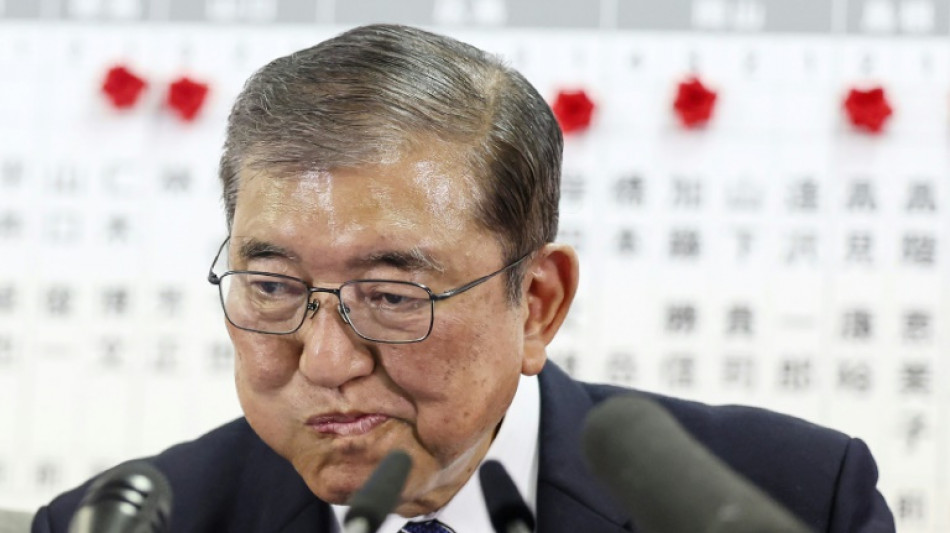
What next after Japanese election / Photo: STR - JIJI PRESS/AFP

 Sri Lanka to issue verdict in landmark Easter attack trial

 Macron says talks with Trump on Red Sea, Ukraine 'constructive'

 Green policies just good politics, says UK minister

 Bardot auction in Paris fetches nearly one million euros

 No timeline on Daniels injury return, says Commanders coach

 British Columbia sues OpenAI in US court over Canada school shooting

 French star Batum retires after 18-year NBA career

 Zidane leads first France training session

 Man shot by ICE agent in Texas detained with bullet inside him: lawyer

 California declares state of emergency ahead of El Nino

 South Africa arrests three more suspects, after nine women murdered

 Carse needs time away from England, says captain Brook

 NOWPayments Releases Cross-Chain Payout Data Revealing Key Performance Benchmarks Across TRON, BNB Chain, and Solana

 British Museum bans photos of Bayeux Tapestry as crowds linger

 COP31 host says AI climate footprint to be a summit priority

 Berlin's far-left vote winners reject anti-semitism charges

 Mancini eager for 'new adventure' on Italy return

 Mbappe says having Zidane as France coach 'like a film'

 Palmer, Rice out of England Nations League squad

 German auto workers stage mass protests in bid to save jobs

 Embattled Merz vows to keep ruling for 'democratic future' of Germany

 Merz vows to keep ruling coalition together for 'democratic future' of Germany

 Spain coach De la Fuente gets new deal after World Cup success

 Pressure grows on Germany's Merz after election defeats

 China's Zhang beats Japan rivals to Asian Games gymnastics gold

Japanese Prime Minister Shigeru Ishiba insisted Monday he would stay in office even after his ruling coalition fell short of a majority in parliamentary elections.
AFP examines the options now for the Liberal Democratic Party (LDP) after its worst result since 2009, and the prospects for its bruised leader Ishiba, who only took office on October 1.
- Why the big loss? -
Fiercely critical of former prime minister Shinzo Abe and his brand of establishment politics, Ishiba has long played on his relative popularity with voters as the LDP's "intraparty foe".
But while this won him the party leadership, in the election voters were more interested in punishing the LDP over a scandal that saw party members pocket money from fund-raisers.
The opposition jumped on the scandal, in particular the big winners of the election, the Constitutional Democratic Party (CDP) led by former prime minister Yoshihiko Noda.
While the LDP's seats as projected by public broadcaster NHK tumbled to 191, from 259 at the last election, the CDP's tally soared to 148 from 96.
Komeito, the LDP's coalition partner, slipped to 24 from 32, with new party chief Keiichi Ishii even losing his seat.
- Could the opposition form a government? -
This is tricky given that the opposition comprises eight different parties, while memories of the last tumultuous period of opposition rule between 2009 and 2012 still linger, analysts say.
They range from the liberal CDP to the centrist Democratic Party For the People (DPP) to the "reformist conservative" Japan Innovation Party (Ishin), while others are more fringe.
These include the Communist Party, the anti-immigration and traditionalist Conservative Party of Japan and Reiwa Shinsengumi, founded by a former television actor, which wants to abolish sales tax.
"The possibility of a handover of power to the opposition isn't zero, but there are far too many opposition parties for any of them to reach a majority," said Yu Uchiyama, a political science professor at the University of Tokyo.
- What about a minority government ? -
With the clock ticking on a 30-day deadline to form a government, Ishiba conceded on Monday that a minority administration was the most likely "at this point".
This is just as well considering potential partners appear thin on the ground.
On the campaign trail, CDP leader Noda said it would be "impossible" to join forces with the LDP, having been part of previous no-confidence votes.
The Japan Innovation Party also remains unconvinced, with its head Nobuyuki Baba dismissing a tie-up with the LDP in its current scandal-tainted state as "impossible".
The DPP, too, denied it would sign up for the coalition.
But its leader, Yuichiro Tamaki, left open the possibility of a "partial coalition" where it can offer some flexibility on individual policies.
- Are Ishiba's days numbered? -
There was speculation in some quarters that Ishiba might even resign after the election results and become the shortest-serving prime minister in Japan's post-war history.
But on Monday he said he would stay in office in order to avoid a "political vacuum".
But the constant need to secure support from other parties promises to slow down the parliamentary process, and force Ishiba into making compromises and offering sweeteners.
It could also leave Ishiba vulnerable to challenges from within the LDP, which has governed almost non-stop since 1955 but with frequent changes of leader, analysts said.
"Lawmakers aligned with (former prime minister Shinzo) Abe were cold-shouldered under Ishiba, so they could potentially pounce on the opportunity to take their revenge," Uchiyama told AFP.
"But at the same time, with the number of LDP seats reduced so much, they might take the high road and support Ishiba for now, thinking it's not the time for infighting," he said.
N.Shalabi--SF-PST