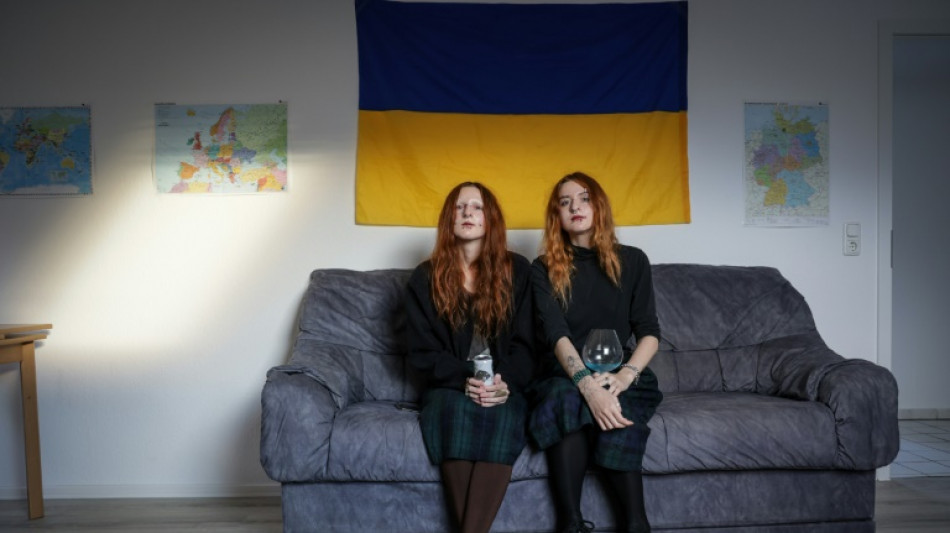
'Freedom': Russian anti-war sisters find new home in exile / Photo: FOCKE STRANGMANN - AFP

 In Bangladesh, Pakistan's Jinnah photo stirs anger

 Two New Zealand naval ships transit Taiwan Strait

 Zidane gets down to work as France start new era
 Inside the Venezuelan prison meant to 'drive you insane'

 UK king braces as memoir by Diana's brother goes on sale
 No green light to lift EU sanctions on Russian oligarchs, talks to resume

 UK agrees support for Saudi in struggle with Houthis: reports

 EU foreign policy chief calls for continued sanctions on Russia
 Flights scrapped, evacuations urged as Typhoon Dujuan wallops Japan

 Fonseca to take break from tennis
 A Cuban zoo, and its animals, in epic battle for survival

 Infantino proposes consulting federations to reform FIFA

 El Nino weather pattern enters record territory: scientist
 OpenAI calls for US to lead global effort on AI standards

 South African ostriches plucked alive for luxury fashion: report
 US networks halt Trump coverage in revolt over White House ban

 Paramount settles with US states to clear Warner Bros. mega-merger

 Climate crisis a job for world leaders, not just activists: UK FM

 US networks halt Trump coverage over White House ban
 French singer accuses Miley Cyrus of plagiarism

 EU fines Google 403 mn euros for location data breach

 'Best is yet to come,' says De la Fuente after Spain extension

 Why diesel prices are rising more than crude oil

 COP31 host says AI's climate footprint to be a summit priority

 Renewables hit record in 2025, but world must move faster: report
In a Russian forest, the Grigoryeva sisters had found a comforting refuge in their old wooden house, their "izba".
It was an isolated spot where the twins felt safe despite the war in Ukraine and Kremlin repression.
It was there that their father, a Russian paratrooper, spoke to them of his disgust at the actions of the Russian army during the battle for Kyiv in which he took part in 2022.
Months into Russia's invasion, he was already deeply psychologically scarred, haunted by his demons.
In August 2022, AFP spoke to Anastasia and Yelizaveta Grigoryeva in Pskov in western Russia, a garrison city for the 76th Guards Air Assault Division where their father served.
The 18-year-olds asked him then if he had committed war crimes. He assured them he had never killed anyone.
According to various media, the 76th division was involved in the massacre of hundreds of civilians in Bucha, a suburb of Kyiv, that has become a symbol of alleged Russian atrocities.
While their father was away fighting, the girls protested against the invasion in Pskov on March 6, 2022.
They were arrested and fined.
The sisters' story gave an insight into the human and moral cost of the war for Russians, even as President Vladimir Putin's regime imprisoned or exiled critics of the invasion.
The Grigoryevas swore they would continue their anti-war activism.
They said their father planned to quit the army on medical grounds.
After telling AFP in 2022 that she felt a "huge feeling of guilt" for the suffering of Ukrainians and denouncing Russian "war crimes", Anastasia was called in for questioning by the authorities.
She did not go. Then a court ordered her to pay a fine for "discrediting the army", under a law used by Moscow to silence dissent. She did not pay it.
Yelizaveta moved to St Petersburg, where she was arrested at a protest against mobilisation in September 2022. She spent three days in jail.
- 'A feeling of freedom' -
From time to time, Yelizaveta would send news about her and Anastasia to the AFP journalists who had interviewed her. Two years went by.
On October 2, AFP caught up with them in Nienburg/Weser, a town in the German state of Lower Saxony.
Yelizaveta said the town is known for "its museum and asparagus festival".
The twins talked about their new lives as they walked through Nienburg's historic centre and showed their apartment, which had little furniture and smelled of washing.
They planned to go to the Munich beer festival later with some new Russian friends -- young exiles like them.
Now aged 20, the sisters have grown up.
Their once hesitant voices are clearer now. They resemble each other more and more with their black clothes, long copper-red hair and piercings.
But they are still different.
Yelizaveta is more impulsive and extrovert. Anastasia, who now likes to be known as "Stas", measures her words and often speaks with irony.
Back to September 2022. The sisters felt in danger and feared being charged for crimes punishable by prison time for their activism.
An association put them in touch with a man who could take them to Estonia, across the border from the Pskov region, by crossing over illegally.
Fearing a trap by the FSB security service, they turned down the offer.
They thought of hiding away in their izba where there was no mobile network and where, Yelizaveta said, "sometimes the wolves and bears roam".
"There's no real road to get there, so the police would not have been able to reach it," Stas said.
They finally left Russia in November 2022 for Georgia, which they could enter without a visa.
Tens of thousands of Russians also fled there to escape mobilisation and growing repression.
The sisters lived there for a year.
Helped by a non-governmental organisation, Stas applied for a humanitarian visa to Germany.
Six months later, she received a positive reply. In December 2023, they arrived in Lower Saxony, spent a month in a refugee centre, then got their lodging in Nienburg, paid for by the region, and a living allowance.
"We finally have some stability" and "a feeling of freedom", said Stas, who is now learning German in school.
- 'Destroy myself' -
Yelizaveta's face tenses up.
She is not doing as well as her sister. While living in St Petersburg in the autumn of 2022 she suffered "serious physical and psychological trauma".
While Russia was mobilising hundreds of thousands of men and hundreds of thousands more were fleeing, she found herself in a spiral of sex and drugs.
"It was an unstable time, the world was collapsing around me and it was like I wanted to destroy myself," she said.
One night, facing money problems, she was taken in by a man who "posed as a kind person" who, she said, drugged and raped her.
She kept the emotions pent up inside. It then all came out during a meeting in German in June 2024 with a councillor.
She spent two and a half months in a psychiatric hospital. She was diagnosed with depression, post-traumatic stress and eating disorders.
Yelizaveta still goes to a hospital in the nearby city of Hanover several times a week. She goes to therapy.
The sisters talk about their father. He never left the army but "he is no longer fighting", said Yelizaveta, adding that he is still "very sick".
He calls them in his dark hours and tells them "details full of blood".
They also keep in touch with their mother, their grandmothers and their aunt.
Stas said she feels the family understands "the ongoing horror" in Russia but tries to live "in a bubble" by saying nothing in public for fear of government repression.
In Germany, the sisters said they do not feel any "Russophobia" -- an accusation frequently used by the Kremlin against the Western world.
"The main russophobe is the Russian government which detests its own people," Yelizaveta said.
They are also critical of the infighting within Russia's exiled opposition and said they plan to meet with and help Ukrainians.
"Slava Ukraini -- and that's it," said Yelizaveta, using a slogan of support for Kyiv.
In their sitting room hangs a large yellow and blue Ukrainian flag.
Yelizaveta said her dream was to heal and find "a reliable partner".
Stas said she just wanted to live in "a hut in a pine forest".
"Really?" Yelizaveta said. "Then me too."
A.Suleiman--SF-PST