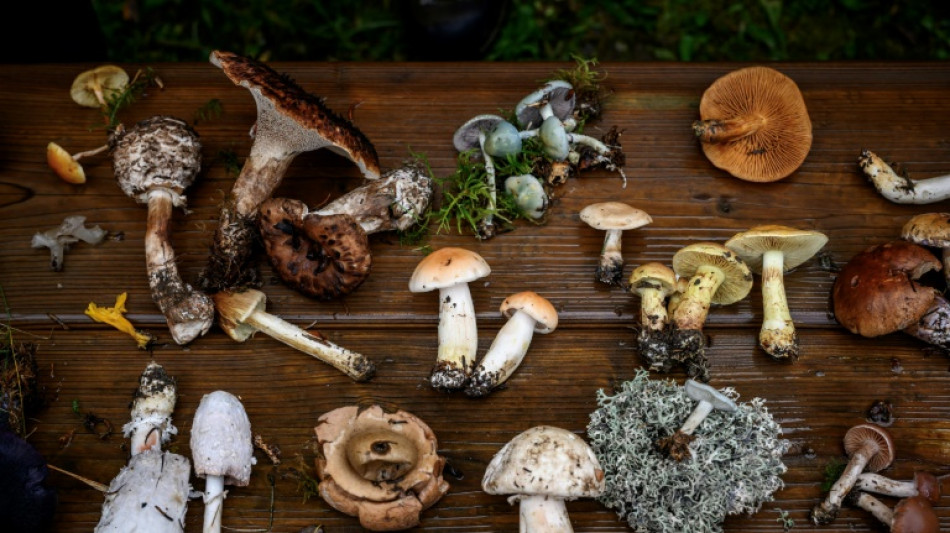
Picky protection rules hamper Swiss mushrooming craze / Photo: Fabrice COFFRINI - AFP

 Swimming prodigy Yu, 13, says 'interviews way harder than racing'

 Star coaches make their bows as Nations League returns
 Rams bounce back as Giants reel from Dart injury

 In Bangladesh, Pakistan's Jinnah photo stirs anger

 Two New Zealand naval ships transit Taiwan Strait

 Zidane gets down to work as France start new era

 Inside the Venezuelan prison meant to 'drive you insane'

 UK king braces as memoir by Diana's brother goes on sale

 No green light to lift EU sanctions on Russian oligarchs, talks to resume

 UK agrees support for Saudi in struggle with Houthis: reports
 EU foreign policy chief calls for continued sanctions on Russia

 Flights scrapped, evacuations urged as Typhoon Dujuan wallops Japan

 Fonseca to take break from tennis
 A Cuban zoo, and its animals, in epic battle for survival

 Infantino proposes consulting federations to reform FIFA

 El Nino weather pattern enters record territory: scientist

 OpenAI calls for US to lead global effort on AI standards
 South African ostriches plucked alive for luxury fashion: report

 US networks halt Trump coverage in revolt over White House ban

 Paramount settles with US states to clear Warner Bros. mega-merger
 Climate crisis a job for world leaders, not just activists: UK FM

 US networks halt Trump coverage over White House ban

 French singer accuses Miley Cyrus of plagiarism

 EU fines Google 403 mn euros for location data breach

 'Best is yet to come,' says De la Fuente after Spain extension

After suffocating Covid-19 restrictions, many embraced the call of the wild and the joys of foraging, but tightening Swiss biodiversity protection measures are infuriating growing hordes of mushroom-picking enthusiasts.
The pandemic times "made people return to the forest", said Jean-Michel Froidevaux, chairman of the Swiss Association of Official Mushroom Control Bodies, which regularly organises training sessions for mushroom hunters and checks whether their foraged mushrooms are safe to eat.
"When you walk in the forest, there's not much to do apart from look around -- and then when you look down, you spot mushrooms."
During training courses and picked mushroom checking sessions, "we saw loads of people who knew nothing about them", he told AFP, during a five-day workshop in Leysin, high up in the Alps.
Faced with surging interest, the association has opened additional courses.
"Since 2020, it has exploded. We hardly have enough trainers," said mushroom inspector Frederique Clerc, as she accompanied a dozen rain-soaked mushroom-lovers, or mycophiles, near Les Mosses, a village high in the mountain pastures near Montreux.
Jean-Paul Landraud, a retired pharmacist attending training courses with his wife, said interest in mushroom foraging was booming.
"I came before Covid and there were a few dozen of us. Now there are 120," he said.
"It has become popular: everyone goes mushroom picking."
- Trampling on the soil -
That enthusiasm has sparked fears though that all the foraging could have adverse impacts on biodiversity.
There is a burgeoning awareness of the importance of fungi, which, with their ability to decompose dead organic matter and to supply water and nutrients to trees, are considered guarantors of the forest ecosystem.
The vital role of fungis is due to be discussed during the United Nations Biodiversity Conference taking place in Colombia until November 1.
In Switzerland, several cantons had some restrictions pre-dating Covid on the number of days a year people could go picking and how much they could forage -- and now the rules are getting tighter.
The western Vaud canton, encompassing Les Mosses and nearby Leysin, introduced new measures in July aimed at giving nature a break.
People can now forage no more than two kilogrammes of mushrooms per day, with picking prohibited in the first seven days of each month, and otherwise only allowed between 7:00 am and 8:00 pm.
Vaud's measures have triggered indignation on social networks, and some politicians have demanded they be withdrawn.
"Everyone finds it ridiculous... we are very frustrated," said Florence Wyss, a retiree who started taking mushroom-picking courses after undercooked foraged mushrooms landed her in hospital.
The Vaud biodiversity authorities insist that the measures are not about "stigmatising" mycophiles.
For mushroom expert Clerc, the restrictions are a step in the right direction to promote respect for nature.
But Froidevaux said the seven-day ban was "difficult to understand".
He noted that a 30-year study by the Swiss Federal Institute for Forest, Snow and Landscape Research showed that picking did not affect the amount or diversity of fungi.
The 2006 study did however show that trampling the ground had negative short-term effects, and suggested limiting the picking period.
Pro Natura, Switzerland's oldest nature preservation organisation, also warned the influx of people into the countryside "can have consequences for ecosystems", such as trampled vegetation, disturbed wildlife or overexploited resources like mushrooms.
But "we are more concerned about sports activities, when they require the creation of new infrastructure, such as specific tracks for mountain biking", the group's spokesman Nicolas Wuthrich told AFP.
- Forest ecosystem -
Mushrooms are not the only wild plants whetting appetites.
There are a growing number of courses on foraging wild edible plants -- a trend inspired by a number of top international chefs, including Denmark's Rene Redzepi and France's Marc Veyrat.
The Swiss branch of the Euro-Toques association, which represents European chefs and producers committed to quality local produce, organises plant seminars for its members.
Its president Thierry Brehonnet, head chef at restaurant Le 1209 in the small ski resort of Blonay, has even made wild herbs his speciality, going out to collect them in the gap between lunch and dinner sittings.
"It's a philosophy," he told AFP, holding a sprig of sweet woodruff in his hand.
"After Covid, we realised that we had to use products growing close to home. We're returning to this side of nature, which we have to relearn how to master."
Brehonnet dismissed concerns that this trend would harm biodiversity, insisting there is far less public interest in foraging wild plants than mushrooms.
"We are not going to pick excessively," he said. "These plants will be preserved for a few more years."
F.AbuZaid--SF-PST