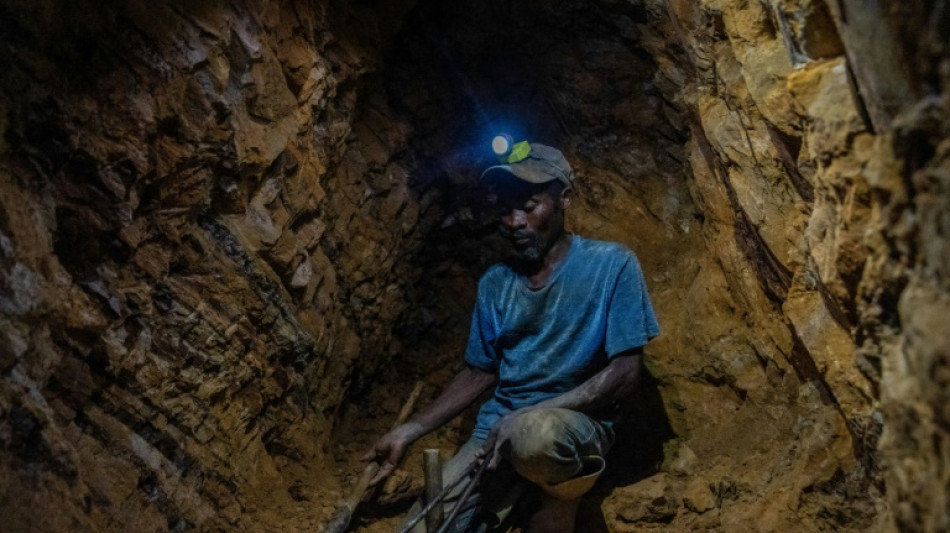
East DR Congo grapples with Chinese gold mining firms / Photo: Glody MURHABAZI - AFP

 Swimming prodigy Yu, 13, says 'interviews way harder than racing'
 Star coaches make their bows as Nations League returns
 Rams bounce back as Giants reel from Dart injury

 In Bangladesh, Pakistan's Jinnah photo stirs anger

 Two New Zealand naval ships transit Taiwan Strait

 Zidane gets down to work as France start new era

 Inside the Venezuelan prison meant to 'drive you insane'
 UK king braces as memoir by Diana's brother goes on sale
 No green light to lift EU sanctions on Russian oligarchs, talks to resume

 UK agrees support for Saudi in struggle with Houthis: reports

 EU foreign policy chief calls for continued sanctions on Russia

 Flights scrapped, evacuations urged as Typhoon Dujuan wallops Japan

 Fonseca to take break from tennis

 A Cuban zoo, and its animals, in epic battle for survival

 Infantino proposes consulting federations to reform FIFA

 El Nino weather pattern enters record territory: scientist
 OpenAI calls for US to lead global effort on AI standards
 South African ostriches plucked alive for luxury fashion: report
 US networks halt Trump coverage in revolt over White House ban

 Paramount settles with US states to clear Warner Bros. mega-merger
 Climate crisis a job for world leaders, not just activists: UK FM
 US networks halt Trump coverage over White House ban
 French singer accuses Miley Cyrus of plagiarism

 EU fines Google 403 mn euros for location data breach

 'Best is yet to come,' says De la Fuente after Spain extension

Italian priest Davide Marcheselli has been fighting for years against Chinese companies illegally mining gold in the town of Kitutu in eastern Democratic Republic of Congo.
He says mining has spoilt the town which lies in South Kivu province, polluting rivers and destroying fields.
Hundreds of foreign companies, most of them Chinese-owned, mine gold in the mineral-rich province often without permits and without declaring profits, according to local authorities.
For a long time, civil society groups and members of the church in Kitutu, have been the only people taking a stand against the powerful mining businesses, who often have friends in high places.
"From the deputies, to the village chief, everyone receives something (from the companies), money or shares (in businesses)," Marcheselli told AFP.
In July, South Kivu governor Jean-Jacques Purusi suspended "illegal" mining activity in the province until companies could comply with Congolese mining laws.
Under the legislation, companies would have to renew their mining permits, some of which have been expired for decades.
Since the ban, firms, which normally operate in the shadows, have come in hordes to the governor's office in an attempt to get authorisation to resume business.
"In place of the 117 illegal companies we invited, 540 showed up here overnight", Purusi said.
- Access denied –
In the town of Kamituga, some 40 kilometres (25 miles) from Kitutu, gold mining is in full throttle.
In one site mined by Congolese cooperative Mwenga Force, around 400 people delve into vast open pits hoping to make a few dollars a day.
The president of an association for artisanal diggers, Felicien Mikalano, says local operators "don't have the same means" as Chinese firms, such as machinery and cash.
Artisanal mining refers to small-scale mining, carried out by individuals without big machinery and not employed by big businesses.
The practice is forbidden to foreigners by the country's mining code, but Chinese companies use local cooperatives as "partners" to circumvent the ban.
Around half of the Congolese cooperatives in the province are partnered with Chinese companies, according to the bureau of scientific and technical study (BEST), a Congolese NGO specialising in mining governance.
A few kilometres from Kamituga, at the end of a dirt track, access to a mine operated by one of these cooperatives is controlled at three checkpoints.
AFP was not allowed to pass them.
Officials employed to control and inspect mining sites are also refused entry.
"It is difficult to monitor these companies," said inspector Ghislain Chivundu Mutalemba.
"These Chinese partners mine (and) the cooperatives sell the product over the counter. We don't know what percentage the Chinese take, or how much they produce", he said.
"All that I know is that the bosses take the gold and bring it to Bukavu, I don't dare ask questions," says gold buyer Siri Munga Walubinja.
"But I have never seen a Chinese person, it is uniquely the Congolese buying," he adds.
Gold bought in Kamituga is transported to South Kivu provincial capital Bukavu by "big traders", most of them Congolese.
Once they arrive in the provincial capital, some declare only a fraction of their merchandise and sell the rest illegally in DRC, which is then transported by smugglers to Rwanda, according to BEST.
In December 2022, the government granted a monopoly on gold exports from South Kivu to Congolese state-owned business Primera Gold.
The move aimed to "break the ore export routes to Rwanda", and "to target political opposition business", according to a note from the French Institute of International Relations published in February 2024.
Gold exports out of South Kivu have boomed from 42 kilograms (92 pounds) in 2022 to more than five tonnes (11,200 pounds) in 2023 -- about a sixth of the officially declared national production.
But Primera Gold now lacks the liquidity to buy the mineral and has failed to curb the black market, according to BEST.
The channels used by the Chinese companies, none of which responded to AFP's requests for comment, remain unknown to the authorities and NGOs.
Even Purusi is having trouble getting answers from businesses.
"Their representatives put you through to this general (telephone line) or a minister in Kinshasa on the phone, to tell you not to bother them," says the provincial governor.
R.Halabi--SF-PST