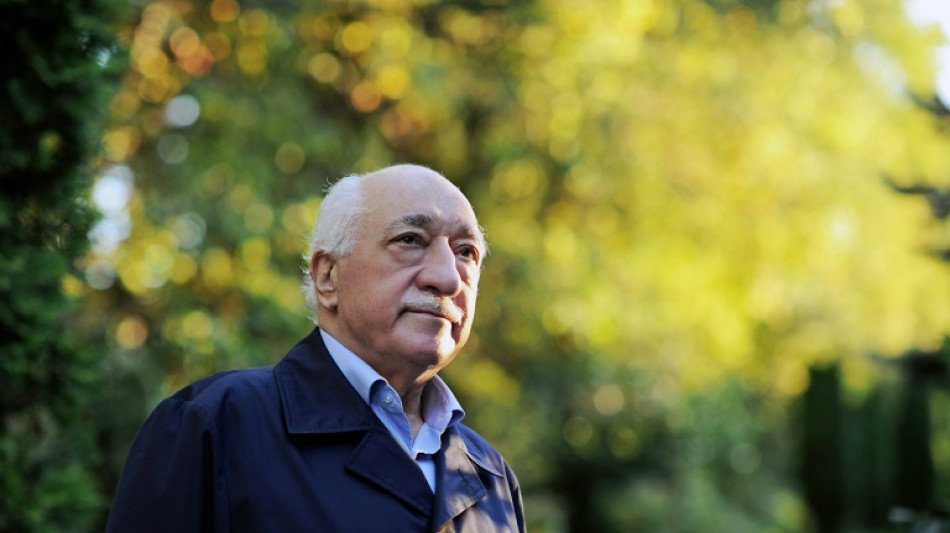
Fethullah Gulen: ex-Erdogan ally who became public enemy number one / Photo: SELAHATTIN SEVI - ZAMAN DAILY/AFP/File

 Missing F-35 fighter parts 'not sensitive', says Australia minister

 Cambodia showcases scams crackdown with global conference

 Afghan cyclist who disguised herself as man wins Asian Games silver

 Typhoon Dujuan leaves four dead in Japan, 45,000 houses without power

 G7 leaders condemn Houthi strikes on Saudi Arabia
 Google data centre sparks protests in Austria

 Shin Ohashi: Junk food-loving teen and Japan's next big swimming hope
 Stocks rise on AI buzz, drop in oil prices

 China's robot dancers limber up for America's Got Talent final

 Despite military might, Saudi struggles to crush the Houthis
 Trump to tout deals, defend Iran war in UN speech
 Sri Lanka to issue verdict in landmark Easter attack trial
 Macron says talks with Trump on Red Sea, Ukraine 'constructive'

 Green policies just good politics, says UK minister
 Bardot auction in Paris fetches nearly one million euros
 No timeline on Daniels injury return, says Commanders coach

 British Columbia sues OpenAI in US court over Canada school shooting

 French star Batum retires after 18-year NBA career
 Zidane leads first France training session
 Man shot by ICE agent in Texas detained with bullet inside him: lawyer
 California declares state of emergency ahead of El Nino
 South Africa arrests three more suspects, after nine women murdered
 Carse needs time away from England, says captain Brook

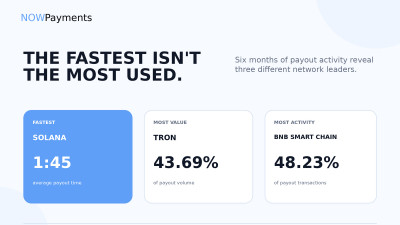 NOWPayments Releases Cross-Chain Payout Data Revealing Key Performance Benchmarks Across TRON, BNB Chain, and Solana

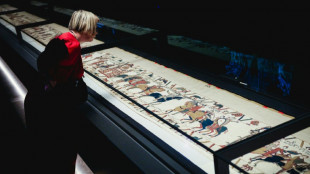 British Museum bans photos of Bayeux Tapestry as crowds linger
A former ally of Recep Tayyip Erdogan, US-based Muslim cleric Fethullah Gulen spent years eluding the clutches of Turkey's president, who accused him of masterminding a failed 2016 coup.
After nearly 25 years living away from Turkey, Gulen died in hospital overnight, Turkish public television said, citing groups close to the 83-year-old preacher.
The head of the influential Hizmet group became the sworn enemy of the president.
Erdogan's government accused him of heading a "terrorist" organisation as well as organising the 2016 bid to overthrow the president.
But Gulen insisted Hizmet -- Turkish for "service" -- was simply a network of charitable organisations and businesses.
The pair were once allies.
Erdogan profited from Gulen's network to consolidate power after becoming prime minister in 2003 in the face of an entrenched secular establishment.
- From ally to nemesis -
But tensions began emerging in 2010 only to explode into full-on enmity three years later when a corruption scandal shattered Erdogan's inner circle.
Erdogan blamed Gulen for masterminding the graft probe through his network of supporters in the judiciary and the police, turning him into "public enemy number one".
Since then, Erdogan has since accused the influential cleric -- whose movement is present on every continent with its sprawling network of public schools -- of leading a parallel state designed to overthrow him.
The president's hatred intensified following the botched coup of July 2016, which he believes was engineered by his former ally.
In the immediate aftermath, the authorities began a crackdown on the preacher's supporters, or "Gulenists".
Nearly 700,000 people were prosecuted and some 3,000 were sentenced to life jail for playing a role in the coup, authorities say.
During the unprecedented purge, more than 125,000 public sector workers were sacked or suspended, including around 24,000 military personnel and thousands of judges.
The authorities shut down private schools, media outlets and publishing houses.
Turkish intelligence services also staged multiple overseas raids in countries across central Asia, Africa and the Balkans to round up Gulen's suspected supporters.
- From anonymity to spiritual leader -
Gulen was born in the eastern Turkish province of Erzurum. Public records say it was 1941 but Gulen said he was born in 1938.
Despite being "just another imam in the 1970s" Gulen quickly became "the spiritual leader of a vast community with millions of supporters", wrote researcher Bayram Balci.
Supporters were "present in all sectors of the economy, in education, in the media, and also in the administration", Balci, a researcher at the Paris Institute of Political Studies (Sciences-Po), said in a 2021 study.
"With a taste for secrecy and influence, and even manipulation and intimidation... Gulen's movement is very similar to various Catholic movements like the Jesuits, Opus Dei and others, from which it has clearly drawn inspiration," he said.
Turkish officials refer to Gulen's movement as the "FETO terrorist organisation".
It has sometimes been described as a "sect", with members known to help each other in business and expected to contribute their time or money, whether students, housewives or wealthy businessmen.
Gulen moved to the US state of Pennsylvania in 1999, ostensibly for health reasons.
Despite multiple attempts by Turkey to extradite him, Gulen led a reclusive life in exile on the edge of the Poconos, a scenic mountainous, wooded region of Pennsylvania.
burs-hmw/tw/gil
M.AlAhmad--SF-PST