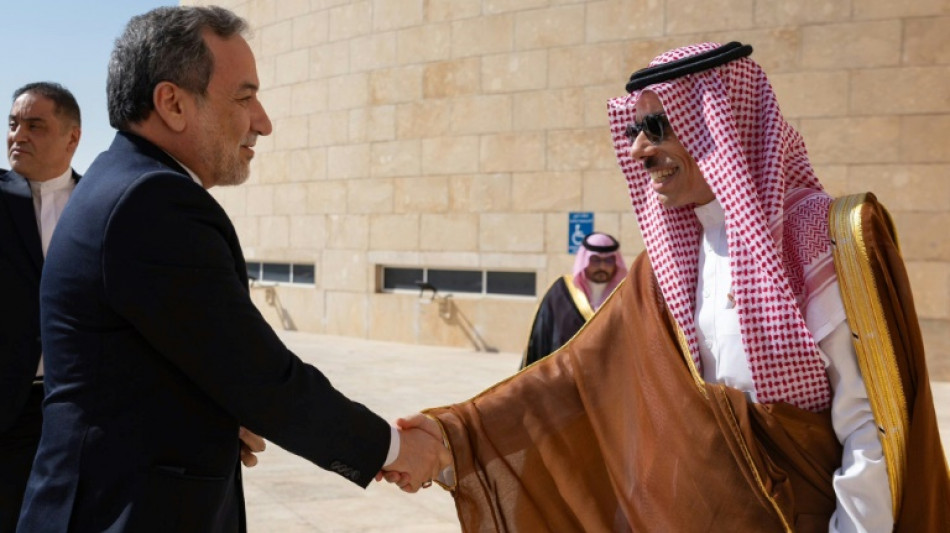
Threats and diplomacy: Iran's dual strategy on Israel / Photo: - - SAUDI FOREIGN MINISTRY/AFP

 Missing F-35 fighter parts 'not sensitive', says Australia minister

 Cambodia showcases scams crackdown with global conference

 Afghan cyclist who disguised herself as man wins Asian Games silver

 Typhoon Dujuan leaves four dead in Japan, 45,000 houses without power

 G7 leaders condemn Houthi strikes on Saudi Arabia

 Google data centre sparks protests in Austria

 Shin Ohashi: Junk food-loving teen and Japan's next big swimming hope

 Stocks rise on AI buzz, drop in oil prices
 China's robot dancers limber up for America's Got Talent final

 Despite military might, Saudi struggles to crush the Houthis

 Trump to tout deals, defend Iran war in UN speech

 Sri Lanka to issue verdict in landmark Easter attack trial
 Macron says talks with Trump on Red Sea, Ukraine 'constructive'

 Green policies just good politics, says UK minister

 Bardot auction in Paris fetches nearly one million euros

 No timeline on Daniels injury return, says Commanders coach

 British Columbia sues OpenAI in US court over Canada school shooting

 French star Batum retires after 18-year NBA career

 Zidane leads first France training session
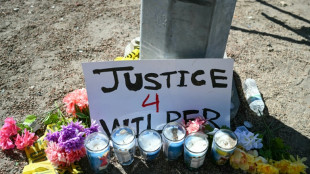 Man shot by ICE agent in Texas detained with bullet inside him: lawyer

 California declares state of emergency ahead of El Nino

 South Africa arrests three more suspects, after nine women murdered

 Carse needs time away from England, says captain Brook

 NOWPayments Releases Cross-Chain Payout Data Revealing Key Performance Benchmarks Across TRON, BNB Chain, and Solana

 British Museum bans photos of Bayeux Tapestry as crowds linger
Awaiting Israel's promised retaliation for a missile attack earlier this month, Iran has balanced threats of a fierce response to any Israeli attack with diplomatic efforts to prevent escalation into all-out regional war.
Iran launched 200 missiles at its arch-foe on October 1 in response to an Israeli strike that killed Iranian general Abbas Nilforoushan and Hezbollah chief Hassan Nasrallah in Beirut late last month.
The missile barrage was also in retaliation for Hamas chief Ismail Haniyeh, who was killed in Tehran in July in an attack widely blamed on Israel.
Israel has vowed to respond to the Iranian missile barrage with a "deadly, precise and surprising," attack, according to Israeli Defence Minister Yoav Gallant, leading Iran to warn that it would in turn hit back if struck.
"If you make a mistake and attack our targets, whether in the region or in Iran, we will strike you again painfully," Iran's Revolutionary Guards chief Hossein Salami said on Thursday.
"The Zionist enemy should know that it is approaching the end of its miserable life," the chief of staff of the Iranian armed forces, General Mohammad Bagheri, said on Friday, calling Israel a "cancerous tumour".
Since the revolution that toppled the US-backed Shah in 1979, the Islamic republic has not recognised Israel, and has made support for Palestinians a pillar of its foreign policy.
Both Hamas and Hezbollah are part of the "axis of resistance," Tehran-aligned armed groups arrayed against Israel.
- Two positions not 'contradictory' -
The warnings from Iran's military chiefs come as Iranian Foreign Minister Abbas Araghchi has embarked on a regional tour in an intense diplomatic effort to prevent the conflict from spreading across the region.
Iran's top diplomat has visited nine capitals in two weeks and talked with United Nations chief Antonio Guterres on Tuesday.
"We cannot say that these positions (of Iran) are contradictory," Tehran-based international relations expert Ahmad Zeidabadi told AFP.
Araghchi "repeats the words of the military", including that if Israel attacks, "Iran will give a painful response," Zeidabadi said.
He added that Araghchi has said Iran is "totally ready for war," while the country also intends to "reduce the escalation".
"The question is to know by what mechanism," Zeidabadi added.
Araghchi visited Lebanon's capital Beirut a week after Nasrallah's death.
The minister then went to Damascus where he met with his Syrian counterpart and President Bashar al-Assad, a close ally of Tehran.
- Pursuing 'different objectives' -
These visits allowed Tehran "to reiterate Iran's commitment to supporting its allies in the axis of resistance," Hamidreza Azizi, a Berlin-based analyst at the Middle East Council on Global Affairs, told AFP.
Araghchi also travelled to Saudi Arabia -- whose ties with Iran have warmed in the past year -- as well as Qatar, Iraq and Oman, the latter of which has long mediated indirect talks between Iran and the United States.
He then flew to Jordan, which has complicated relations with Tehran, then to Egypt, for the first trip there by an Iranian foreign minister since 2013.
On Friday, Araghchi was in Turkey, where he reiterated that Iran is "ready for any situation".
"Iran wants Arab countries to turn away from the Israeli axis", Zeidabadi said, after the United Arab Emirates, Bahrain and Morocco normalised ties with Israel under the 2020 Abraham Accords backed by the US.
Azizi said Iran is pursuing "different objectives".
In addition to reaffirming support for its allies, Araghchi has also delivered "a combination of warning and reassurance" to some Gulf countries, he said.
"Everybody is awaiting the Israeli response to the Iranian attack... and there have been talks about the potential use of the Arab states' airspace" for attacking Iran, Azizi added.
Araghchi has given a "warning to these countries not to allow their territory or their airspace to be used for attacking Iran," Azizi said.
At the same time Araghchi has been "reassuring that Iran is still committed to the improvements of relations with these countries," the expert added.
"The foreign minister seeks to urgently bring together the policies of Iran and Arab countries" and to "reduce the military adventurism of Israeli leaders," the government's official newspaper Iran Daily said on Thursday.
"His diplomatic efforts aim to create peace and put an end to Israel's crimes in the region," it added.
H.Nasr--SF-PST