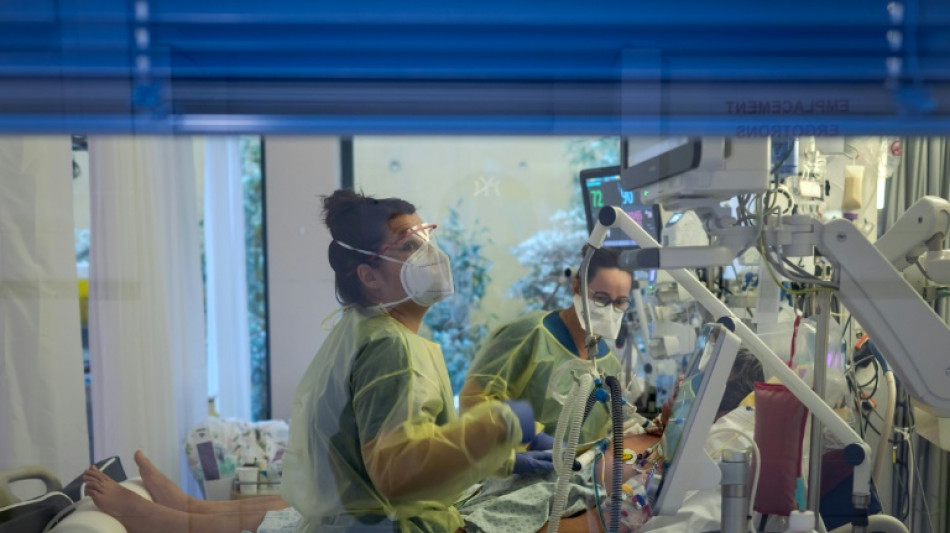
Swiss switch to 'presumed consent' on organ donations / Photo: Fabrice COFFRINI - AFP/File

 Australia's new Ghost Shark submarines grow some 'teeth'
 'I call it a bribe': Pennsylvania residents spurn $10,000 data center checks

 In a former US steel city, ordinary people struggle to get by
 'Liar,' 'clown': Lula and Bolsonaro spar in Brazil poll debate
 Record El Nino? Depends who's counting
 On the front line of ocean conservation off Portugal's Madeira

 Wembanyama targets title breakthrough as NBA season tips off

 With LeBron on board it's title or bust for Philly fans
 One year after Louvre heist, where are the missing jewels?

 Knicks face tall task in NBA championship repeat bid

 Warriors' Curry 'fine' after limping out of practice - Kerr

 Zelensky speaks to US envoys as Trump lashes out

 'Surprise package' Lazio crush Juve to keep pace with Serie A leaders Inter

 China growth expected to miss official target in third quarter
 Lazio crush Juventus to move level with Serie A leaders Inter

 Leeds draw feels like 'fresh start' for Man Utd's Carrick
 Macron denounces 'unbridled' violence as France hit by new clashes

 Hurzeler lauds 'hard worker' Gomez after Brighton goal from halfway line

 Toulouse hold off Exeter, Northampton save English Champions Cup blushes

 Arsenal snatch late win to keep pressure on Man City as Man Utd held

 Arsenal strike late to keep pressure on Man City as Man Utd held

 Four soldiers dead, dozens injured in fire at Canada military base
 Ton-up Agha helps Pakistan down Sri Lanka in tri-series opener

 Man Utd draw at Leeds keeps pressure on Carrick

 Barca defenders Garcia, Kounde injured before key games
Switzerland voted Sunday to boost the availability of transplant organs by making everyone a potential donor after death unless they have expressly objected.
The legal change, approved by 60 percent of voters in a referendum, marks a dramatic shift from the current system.
Under the existing laws, transplants are only possible if the deceased person consented while alive -- and their wishes are often unknown.
In such cases, the decision is left up to relatives -- who in most cases opt against organ donation.
This has left many of those in need of a transplant waiting in vain for an organ.
At the end of 2021, more than 1,400 patients were awaiting transplant organs in Switzerland, a country of around 8.6 million people.
Last year, 166 deceased persons donated their organs in Switzerland, and a total of 484 organs from deceased donors were transplanted.
But 72 people died in 2021 while waiting on an organ transplant waiting list, according to the organisation Swisstransplant.
"The public have shown that they are ready to give a chance to the people who are on the waiting list," said Swisstranspant director Franz Immer.
In a bid to reduce the backlog, the government and parliament wanted to change the law to a "presumed consent" model, something already adopted in a number of other European countries.
According to that system, people who do not wish to become an organ donor after death must explicitly say so.
Those who have not made their wishes clear would be assumed to be in favour. However, relatives would still be given a say. The rules would only apply to people aged 16 and over.
The medical conditions for donation remain the same: only people who die in a hospital intensive care unit can donate their organs, and two doctors must confirm the death.
- Evolution not revolution -
Under the incoming laws, relatives can refuse if they know or suspect that the person concerned would have chosen not to donate an organ.
In cases where no relatives can be contacted, no organs may be removed.
"It's not a revolution, but an evolution," Health Minister Alain Berset said following the result.
Not everyone had agreed with the government's proposals.
A group headed by a midwife and a doctor, with support from some theologians and jurists, as well as the populist and religious right, gathered enough signatures to force the issue to a referendum.
They claimed it was ethically dubious to assume that someone who has not made their wishes clear would consent to donate an organ.
They insisted on the need for patients to provide explicit, informed consent before any and all medical procedures.
They also warned that the shift would place greater strain on relatives of the deceased, who might not dare refuse, for fear that they would be viewed as selfish.
R.Halabi--SF-PST