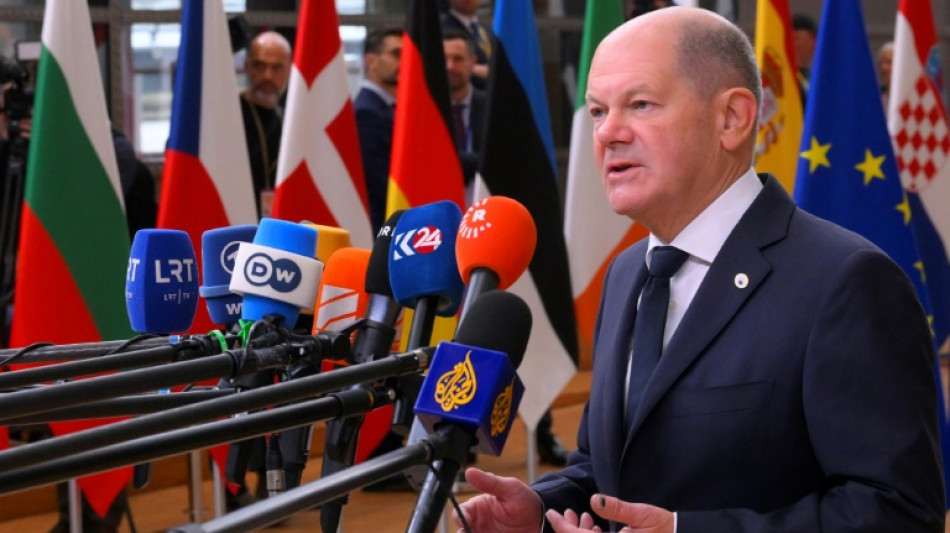
Hard talk on migration tops agenda at EU summit / Photo: JOHN THYS - AFP

 Stocks rise on AI buzz, oil prices cool

 India narrowly survive huge scare against minnows Japan

 Missing F-35 fighter parts 'not sensitive', says Australia minister
 Cambodia showcases scams crackdown with global conference

 Afghan cyclist who disguised herself as man wins Asian Games silver

 Typhoon Dujuan leaves four dead in Japan, 45,000 houses without power

 G7 leaders condemn Houthi strikes on Saudi Arabia
 Google data centre sparks protests in Austria

 Shin Ohashi: Junk food-loving teen and Japan's next big swimming hope

 Stocks rise on AI buzz, drop in oil prices

 China's robot dancers limber up for America's Got Talent final

 Despite military might, Saudi struggles to crush the Houthis
 Trump to tout deals, defend Iran war in UN speech

 Sri Lanka to issue verdict in landmark Easter attack trial
 Macron says talks with Trump on Red Sea, Ukraine 'constructive'
 Green policies just good politics, says UK minister
 Bardot auction in Paris fetches nearly one million euros

 No timeline on Daniels injury return, says Commanders coach

 British Columbia sues OpenAI in US court over Canada school shooting

 French star Batum retires after 18-year NBA career
 Zidane leads first France training session
 Man shot by ICE agent in Texas detained with bullet inside him: lawyer
 California declares state of emergency ahead of El Nino

 South Africa arrests three more suspects, after nine women murdered

 Carse needs time away from England, says captain Brook

Plans to tighten rules on migration dominated the agenda as EU leaders headed into summit talks Thursday in Brussels that were set to crystallise a rightward shift in the bloc's rhetoric.
Hard-right gains in several countries have translated into a harsher stance on migration across the bloc, with some governments pushing for reform only months after a long-negotiated deal was agreed on.
"Migration will dominate our debates, (it) has already for quite a few weeks and months," EU parliament president Roberta Metsola said ahead of the talks.
"There is a desire to work on pragmatic solutions," Italy's hard-right Prime Minister Giorgia Meloni told reporters on the eve of the gathering.
Meloni hosted a mini-summit in Brussels just ahead of the main event to discuss a common approach to migration with like-minded countries, including Denmark, the Netherlands and Hungary. EU chief Ursula von der Leyen was also present.
Italy started sending some migrants to Albania this week as part of a deal with Tirana. Other EU capitals have shown a keen interest and von der Leyen has said the bloc will draw lessons from the scheme.
Detected irregular border crossings into the European Union are down more than 40 percent this year after reaching the highest level in nearly a decade in 2023, according to EU border agency Frontex.
But migration remains "seen as a pressing and an urgent domestic issue" by many of the EU's 27 nations, said a senior EU diplomat.
- 'New wind' -
Germany -- which is part of the Schengen free movement area -- tightened border controls in September in response to several suspected Islamist attacks.
And this month Poland said it would partially suspend asylum rights, accusing Russia and Belarus of pushing migrants over the border to destabilise the country.
"There is a new wind blowing in Europe," said Dutch politician Geert Wilders, whose nationalist populist party came top in general elections in the Netherlands last year.
Wilders was in Brussels to attend another event: a meeting of the far-right Patriots for Europe group in the European Parliament.
"When Germany starts to re-establish controls at its borders, when the northern countries start to say stop, it is because they have heard what we have been saying for years," French far-right leader Marine Le Pen said, arriving at the same gathering.
Hard-right parties often riding anti-immigrant sentiment performed strongly in June European elections and have topped recent national and regional votes in Austria and Germany.
France also tilted to the right after a snap election this summer.
Whether the tough talk on migration will result in concrete reforms however remains to be seen.
- 'Vague' ideas -
Some nations want an early implementation of the landmark migration pact struck this year, which hardens border procedures and requires countries to take in asylum seekers from "frontline" states or provide money and resources.
"If we all followed the rules we have together, we would already be much further ahead," said German Chancellor Olaf Scholz.
But others feel the package, which will come into force in June 2026, falls short.
A majority of EU countries, including France and Germany, recently signed a proposal to facilitate the deportation of irregular migrants.
Von der Leyen kickstarted the process earlier this week, promising reforms to "streamline the process of returns".
In a letter to the bloc, she mentioned the controversial idea of developing deportation centres outside the EU.
But an EU diplomat cautioned the idea was "vague and preliminary" and there was no real plan at this stage for it, adding no "major decisions" were expected at the summit.
Disagreement over what remains a subject fraught with legal and ethical issues caused a similar reform effort to fail in 2018 and Spain has already made clear its opposition.
The summit is taking place in a transition phase in Brussels, where the new European Commission team should take office in early December.
Ukrainian President Volodymyr Zelensky also attended the meeting to present Kyiv's "victory plan" to defeat Russia, and the EU leaders will also discuss other topics, including democratic backsliding in Georgia and upcoming elections in Moldova.
Calls for de-escalation in Israel's conflicts in Gaza and Lebanon, which are fuelling fears of a broader regional war, are also to feature prominently.
Q.Najjar--SF-PST