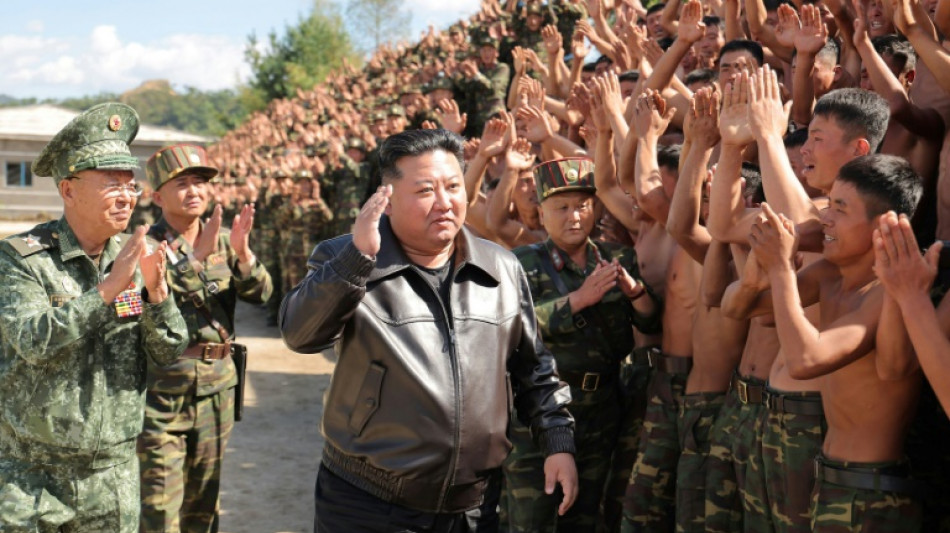
North Korea says constitution now defines South as 'hostile' state / Photo: STR - KCNA VIA KNS/AFP

 Japan's Kojima sounds Marchand warning with Asian Games gold

 England rugby star Pollock signs new Northampton deal

 STARTRADER Expands Its Chinese Equity CFD Range with CXMT and Unitree Robotics

 MEXC Expands Opportunity Compass with Stock Trading Handbook to Help Crypto Users Build Investment Knowledge

 England paceman Wood retires from international cricket

 Magnificent Mandhana's 79 helps India to Asian Games cricket gold

 Marchand 'stressed' about racing Japanese rivals at LA Olympics
 Mobile boat clinics bring healthcare to India's remote islands
 Former India paceman Zaheer Khan named Chennai coach in IPL

 Six-year-old Chinese girl sets world record with Rubik's Cube

 Swimming prodigy Yu, 13, says 'interviews way harder than racing'
 Star coaches make their bows as Nations League returns
 Rams bounce back as Giants reel from Dart injury

 In Bangladesh, Pakistan's Jinnah photo stirs anger

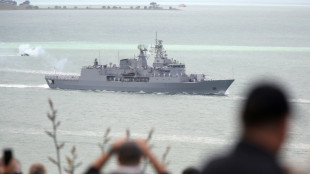 Two New Zealand naval ships transit Taiwan Strait

 Zidane gets down to work as France start new era
 Inside the Venezuelan prison meant to 'drive you insane'
 UK king braces as memoir by Diana's brother goes on sale
 No green light to lift EU sanctions on Russian oligarchs, talks to resume

 UK agrees support for Saudi in struggle with Houthis: reports

 EU foreign policy chief calls for continued sanctions on Russia

 Flights scrapped, evacuations urged as Typhoon Dujuan wallops Japan

 Fonseca to take break from tennis

 A Cuban zoo, and its animals, in epic battle for survival

 Infantino proposes consulting federations to reform FIFA

North Korea said Thursday that its constitution now defines the South as a "hostile" state, the first time Pyongyang has confirmed legal changes called for by leader Kim Jong Un earlier this year.
The country blew up roads and railways linking it to the South this week as "an inevitable and legitimate measure taken in keeping with the requirement of the DPRK Constitution which clearly defines the ROK as a hostile state," the official Korean Central News Agency said.
South Korea's military on Tuesday released video footage of North Korean soldiers dynamiting deeply symbolic roads and railways connecting the two Koreas, days after Pyongyang's military had vowed to "permanently" seal the border with the South.
Relations between the two Koreas are at one of the lowest points in years, after Kim in January defined Seoul as his country's "principal enemy" and said they were no longer interested in reunification.
KCNA said Thursday that the army had taken "a measure to physically cut off the DPRK's roads and railways which lead to the ROK (South Korea)".
The move was "part of the phased complete separation of its territory, where its sovereignty is exercised, from the ROK's territory".
North Korea said that sections of the key inter-Korean roads and railways had "been completely blocked through blasting."
"This is an inevitable and legitimate measure taken in keeping with the requirement of the DPRK Constitution which clearly defines the ROK as a hostile state," it added.
The North held a key meeting of its rubber-stamp parliament last week, and this is the first confirmation that the country's basic law was amended in line with Kim's demands.
The report did not provide further details about the constitutional changes.
Previously, under a 1991 inter-Korean accord, relations between the North and South were defined as a "special relationship" as part of a process aimed at eventual reunification, not as state-to-state relations.
Kim called for the constitutional change in a speech in January, during which he threatened war if the South were to violate "even 0.001 mm of our territorial land, air and waters."
- Drones -
Seoul has said the North Korean military had been clearing land and laying fresh mines along the border for months, as part of a drive to reinforce the border, which the South claims is largely to prevent defections by Pyongyang's own citizens.
North Korea also recently accused Seoul of using drones to drop anti-regime propaganda leaflets on the capital Pyongyang, with Kim convening a security meeting to direct a plan of "immediate military action" in response, state media reported Tuesday.
Seoul's military initially denied sending drones north but has subsequently declined to comment, even as Pyongyang has warned it would consider it "a declaration of war" if another drone was detected.
Activist groups in the South have long sent propaganda northwards, typically carried by balloons, but enthusiasts are also known to have flown small, hard-to-detect drones into the North.
Unlike conventional drones made of metal, the devices they used were constructed from expanded polypropylene, similar to Styrofoam, allowing them to go undetected by both South and North Korean authorities, according to enthusiasts who spoke to local media.
North Korea has itself sent drones southwards -- in 2022, five of Pyongyang's drones crossed the border, prompting the South Korean military to fire warning shots and deploy fighter jets.
The jets failed to shoot down any of the drones.
W.Mansour--SF-PST