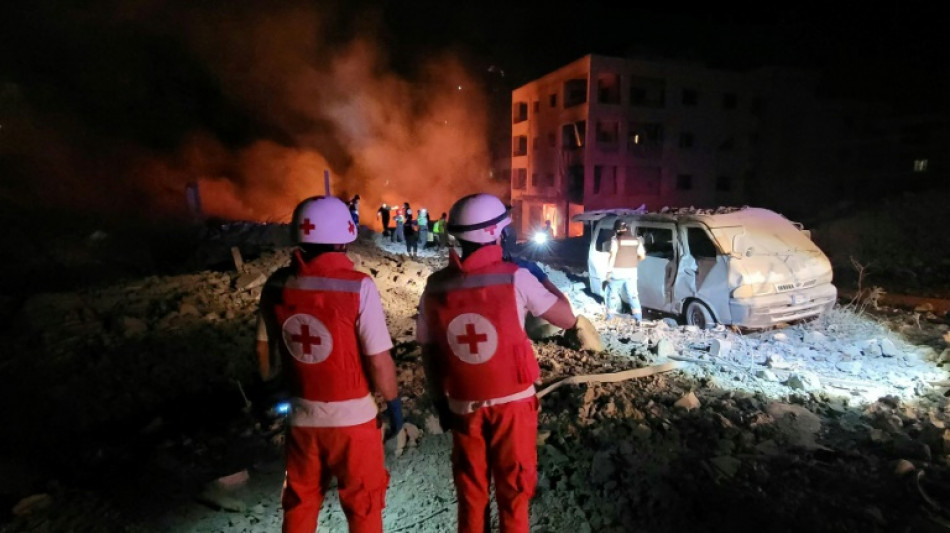
Israel strikes south Beirut after Netanyahu vows 'no ceasefire' / Photo: Abbas FAKIH - AFP

 Oil falls, stocks steady as Trump hails 'good' Iran talks
 UK sets up unit to combat disinformation from Russia, AI

 ICC convicts C.Africa rebel leader

 China's Yu, 13, wins third gold with latest Asian Games record
 UK says will revisit Chagos deal after latest Trump criticism

 In first, French presidential candidate gives birth during campaign

 Cambodia no 'safe haven' for cyberscams, PM says

 North Korea weightlifter sets three world records for Asian Games gold

 A Full Moon for Every Child: STARTRADER's STARCARES Brings Support to SOS Children's Village Ho Chi Minh City
 Meta leans into AI, smart glasses amid privacy pushback
 Battered Duerer masterpiece up for five-year revamp
 Trump met with Venezuela's interim leader at UN

 Malaysia furore after Najib wins conditional house arrest

 Italy hope for new dawn under Mancini

 Mongolian herders enlist new tech against harsher, drier climate
 Tata turmoil shines light on India succession woes
 World Cup 'not enough' as Spain begin next chapter

 Meta acts against 3.7 mn scammers' accounts with Singapore police help

 Australia PM says draft social media rules about taking back control

 Voting opens in Alaska's annual Fat Bear Week

 MLS coach axed for telling female ref 'It's a man's game'

 US refuses to give Sudan's de facto leader visa for UN
 Man City hold Bayern to start Women's Champions League, Arsenal win late
 Trump threatens Iran with 'hell' but reveals fresh talks

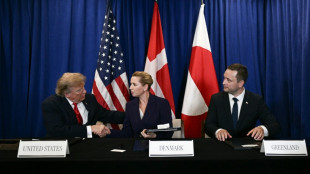 Trump signs security deal with Greenland, Denmark at UN
The Israeli military launched strikes in south Beirut on Wednesday, after Prime Minister Benjamin Netanyahu rejected the idea of a ceasefire in Lebanon that would leave Hezbollah close to his country's border.
An AFP journalist saw black smoke billowing between buildings in the capital's Haret Hreik area following two strikes, which hit shortly after an Israeli military order for residents to leave.
Netanyahu's vow to keep fighting Hezbollah came as the United States ramped up pressure over Israel's conduct of the wars in Lebanon and Gaza, criticising the recent bombing of Beirut and demanding that more aid reach the Palestinian territory.
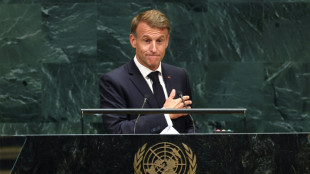
In a call with French President Emmanuel Macron, Netanyahu said he was "opposed to a unilateral ceasefire, which does not change the security situation in Lebanon, and which will only return it to the way it was", according to a statement from his office.
Netanyahu and the Israeli military have insisted there must be a buffer zone along Israel's border with Lebanon where there is no presence of Hezbollah fighters.
"Prime Minister Netanyahu clarified that Israel would not agree to any arrangement that does not provide this (a buffer zone) and which does not stop Hezbollah from rearming and regrouping," the statement said.
In a defiant televised speech, Hezbollah's deputy leader Naim Qassem said the only solution was a ceasefire while threatening to expand the scope of its missile strikes across Israel.
"Since the Israeli enemy targeted all of Lebanon, we have the right from a defensive position to target any place" in Israel, he said.
Early Wednesday Israel's military said around 50 projectiles were fired from Lebanon at the country's north, without any reports of casualties.
Iran-backed Hezbollah said it launched "a large salvo of missiles" at the town of Safed.
Israel's military bombed several areas in southern and eastern Lebanon on Tuesday, including in the Bekaa Valley where a hospital in Baalbek city was put out of service, Lebanon's official National News Agency reported.
It also said it had captured three Hezbollah fighters in south Lebanon.
Lebanon's health ministry said nine people were killed Tuesday evening in strikes on the country's south, and five others in the east, including three children.
Asked about Israeli air strikes in Lebanon in which residential buildings in central Beirut were hit on October 10, the US State Department voiced open criticism.
"We have made clear that we are opposed to the campaign the way we've seen it conducted over the past weeks" in Beirut, State Department spokesman Matthew Miller told reporters.
In a letter sent to the Israeli government on Sunday, Secretary of State Antony Blinken and Defense Secretary Lloyd Austin also warned that the United States could withhold weapons deliveries unless more humanitarian aid was delivered to Palestinians in Gaza.
The letter made "clear to the government of Israel that there are changes that they need to make again to see that the level of assistance making it into Gaza comes back up from the very, very low levels that it is at today," Miller said.
- 'Worst restrictions' -
Despite the need for food, medical supplies and shelter in hunger-ravaged Gaza, a spokesman for the UN's children's agency UNICEF said Tuesday that aid was facing the tightest restrictions since the start of Israel's offensive in October last year.
"We see now what is probably the worst restrictions we've seen on humanitarian aid, ever," spokesman James Elder said in Geneva, adding that there were "several days in the last week (where) no commercial trucks whatsoever were allowed to come in".
For more than a week, Israeli forces have engaged in a sweeping air and ground assault targeting northern Gaza and the area around Jabalia amid claims that Hamas militants were regrouping there.
"The whole area has been reduced to ashes," said Rana Abdel Majid, 38, from the Al-Faluja area of northern Gaza.
Majid said entire blocks had been levelled by "the indiscriminate, merciless bombing".
At a school-turned-shelter hit by an Israeli strike in the central Nuseirat camp, Fatima al-Azab said "there is no safety anywhere" in Gaza.
"They are all children, sleeping in the covers, all burned and cut up," she said.
Israel launched a military campaign in Gaza after an October 7, 2023 attack by Hamas that resulted in the deaths of 1,206 people, mostly civilians, according to an AFP tally of official Israeli figures, including hostages killed in captivity.
The Israeli campaign has killed 42,344 people, the majority civilians, according to figures from the health ministry in the Hamas-run territory which the UN considers reliable.
- Lebanon strikes -
Israel escalated its air campaign against Hezbollah in Lebanon from September 23 and then launched a ground offensive a week later intended to push the group back from its northern border.
Hezbollah has been firing thousands of projectiles into Israel over the last year in support of Hamas, displacing tens of thousands of Israelis.
At least 1,356 people have been killed in Lebanon since Israel escalated its bombing last month, according to an AFP tally of Lebanese health ministry figures, though the real toll is likely higher.
The war in Lebanon, which has suffered years of economic crisis, has displaced at least 690,000 people, according to figures from the International Organization for Migration.
Israel is also weighing how to respond to Iran's decision to launch around 200 missiles at the country on October 1.
Netanyahu's office said that Israel -- and not its top ally the United States -- would decide how to strike back.
"We listen to the opinions of the United States, but we will make our final decisions based on our national interest," it said Tuesday.
US President Joe Biden, whose government is Israel's top arms supplier, has warned Israel against striking Iran's nuclear or oil facilities.
According to a Washington Post report on Monday citing unnamed US officials, Netanyahu reassured the White House that Israel was contemplating targeting only military sites.
burs-adp/rsc/mtp
I.Yassin--SF-PST