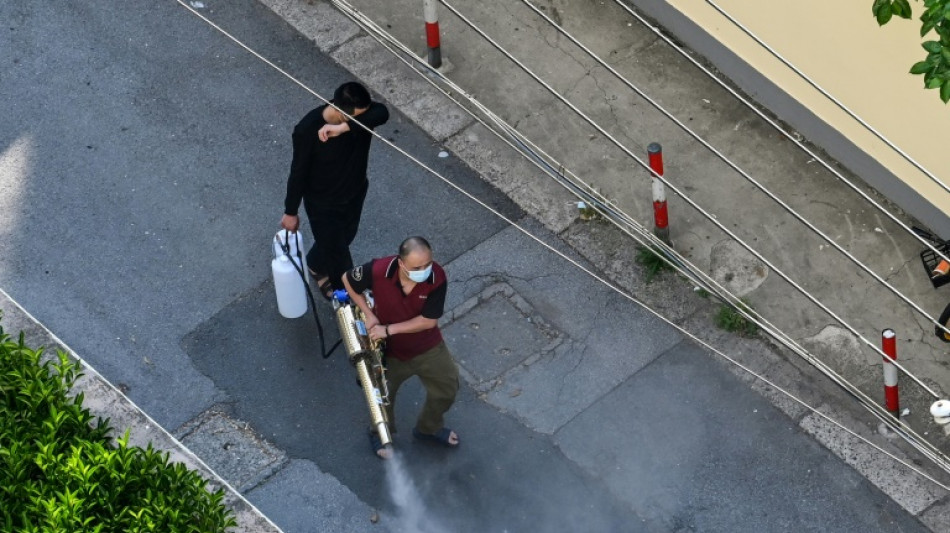
In a haze of disinfectant, China struggles with invisible enemy / Photo: HECTOR RETAMAL - AFP

 Australia's new Ghost Shark submarines grow some 'teeth'
 'I call it a bribe': Pennsylvania residents spurn $10,000 data center checks

 In a former US steel city, ordinary people struggle to get by
 'Liar,' 'clown': Lula and Bolsonaro spar in Brazil poll debate

 Record El Nino? Depends who's counting

 On the front line of ocean conservation off Portugal's Madeira

 Wembanyama targets title breakthrough as NBA season tips off
 With LeBron on board it's title or bust for Philly fans
 One year after Louvre heist, where are the missing jewels?

 Knicks face tall task in NBA championship repeat bid

 Warriors' Curry 'fine' after limping out of practice - Kerr

 Zelensky speaks to US envoys as Trump lashes out

 'Surprise package' Lazio crush Juve to keep pace with Serie A leaders Inter

 China growth expected to miss official target in third quarter

 Lazio crush Juventus to move level with Serie A leaders Inter

 Leeds draw feels like 'fresh start' for Man Utd's Carrick

 Macron denounces 'unbridled' violence as France hit by new clashes

 Hurzeler lauds 'hard worker' Gomez after Brighton goal from halfway line
 Toulouse hold off Exeter, Northampton save English Champions Cup blushes

 Arsenal snatch late win to keep pressure on Man City as Man Utd held
 Arsenal strike late to keep pressure on Man City as Man Utd held

 Four soldiers dead, dozens injured in fire at Canada military base

 Ton-up Agha helps Pakistan down Sri Lanka in tri-series opener

 Man Utd draw at Leeds keeps pressure on Carrick
 Barca defenders Garcia, Kounde injured before key games
Leaving a fine mist of disinfectant in their wake, China's hazmat-clad health workers are cleaning homes, roads, parcels and even people -- but more than two years into the pandemic, experts say it is a futile measure against Covid-19.
China is tied to a zero-Covid strategy, wielding snap lockdowns, mass testing and lengthy quarantines as part of unrelenting efforts to quash virus outbreaks no matter the cost to the economy or freedoms of its people.
Among its arsenal of virus controls is disinfectant spraying, which a top Shanghai official earlier this month lauded as a key part of a "grand assault" on the virus.
Footage shows legions of "big whites" -- as health workers in hazmat suits are referred to in China -- spraying apartments with a virus-killing haze after their inhabitants have been taken into state quarantine.
The sight has become one of the most visual expressions of China's zero-Covid policy, which has taken on a political dimension as President Xi Jinping has pegged the legitimacy of his leadership on protecting Chinese lives from Covid.
Personal possessions and home furnishings lie amid clouds of cleanser, the images show -- while in other cases the targets are city streets, walls and parks.
But such labour-intensive campaigns are relatively pointless against a virus that spreads through droplets expelled in coughs and sneezes into the air, experts told AFP.
"Since infection through touching contaminated surfaces is not an important route of transmission, extensive and aggressive use of disinfectant is not necessary," said Yanzhong Huang, senior fellow at the New York-based Council on Foreign Relations.
Transmission through contaminated surfaces and objects is possible but comparatively rare.
The odds have not deterred China's disinfectant sprayers.
Shanghai alone had sterilised 13,000 areas as of May 2 under a policy targeting infected people's homes, apartment blocks and "preventative" disinfection of entire compounds, vice-mayor Liu Duo said.
The city has seethed for weeks under a shifting mosaic of lockdowns that have seen some of its 25 million residents scuffle with police and unleash a flood of fury and frustration on social media.
- Beds, clothes, scooters -
In one social media video verified by AFP, a hazmat-suited health worker brandishing a powerful hose sprays clouds of disinfectant on a resident's bed, desk and clothes.
Other clips show workers wandering through streets and housing compounds, casually spritzing walls, scooters -- and even the ground while residents line up for tests.
One Shanghai resident told AFP his home was sterilised twice after they returned from quarantine, with his family being ordered to wait outside for an hour each time.
Experts struggled to see the necessity of the measure for maintaining public health.
While the virus can transmit through surfaces, "it cannot survive long outside the human body, so it is unnecessary to sterilise outdoor surfaces," Huang from the Council on Foreign Relations said.
"The widespread use of some chemical disinfectants, such as chlorine disinfectant, could have harmful impacts on human health (and) the environment."
Leong Hoe Nam, an infectious disease expert at Singapore's Mount Elizabeth Novena Hospital, said outdoor disinfection was "absolutely pointless."
"The Chinese phrase is 'drawing feet on a snake' -- superfluous," he told AFP.
- Politics of spraying -
China's refusal to waver on zero-Covid may be driving the zealous use of sterilisers, said Ben Cowling, a professor at the University of Hong Kong's School of Public Health.
Given the disruptive impact of sudden lockdowns, "one could see a rationale for using every possible approach to reduce transmission," he told AFP.
Those may include strategies that "might have close to zero effect but might in rare circumstances prevent one infection," he added.
Leong said the disinfection drive was mostly "a lot of visible intervention that pleases administrators" without doing much to prevent Covid spreading.
But Beijing's desire to demonstrate its commitment to a flagship policy was perhaps the more important aspect, Huang said.
The move "conjures up the image of a heroic battle against an invisible enemy," he said.
G.AbuGhazaleh--SF-PST