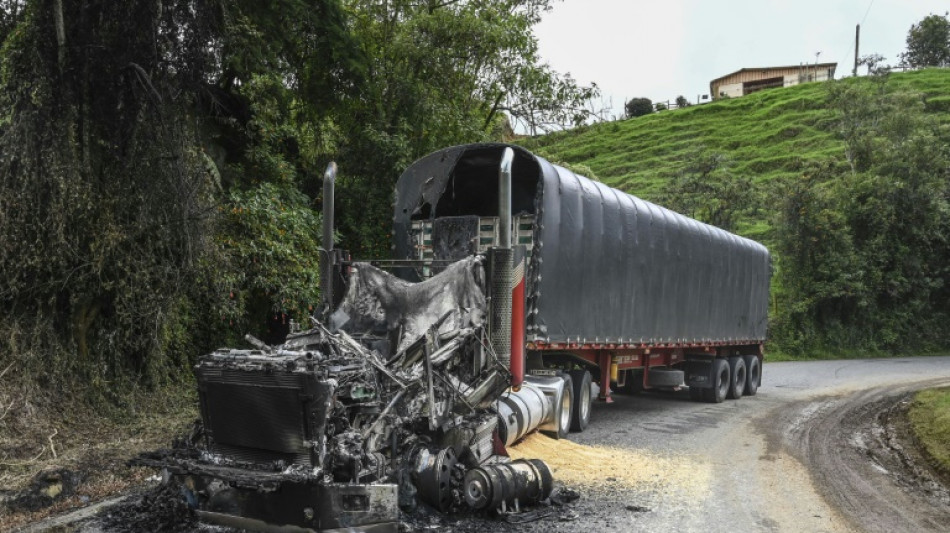
Colombia's Gulf Clan sows terror ahead of presidential vote / Photo: JOAQUIN SARMIENTO - AFP

 Australian lawmaker 'critically' hurt in attack, officials say

 Indonesia fires burned over 1.9 mn hectares through September: monitor
 Asian tech stocks mixed after Wall St losses, eyes on earnings

 China's third-quarter growth narrowly beats forecasts
 Asian stocks start week on back foot, tracking tech-led Wall St losses

 China growth narrowly beats forecasts

 Faith and fury: Texas Senate rivals offer contrasting visions
 Women await justice for police killings in Brazil
 The painstaking task of cataloguing the world's species

 Nations seek reset at UN talks as nature goals off track

 Rubio seeks to strengthen US foothold in Central Asia

 LeBron joins 76ers to chase one more NBA title at age 41

 Rays one win from World Series return after downing Guardians

 Kings' Ben Simmons tears Achilles in training
 Lula, Bolsonaro set for first debate showdown in bitter election race

 Mbappe hits two as Real Madrid rout Sevilla
 Browns edge Ravens for division lead, Texans beat Jags

 Lyon go top of Ligue 1 as Monaco fall to first defeat of the season

 Venezuela opposition alliance reaffirms Nobel laureate Machado as leader
 'Street Fighter' wins N. America box office, buzzy doc stuns in 2nd

 NFL: Paris game to go ahead despite protests in France

 Arteta hails Arsenal 'finishers' after Madueke fells Forest

 Trump backs ally Netanyahu ahead of Israel's tight election

 Madueke strikes late as below-par Arsenal sink Forest
 Second day of street clashes in Milan

With dozens of villages under siege and as many as two dozen people killed in a week, Colombia's largest drug cartel is sowing terror among civilians, flexing its muscle with days to go to presidential elections.
The Gulf Clan, which moves 30 to 60 percent -- some 700 tons -- of all the cocaine exported from Colombia, is exacting revenge for the extradition of its boss, known as "Otoniel," to the United States last week for trial.
In a show of force, it called a so-called "armed strike" that has forced shops and schools to close and brought transport to a standstill in 141 of Colombia's 1,100 municipalities, according to official data.
Dozens of roads were blockaded despite the best efforts of some 52,000 soldiers and police deployed to restore order.
The government says the clan has killed eight people, including five security forces personnel, in a week.
But according to the JEP, a special entity set up under Colombia's 2016 peace deal with the leftist rebel group FARC, the toll is even higher.
It reports 24 dead, 178 municipalities affected in 10 departments out of 36, as well as 22 attacks on uniformed personnel. Nearly 200 vehicles including trucks have been burnt.
When "Otoniel" was arrested last October, President Ivan Duque rejoiced: "It is a blow that marks the end of the Gulf Clan" -- the biggest cartel in the world's largest cocaine exporting country.
Seven months later, the group still operates with a large degree of impunity under replacement leaders "Siopas" and "Chiquito Malo."
- Situation 'very serious' -
"The State no longer knows what to do," analyst Kyle Johnson of the Conflict Response Foundation, a Colombian think-tank, told AFP.
Its actions to date, "have made little difference on the ground," he said.
According to the Foundation for Peace and Reconciliation, a monitoring group, the gang is now present in 241 municipalities -- 31 more than last year -- and has some 3,200 members, half of them armed.
For its "armed strike," the clan has targeted areas in Colombia's north that have been largely untouched by the violence that has long plagued the south in fighting over resources and territory between leftist guerrillas, drug gangs and other armed groups.
The situation in the north is now "very serious," said Johnson.
Hector Espinosa, governor of the Sucre region, hard hit by the clan's activities, said it was also waging a campaign of cyber terror -- scaring civilians with threats on WhatsApp and Facebook.
Despite the mass security deployment, people in these areas "don't want to go out because they receive messages on WhatsApp and Facebook telling them not to," said Espinosa.
In doing so, the clan portrays the state as weak and itself as being in charge.
A journalist in one of the affected regions told AFP he was forced to diffuse a clan pamphlet on the Facebook page of his outlet under threat of death.
With just days to go to the first round of presidential elections on May 29, the violence that has persisted in Colombia despite its historic 2016 peace accord, features prominently in the political campaign.
Leftist Gustavo Petro, ahead in the polls, has heavily criticized the "failure of the security option" of the outgoing government for addressing the matter.
He has, instead, mooted a "collective amnesty" for traffickers, with legal guarantees in exchange for abandoning the lucrative trade in a country battling growing poverty and unemployment.
His main rival on the right, Federico Gutierrez, is in favor of a strong-arm security response.
According to Johnson, an amnesty agreement can work only if the state manages to regain control of territories dominated by the clan.
This is something it failed to do with regions formerly under control of the disbanded FARC guerrilla group, now the scene of a territorial war.
Y.Zaher--SF-PST