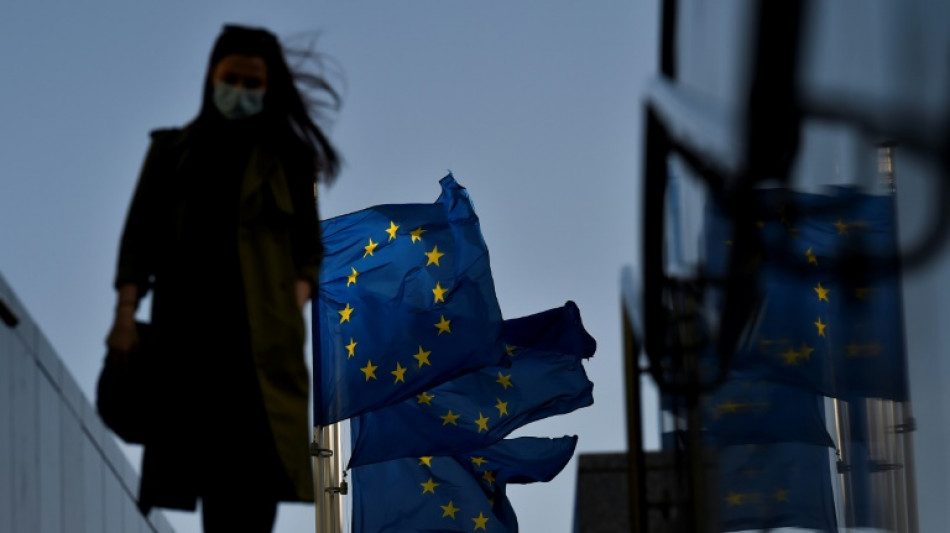
Ukraine war puts EU 'at crossroads' on anniversary / Photo: JOHN THYS - AFP

 European stocks retreat as France violence spreads
 North Korea warns 'grave situation' prevailing along border
 Raya proud of Arsenal's 'incredible' reaction after third straight win

 Indonesia fires have burned nearly two million hectares: monitor
 Australian lawmaker 'critically' hurt in attack, officials say

 Indonesia fires burned over 1.9 mn hectares through September: monitor
 Asian tech stocks mixed after Wall St losses, eyes on earnings
 China's third-quarter growth narrowly beats forecasts
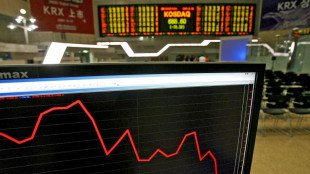 Asian stocks start week on back foot, tracking tech-led Wall St losses
 China growth narrowly beats forecasts
 Faith and fury: Texas Senate rivals offer contrasting visions

 Women await justice for police killings in Brazil

 The painstaking task of cataloguing the world's species
 Nations seek reset at UN talks as nature goals off track

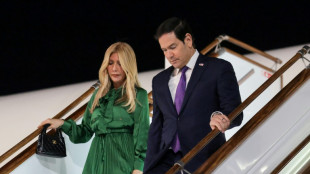 Rubio seeks to strengthen US foothold in Central Asia
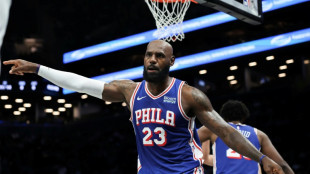 LeBron joins 76ers to chase one more NBA title at age 41

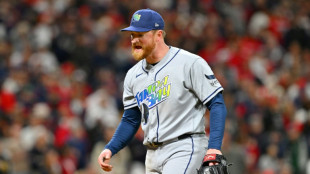 Rays one win from World Series return after downing Guardians
 Kings' Ben Simmons tears Achilles in training
 Lula, Bolsonaro set for first debate showdown in bitter election race
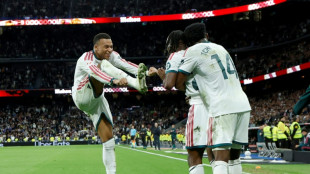 Mbappe hits two as Real Madrid rout Sevilla
 Browns edge Ravens for division lead, Texans beat Jags
 Lyon go top of Ligue 1 as Monaco fall to first defeat of the season
 Venezuela opposition alliance reaffirms Nobel laureate Machado as leader
 'Street Fighter' wins N. America box office, buzzy doc stuns in 2nd
 NFL: Paris game to go ahead despite protests in France
As the EU poises to mark its anniversary on Monday, it is morphing into a more muscular global actor, a transformation accelerated by Russia's invasion of Ukraine.
"(The) war in Ukraine is fundamentally challenging our European peace architecture," European Commission chief Ursula von der Leyen declared on Friday.
That can be seen in the EU's evolution.
What began seven decades ago as a trade bloc binding formerly warring nations together, is today a political heavyweight funnelling weapons to Kyiv and imposing unprecedented sanctions on Russia.
The EU is also challenging an assertive China, and it learned bitter lessons from Brexit and four years of Donald Trump in the United States.
But analysts say it still has a long way to go to become the strategically autonomous goliath championed by French President Emmanuel Macron, who currently holds the EU presidency.
"Fundamentally, for Europe to morph into a geopolitical actor, this requires more than some policy fix or institutional fixes," said Luuk van Middelaar, a Dutch political theorist who served in the cabinet of former European Council president Herman Van Rumpuy.
The EU indeed "crossed a Rubicon" by deciding to finance 1.5 billion euros ($1.6 billion) of arms deliveries to Ukraine, he said, a "striking" turnaround from its pacifist history.
Yet it has a poorly defined common strategy towards its near neighbours, whether they be Russia or the "grey zone of countries" aspiring to join, including Ukraine, he said.
- 'Pragmatic federalism' -
Newly re-elected Macron is expected to pursue his agenda more vigorously, backed by some other leaders this week and a bloc-wide citizens' consultation for ground-up changes to the EU's underpinning treaties.
The EU needs "pragmatic federalism" which would see member states lose their ability to veto decisions agreed by a super majority, Italian Prime Minister Mario Draghi argued to MEPs on Tuesday.
If there is any treaty revision, it should be embraced "with courage and confidence", he said.
Current EU institutions and processes were "inadequate" to address the fall-out from the Ukraine war, he added.
Fabian Zuleeg, head of the European Policy Centre, told AFP: "We are at a crossroads, that for me is unquestionable."
When Russia invaded Ukraine on February 24, "everything changed," he said.
"Many taboos have fallen and countries are doing things which they never thought they would do," said Zuleeg.
Not only was EU foreign and security policy affected, but also its agriculture, migration, industrial policies and other areas, he added.
"We can decide to use this as a moment when the European Union gets equipped with the kind of decision making processes, the kind of competences, the kind of laws it needs.
"Or we try to go down the route of individual countries doing things by themselves, which in my opinion is going to fail."
Treaty change was one option, he said. Another was for EU countries to band together and exclude dissenting member states from their decisions.
Zuleeg said certain decisions would still need to be taken together, and where that was not possible, groups could work in smaller intergovernmental formats.
- Ditching vetoes? -
The European Parliament has endorsed a rewrite of the treaties, brandishing over 300 recommended changes formulated by the Conference on the Future of Europe citizen consultation, drawn up into 49 proposals.
One idea is qualified majority voting advanced by Macron and Draghi to streamline decision-making.
Another is more powers for the European Commission over areas jealously guarded by national governments, such as defence.
EU officials said the list of proposals -- to be formally handed to Macron on Monday -- would be assessed, but it was too early to say whether any of those retained would require a treaty overhaul.
One EU diplomat said: "More than 90 percent of the proposals can be implemented below the threshold of treaty changes."
Other EU countries said to back treaty change are Spain, Belgium, the Netherlands and Luxembourg.
Analysts cautioned, though, that those against -- small EU states that would rue losing their veto -- would likely initially keep quiet.
If a majority of EU member states decided treaty change was needed, there could be a vote in the European Council that would lead to negotiations.
"We should be able to get the simple majority in council for that," another EU diplomat said.
Any resulting text would require all 27 EU countries' ratification or approval.
Attempts have been made before to reform the EU, not always successfully.
In 1992, Danish voters rejected the Maastricht Treaty, the modern EU's founding text, only to approve it a year later after their government negotiated opt-outs in sensitive policy areas.
In 2005, voters in France and the Netherlands rejected a treaty that would have brought in a formal EU constitution.
N.Shalabi--SF-PST