
US radio sets out to break Russian 'propaganda wall'

 Rees-Zammit returns to wing as Wales face Fiji
 Renovations on historic Paris Opera house extended by three years

 Thailand denies viral claim Macron knelt before king

 Spain, Portugal eye World Cup last 16

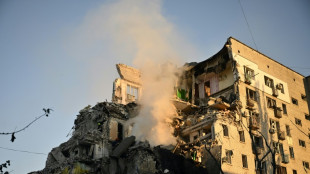
 Russian strikes kill 17 in biggest ever attack on Kyiv, mayor says

 Uruguay veteran Cavani quits Boca Juniors
 West Ham's Fernandes joins Spurs

 Bones of contention: More research needed on 'd'Artagnan corpse'
 Coffee with a view: tourists flock to Starbucks overlooking North Korea

 German coalition agrees on reform package in key breakthrough

 France recall record try scorer Penaud for All Blacks Test

 Seoul's Kospi tanks as Asia tech firms suffer another blow

 'Outstanding' Love to start at fly-half for All Blacks against France
 Campbell back from four years in Wallabies wilderness to face Ireland

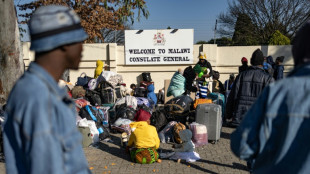 Migrants pick up pieces back home after fleeing South Africa

 Farrell names Leinster-heavy Ireland side to face Wallabies

 Fearing Russian strike, Kyiv's Holodomor museum evacuates exhibits

 Germany's energy-hungry small firms struggle with green shift

 Pochettino says Balogun foul 'never' a red card as suspension looms

 Campbell back after four years in Wallabies team to face Ireland

 Kane saves England as USA, Belgium reach last 16

 Budding chefs cook up new career at China's BBQ academy

 One stitch at a time: Artist's mission to recreate the Bayeux Tapestry

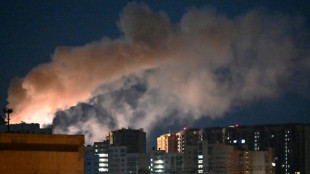 Deadly Russian barrage pounds Ukraine capital

 Belgium coach salutes Tielemans after World Cup rescue act

With Russian troops massed on Ukraine's border, US-funded Radio Free Europe/Radio Liberty is trying to break through a "wall of Russian propaganda", its director for Europe told AFP.
Based in Prague, RFE/RL was founded in 1950 as an anti-communist outlet to beam programmes into the Soviet bloc, helping topple those totalitarian regimes nearly four decades later.
These days, it still broadcasts in 27 languages -- including Russian, Belarusian and Ukrainian -- to 23 countries, many where media freedoms face severe restrictions.
It has more than 200 journalists in Ukraine and plays a major role in covering the looming conflict on the Ukrainian border, according to Kiryl Sukhotski, regional director for Europe and TV production.
"Our role is to provide objective and impartial information from both sides of the conflict to our audiences. We're a surrogate broadcaster and we don't take sides," Sukhotski said in an interview.
"We are penetrating the wall of Russian propaganda."
The West has repeatedly accused Russia of spreading disinformation to justify its cause, while Russia says the Western view of the crisis is distorted.
Most recently, the Russian foreign ministry slammed as "nonsense" and "provocative" reports from Britain about Moscow planning to install a pro-Russian leader in Kyiv.
RFE/RL, which has a target audience of 37 million people, stepped up activities in the region following Russia's annexation of Crimea in 2014 and the occupation of eastern Ukraine by pro-Moscow rebel forces.
It launched the Current Time TV channel in Russian, as well as programmes targeting audiences in the Donbass and Crimea regions.
- 'My boyfriend is there' -
The radio station's journalists -- staff and freelancers alike -- face constant threats from Russian and rebel authorities.
Some have already ended up in prison, such as Vladyslav Yesypenko, who is facing 15 years in jail on espionage charges.
Their coverage methods vary, from on-the-ground reporting to journalism based on open sources.
Last week, an RFE/RL journalist gave an account of how Russian troops are gathering on the Ukrainian border by following scores of TikTok accounts.
"Soldiers were sharing TikTok videos of how they go towards the border, and then there were hundreds of comments saying, 'Oh, my son is going there', or 'My son is on that train', or 'My boyfriend is there'," said Sukhotski.
"And we started talking to their families posting those comments and suddenly this whole picture of dozens of thousands of troops moving to Belarus, towards the Ukrainian border, we were able to do it just by looking at TikTok accounts," he added.
- 'White noise' -
Funded by the US Congress, RFE/RL is also setting out to battle what it says is Russian disinformation.
"We are creating a new unit in Kyiv that will do same-day rapid reactions to fake news, disinfo, propaganda -- just saying OK, this is true, this is not true," Sukhotski said.
"Russia very quickly understood that it is not necessary to lie to make successful propaganda. All you need is to withhold context and create white noise.
"Our task is to present the context and for our audiences to make their own decisions, and this is what the Russian authorities perceive as a threat," he added.
Recalling Moscow's attempts to jam RFE/RL broadcasts during the Cold War, Sukhotski said variety was key.
The radio is present on Facebook, Twitter, and also on Russian social media including VKontakte and Odnoklassniki.
"The whole digital landscape is changing fast and if we are not changing with it, we will be left behind," he said.
"You can block a website but it would be very difficult to block Facebook or YouTube. Russia is not yet there."
"It is the beauty of social media that can get us there despite any attempts by the authorities to block us."
S.Barghouti--SF-PST