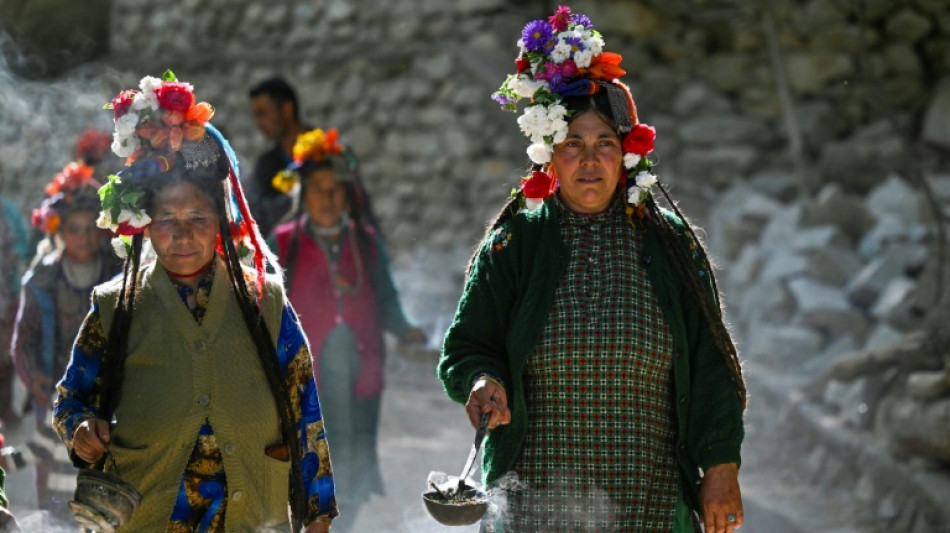
Divided land, disputed origins: India's Brokpa people / Photo: TAUSEEF MUSTAFA - AFP

 Austria 'ghetto' language classes leave children to repeat school
 S.African women runners arm themselves after string of killings
 'I felt embarrassed': Japan eSports whizz-kid, 11, wins Games gold
 Indonesia fires threatens critically-endangered orangutan: IUCN

 Bangkok declares flood disaster across city
 'World records not enough': North Korea weightlifters target Olympic gold rush

 Iran proposes Hormuz plan, Trump reportedly refuses
 El Nino rewrites the menu in the world's top restaurants
 Pope to hold giant mass on Champs-Elysees

 TikTok to pay Alabama $100 mn under pre-trial settlement

 Internationals take 7-3 Presidents Cup lead after foursomes sweep
 Brazil team returns to Colombian site of doomed jet crash

 Mbappe injured as Zidane wins on France debut, Italy lose on Mancini return

 Senegal draw in Vieira debut, Nigeria survive scare as Cape Verde crash
 U2 performs surprise 50th anniversary gigs in Dublin

 Pope calls worshippers 'saints of France' after AI warning

 US court sides with Pentagon in Anthropic AI ban
 Wall Street stocks rise, greeting optimism over possible US-Iran deal
 NFL players chief raises concerns over pitch for Maracana game

 Daytime Russian attacks kill seven in Kyiv
 Spotting AI writing: how reliable are the detectors?
 French youth await pope after AI 'paradise of machines' warning
 Man City found guilty of Premier League charges, set to appeal: reports
 Embolo follows Xhaka out of Swiss squad over fake Covid documents
 Trump, Xi inspect founding documents of US democracy to close summit

High in the icy Indian Himalayas, a long-isolated people recall origin myths of millennia-old migrations from afar -- an identity in disputed lands twisted today by politics.
The Brokpa people of Ladakh have no written language, practise a culture of polygamy, and have their own calendar.
The most cherished ballad of the Brokpa, some 6,000 of whom live in a rugged mountain valley of the Indus river, is the "song of history".
A new verse is added every 12 years, a cycle which counts as just one "year" in their calendar.
Tsering Gangphel, 85, said it details Brokpa legends that they came from ancient Rome.
Other Brokpa people recount myths of ancestral links to Alexander the Great's army, who invaded in the fourth century BC.
Scientists are sceptical, with one study of Brokpa DNA suggesting their roots lay in southern India.
But Gangphel -- who said he can sing a thousand songs in the Brokpa language detailing their culture -- is adamant about his people's past.
"We still celebrate our arrival here by dancing and singing in each village, once every three years," Gangphel told AFP, at his home overlooking the roaring river.
"We are Aryans," he added.
The deeply contested term refers to opaque pre-history -- which critics say is today more about gritty realpolitik than foundation fables.
- 'Validate their hold' -
In South Asia's ancient Sanskrit language, "aryan" means "noble" or "distinguished", not a separate ethnicity.
It was once a loose term suggesting that people from Europe to Asia had linked ancestors in Central Asia, reflected in common linguistic roots.
That is a far cry from the genocidal Nazi fantasies of a blond-haired and blue-eyed master race.
Some right-wing Hindus use the term to claim "Aryan" ancestors originated in India, linking it to a Hindu and national identity.
For the Brokpa, the term "Aryan" has been used as a tool to promote both tourism and India's geopolitical ambitions.
Ladakh, part of Kashmir, is divided between India and Pakistan by a highly militarised frontier.
Each country claims the region as their own.
In 1999, Brokpa yak herder Tashi Namgyal sighted "Pakistani intruders" in Indian-controlled territory and told Indian troops.
That triggered a 10-week conflict between the nuclear-armed rivals which cost 1,000 lives on both sides.
"I saved the nation's honour," 60-year-old Namgyal told AFP, proudly showing army letters praising his service.
After the fighting stopped, Indian authorities pushed tourism in Brokpa areas calling their lands the "Aryan Valley".
The tourism ministry promotes them as the "Last Aryan Villages of India".
Mona Bhan, a Brokpa expert at Syracuse University in New York, says the community uses "Aryan" to highlight its socio-cultural practices and history.
But Indian Hindu nationalists have used the term to "validate their hold on India's disputed territory", according to the anthropologist.
- 'It's a sin' -
The Brokpa calendar means a child's first birthday is marked when they turn 12.
Using that calculation, a laughing and grey-haired Gangphel remarked that he is "just seven years old".
Gangphel, a father of six who has two wives, said marrying outsiders was frowned upon.
"Being Brokpa means being unique in language, dress and dance," said 14-year-old schoolgirl Etzes Dolma.
But an influx of tourists and government development policies are bringing increasing modernity.
Earth and wood homes are being replaced with concrete and glass construction.
The Brokpa worship their traditional gods, but those now are often amalgamated into other beliefs.
Most Brokpas in India are Buddhists, while in Pakistan many have become Muslim.
Sangay Phunchok, 43, a lama, or Buddhist spiritual leader, said he shifted faith after hearing that "our ways will not grant us heaven".
A monastery is being built in the village, but the Brokpa also honour their ancestral gods at a shrine of piled ibex horns.
"We still pray to our own gods," Gangphel said. "But goat sacrifice has stopped, because our lama said it's a sin."
Q.Jaber--SF-PST