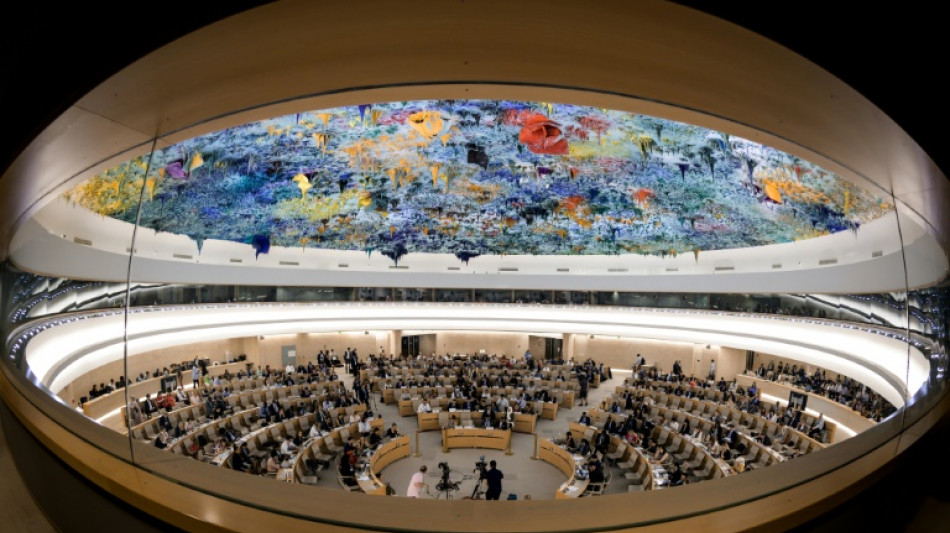
Women, gender rights resist pushback at UN, for now / Photo: FABRICE COFFRINI - AFP/File

 Ahead of Paris mass, pope urges life together in 'dignity and peace'

 Austria 'ghetto' language classes leave children to repeat school

 S.African women runners arm themselves after string of killings
 'I felt embarrassed': Japan eSports whizz-kid, 11, wins Games gold
 Indonesia fires threatens critically-endangered orangutan: IUCN

 Bangkok declares flood disaster across city
 'World records not enough': North Korea weightlifters target Olympic gold rush

 Iran proposes Hormuz plan, Trump reportedly refuses

 El Nino rewrites the menu in the world's top restaurants
 Pope to hold giant mass on Champs-Elysees

 TikTok to pay Alabama $100 mn under pre-trial settlement

 Internationals take 7-3 Presidents Cup lead after foursomes sweep

 Brazil team returns to Colombian site of doomed jet crash

 Mbappe injured as Zidane wins on France debut, Italy lose on Mancini return

 Senegal draw in Vieira debut, Nigeria survive scare as Cape Verde crash

 U2 performs surprise 50th anniversary gigs in Dublin

 Pope calls worshippers 'saints of France' after AI warning

 US court sides with Pentagon in Anthropic AI ban

 Wall Street stocks rise, greeting optimism over possible US-Iran deal
 NFL players chief raises concerns over pitch for Maracana game

 Daytime Russian attacks kill seven in Kyiv
 Spotting AI writing: how reliable are the detectors?
 French youth await pope after AI 'paradise of machines' warning

 Man City found guilty of Premier League charges, set to appeal: reports

 Embolo follows Xhaka out of Swiss squad over fake Covid documents

The UN rights council adopted several resolutions this week dealing with women and gender rights, despite a mounting bid by Russia and others to remove "controversial concepts" around things like reproductive rights.
Diplomats and others have been warning of growing efforts to remove references to women's rights or to sexual orientation and gender identity that had long gone uncontested in texts across the United Nations system.
The tensions, which have especially pitted mainly Western countries against conservative, largely Muslim states, were on full display during the latest session of the UN Human Rights Council, which concluded Friday.
As always with the June-July session of the council, women, gender and sexuality issues were heavily in focus in a large number of the resolutions debated.
The resolutions discussed included one on eliminating all forms of discrimination against women and girls, and one on human rights in the context of HIV and AIDS.
They were finally adopted, but only after numerous attempts to change "controversial" wording in the texts failed to garner enough support.
- 'Controversial' -
The council had to first debate and vote on a total of 15 proposed amendments, put forward mainly by Russia, before adopting those two resolutions.
Russian representative Ilia Barmin lamented to the council that the resolutions were "promoting controversial concepts".
Among the proposed changes: "delete gender", "delete sexuality", delete the reference to women's and girls' "right to bodily autonomy".
One proposed amendment also questioned the long-established focus for HIV and AIDS prevention on "key populations", including men who have sex with men and gender diverse people.
"Each country should define the specific populations that are key to their epidemic and response," it said.
Such efforts drew harsh rebukes from representatives of mainly Western countries.
"We believe that efforts to change this definition (of key populations), are driven not by sound epidemiological evidence, but in fact by prejudices," US ambassador Michele Taylor told the council.
German ambassador Katharina Stasch meanwhile slammed the proposal to remove references to women's "bodily autonomy", insisting this "should not be something we have to debate about in this council".
"Free and informed decisions over one's own body is about protecting the very foundation of human rights."
- Undermining progress -
The proposed amendments were all rejected, with most garnering support from fewer than a dozen of the council's 47 members.
The proposed amendment with the most traction came from Kuwait, asking to remove references to "universal access to evidence-based comprehensive sexuality education" -- a "controversial and non-consensual" concept, according to Kuwaiti ambassador Naser Abdullah Al Hayen.
It should be replaced with "universal access to scientifically accurate and age-appropriate education that is relevant to cultural contexts", the amendment said.
Sex education must be "culturally sensitive", Ghana's ambassador Emmanuel Kwame Asiedu Antwi told the council.
French ambassador Jerome Bonnafont slammed attempts "to undermine progress obtained by the international community in guaranteeing sexual and reproductive rights".
The rights council is not the only UN forum where words are being hotly debated.
The World Health Organization's decision-making assembly last month was for instance forced for the first time to take a resolution to a vote instead of adopting it by consensus due to opposition over gender-related terminology.
A conservative alliance of countries, including Egypt, Russia and Saudi Arabia, balked at the term "gender-responsive" in the text, although they ultimately failed in their bid to change it.
X.AbuJaber--SF-PST