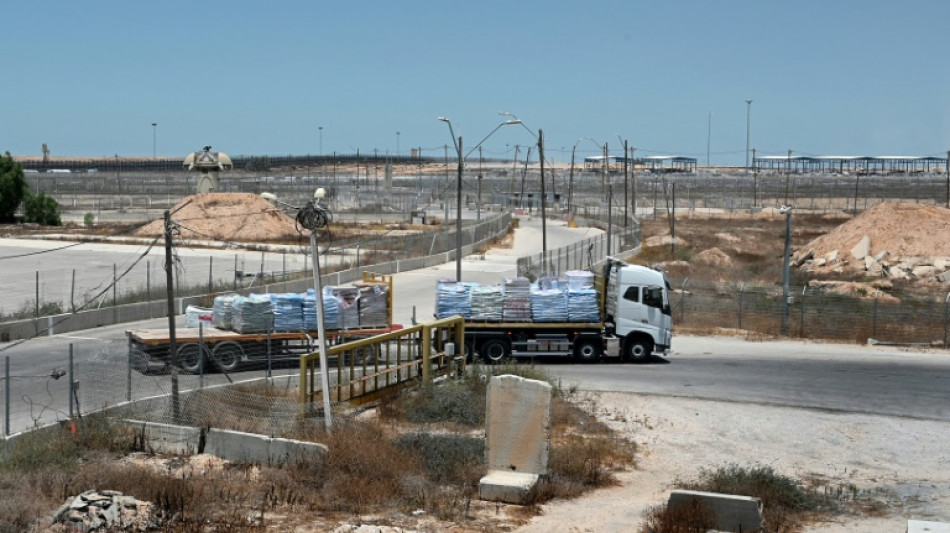
Commercial goods trucked into Gaza after aid logjams / Photo: Ahikam SERI - AFP

 Ahead of Paris mass, pope urges life together in 'dignity and peace'

 Austria 'ghetto' language classes leave children to repeat school
 S.African women runners arm themselves after string of killings

 'I felt embarrassed': Japan eSports whizz-kid, 11, wins Games gold
 Indonesia fires threatens critically-endangered orangutan: IUCN

 Bangkok declares flood disaster across city

 'World records not enough': North Korea weightlifters target Olympic gold rush

 Iran proposes Hormuz plan, Trump reportedly refuses
 El Nino rewrites the menu in the world's top restaurants

 Pope to hold giant mass on Champs-Elysees

 TikTok to pay Alabama $100 mn under pre-trial settlement

 Internationals take 7-3 Presidents Cup lead after foursomes sweep

 Brazil team returns to Colombian site of doomed jet crash

 Mbappe injured as Zidane wins on France debut, Italy lose on Mancini return

 Senegal draw in Vieira debut, Nigeria survive scare as Cape Verde crash
 U2 performs surprise 50th anniversary gigs in Dublin

 Pope calls worshippers 'saints of France' after AI warning

 US court sides with Pentagon in Anthropic AI ban

 Wall Street stocks rise, greeting optimism over possible US-Iran deal

 NFL players chief raises concerns over pitch for Maracana game

 Daytime Russian attacks kill seven in Kyiv

 Spotting AI writing: how reliable are the detectors?
 French youth await pope after AI 'paradise of machines' warning
 Man City found guilty of Premier League charges, set to appeal: reports
 Embolo follows Xhaka out of Swiss squad over fake Covid documents
As bombs thunder in Gaza, just across the border in southern Israel truck driver Itzik waits in a barbed-wire protected parking lot for his delivery to clear inspection into the hunger-stricken territory.
He lists a lorry loaded with Gaza-bound eggs, chicken, sesame, spices, tea and coffee, all destined for private markets that Palestinians and humanitarian workers describe as unaffordable.
Aid meanwhile languishes on the other side of the Kerem Shalom crossing, with Israel and the United Nations trading blame for the logjam, and Gazans suffering the resulting shortages.
Itzik, who declined to give his last name, said lately his cargo "mostly comes from the private sector".
He described a booming industry that keeps him running the route despite being branded a "traitor" to the Israeli war effort, efforts by right-wing activists to disrupt truck shipments to Gaza.
Israel maintains it lets in enough food to feed the entire Gazan population of 2.4 million. It accuses the United Nations of not effectively distributing aid stacked up on the other side of the checkpoint.
The UN, however, cites "insecurity, damaged roads, the breakdown of law and order, and access limitations" that hamper aid movement from Kerem Shalom to central Gaza.
Philippe Lazzarini, who heads the UN agency for Palestinian refugees, in May regretted that the private sector, though welcome, was "being prioritised" at Kerem Shalom.
The crossing has become the primary conduit for goods into Rafah since early May when Israeli troops seized the nearby Rafah crossing as they began ground operations against Hamas militants in the area.
Now Kerem Shalom is mostly being used to pump commercial supplies into the territory.
"Right now, the private sector is working better than the aid organisations," said Shimi Zuaretz, a spokesperson for COGAT, the Israeli defence ministry body overseeing Palestinian civilian affairs.
COGAT took journalists on a tour of the checkpoint on Wednesday, displaying crates stuffed with watermelons, cherries, tomatoes, oranges, potatoes and pulses.
Heaving open the gates of the remote desert compound, they allowed a parade of a dozen or so lorries to enter and load up the goods before departing for Gaza.
AFP was prevented from speaking to the Palestinian drivers by the Israeli soldiers leading the tour.
- Profiteering -
Funnelling supplies into Gaza was difficult even before the war, which began with Hamas's October 7 attacks on nearby Israeli communities and resulted in the deaths of more than 1,170 people, mostly civilians, according to an AFP tally of Israeli official figures.
Militants also took 251 hostages, 116 of whom remain in Gaza, including 42 the military says are dead.
Israel's retaliatory offensive has killed at least 38,295 people in Gaza, also mostly civilians, according to data from the health ministry in the Hamas-run territory.
After initially blocking all deliveries into Gaza, Israel reopened Kerem Shalom in December under international pressure.
An average of 250 trucks now cross the checkpoint daily according to COGAT, still well below UN figure of 500 aid and commercial trucks before the war.
Independent UN rights experts accused Israel on Tuesday of a "targeted starvation campaign" in the Gaza, where they said 34 Palestinians have died of malnutrition since October.
Israel denied the charge, and Elad Goren, of COGAT, countered that "the UN are not doing their job" distributing aid.
In the meantime, he said "the private sector continues to work."
Earlier in the war, the commercial pipelines dried up, leaving markets bare and a population dependent on aid, according to Juliette Touma, director of communications for UNRWA.
Now, she said the prioritisation of the private sector over the humanitarian has sown "chaos" between Palestinians with and without cash.
In Gaza, where everything is in short supply, profiteering is rife. Eggs now cost 120 shekels ($33), a box of baby formula 70 shekels and a packet of shampoo $26, the Norwegian Refugee Council said this week.
Those without money give what they have. In a territory where nearly the entire population has been displaced, that can mean the clothes or the jewellery they wear.
"To pump commercial supplies into Gaza this late in the war is a terrible idea," said Touma. "Gaza needs both commercial and humanitarian supplies, as it had before the war."
Desperation has fuelled a steady trade, with drivers to Kerem Shalom kept busy.
"I have worked as a driver here for more than 20 years," Itzik said. "I know my Gazan colleagues. I feel sorry for what is happening there."
Y.AlMasri--SF-PST