Brazil's vaunted Academy seeks to shed image as white men's club / Photo: MAURO PIMENTEL - AFP

 Ahead of Paris mass, pope urges life together in 'dignity and peace'

 Austria 'ghetto' language classes leave children to repeat school

 S.African women runners arm themselves after string of killings
 'I felt embarrassed': Japan eSports whizz-kid, 11, wins Games gold

 Indonesia fires threatens critically-endangered orangutan: IUCN

 Bangkok declares flood disaster across city

 'World records not enough': North Korea weightlifters target Olympic gold rush

 Iran proposes Hormuz plan, Trump reportedly refuses

 El Nino rewrites the menu in the world's top restaurants
 Pope to hold giant mass on Champs-Elysees

 TikTok to pay Alabama $100 mn under pre-trial settlement

 Internationals take 7-3 Presidents Cup lead after foursomes sweep
 Brazil team returns to Colombian site of doomed jet crash

 Mbappe injured as Zidane wins on France debut, Italy lose on Mancini return

 Senegal draw in Vieira debut, Nigeria survive scare as Cape Verde crash

 U2 performs surprise 50th anniversary gigs in Dublin

 Pope calls worshippers 'saints of France' after AI warning

 US court sides with Pentagon in Anthropic AI ban

 Wall Street stocks rise, greeting optimism over possible US-Iran deal
 NFL players chief raises concerns over pitch for Maracana game

 Daytime Russian attacks kill seven in Kyiv
 Spotting AI writing: how reliable are the detectors?

 French youth await pope after AI 'paradise of machines' warning

 Man City found guilty of Premier League charges, set to appeal: reports

 Embolo follows Xhaka out of Swiss squad over fake Covid documents
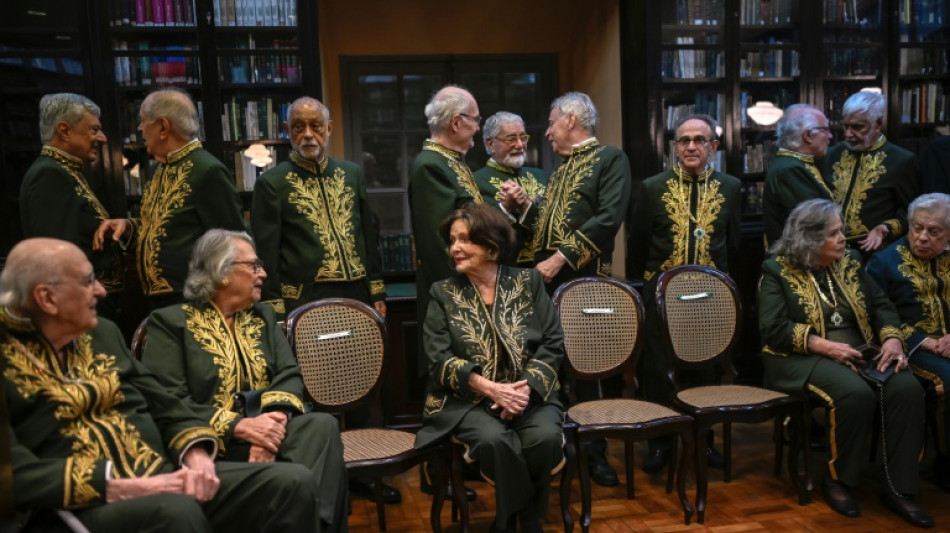
On a warm night in tropical Rio de Janeiro, a who's who of the literary and cultural scene descend on the palatial halls of the Brazilian Academy of Letters, decked out in gold-trimmed uniforms.
They call them the "Immortals": 40 of Brazil's most renowned living writers, academics, artists and public intellectuals.
Despite the nickname, they are a geriatric bunch, with an average age of 80. They are also overwhelmingly white and male -- a controversial image to project in diverse, multicultural Brazil.
Founded in 1897, the Academy is the standard-bearer of Brazilian language and literature. Known for its stately headquarters and hallowed rituals, it resembles France's vaunted Academie Francaise, on which it was modeled.
The occasion for this April gala is the induction of its first Indigenous member, acclaimed writer Ailton Krenak.
Shaking up tradition, Krenak, 70, wears a traditional beaded headband and is welcomed by Indigenous singers and dancers as he receives "Immortal" status.
"We're turning a page," he told journalists before the ceremony, which filled the room to capacity.
"The Brazilian Academy of Letters is a century-old institution, but it has never included Indigenous peoples or languages."
Some say the Academy needs to change faster.
"It was about time we got into this place, after 524 years," said one attendee, 63-year-old Indigenous chief and linguist Jose Urutau Guajajara, referring to 1500, the year Portuguese explorers reached what is now Brazil.
"It's an elitist, Euro-centric institution."
- Divided nation -
Just five Academy members are women. Two of the 40 are Afro-Brazilian, a small fraction in a country where 56 percent of the population identifies as black or mixed-race.
"Immortals" hold their seats for life. When one dies, members elect a successor.
The Academy's current president, journalist Merval Pereira, says he wants it to be more representative of Brazil.
The year he took office, in 2022, the Academy inducted Oscar-nominated actress Fernanda Montenegro and iconic singer-songwriter Gilberto Gil, who is black.
Critics were underwhelmed.
"Still no black women: the racism of the Brazilian Academy of Letters," journalist Thais Rodrigues headlined an article on Afro-Brazilian news site Alma Preta after Gil's election, recalling that the Academy passed over black writer Conceicao Evaristo in 2018.
Pereira, 74, says he is wary of the Academy playing up "identity politics" in a country deeply divided between partisans of leftist President Luiz Inacio Lula da Silva and his far-right predecessor, Jair Bolsonaro (2019-2022).
The Academy, which funds itself mainly by renting out an office building adjacent to its headquarters, has no political or government affiliation -- though it is legally tasked with deciding the rules of Brazilian Portuguese.
"Some people see identity politics as left-wing. That's not what we do. We don't elect anyone for being black, white or Indian. What matters is their work," Pereira told AFP.
"But we do want to represent Brazil's cultural diversity."
- 'Whitening' history -
The Academy's founding president was actually black: the beloved writer Joaquim Maria Machado de Assis.
Born in 1839, nearly half a century before Brazil abolished slavery, Machado, the grandson of former slaves, was a self-taught literary genius who helped transform the modern novel.
But many people do not realize the founding father of Brazilian literature was black.
For years, portraits of him downplayed his Afro-Brazilian features -- including the bust of him in the Academy's hall.
The Academy is now working to reverse that "whitening," Pereira said.
That includes a dark-skinned, digitally animated avatar of Machado that interacts with visitors to the Academy, powered by artificial intelligence.
A group of two dozen mostly black high schoolers from the Rio suburb of Nova Iguacu clustered around the large screen displaying the avatar on a recent trip to the Academy, a neoclassical building where the "Immortals" hold public lectures and gather for tea.
"As a black Brazilian who fought adversity throughout my life, I firmly believe valuing diversity is essential," the avatar said.
"The Academy has a responsibility... to help create a more just and inclusive society."
AI-generated speeches aside, the students' teacher, Ana Luisa Guimaraes, 39, said she would encourage them to think critically about their visit.
"When you look at the history of Brazilian literature... this place should be full of black and Indigenous writers," she said.
H.Nasr--SF-PST