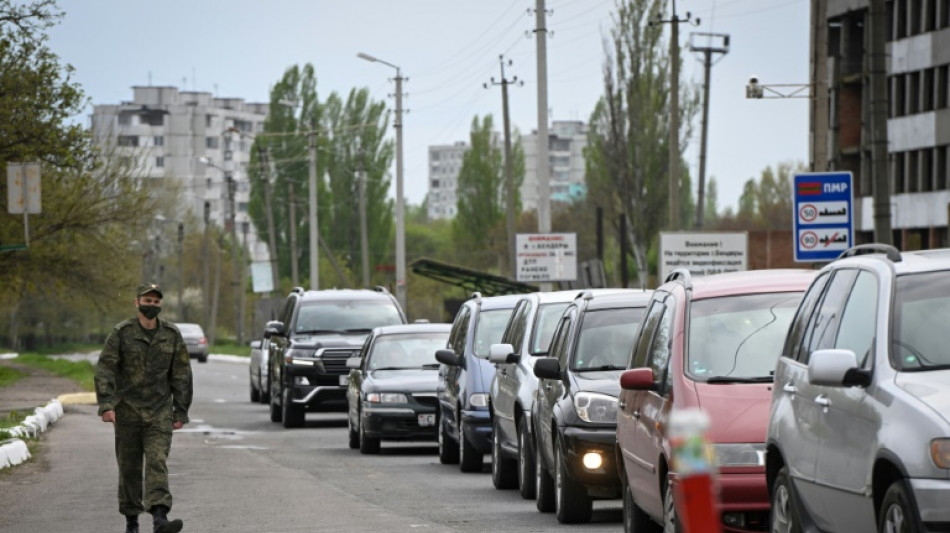
'Very worried': Tensions high on Transnistria border after attacks / Photo: Daniel MIHAILESCU - AFP

 Saudi airport closure disrupts life in kingdom's capital

 Ramaphosa tells South Africa to prepare for loss of US-Africa trade deal
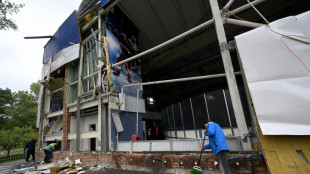
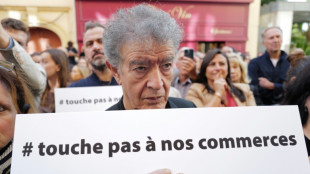 France presses resale platforms to remove 'stolen' goods after unrest
 Yamal v PSG: Ballon d'Or backdrop to Champions League showdown

 Araujo says too soon to talk about permanent Liverpool move

 US wants to be 'strong partner' for central Asia: Rubio
 'Special' to face friend Perez in Champions League, says Liverpool's Iraola
 Monitor says Indonesia fires have burned nearly two million hectares

 French PM says could declare state of emergency over unrest 'if needed'
 Albanian PM warns of 'red line' after days of unrest
 Putin, Xi and Trump could meet at APEC summit: Kremlin

 Microsoft exits data centre deal in blow to UK AI ambitions

 European stocks retreat as France violence spreads

 North Korea warns 'grave situation' prevailing along border
 Raya proud of Arsenal's 'incredible' reaction after third straight win

 Indonesia fires have burned nearly two million hectares: monitor
 Australian lawmaker 'critically' hurt in attack, officials say

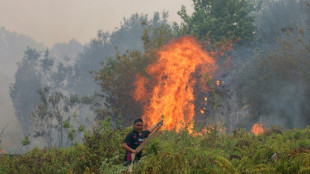 Indonesia fires burned over 1.9 mn hectares through September: monitor
 Asian tech stocks mixed after Wall St losses, eyes on earnings
 China's third-quarter growth narrowly beats forecasts
 Asian stocks start week on back foot, tracking tech-led Wall St losses
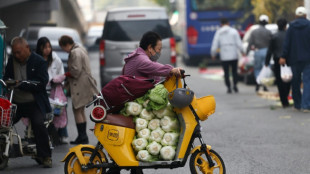 China growth narrowly beats forecasts

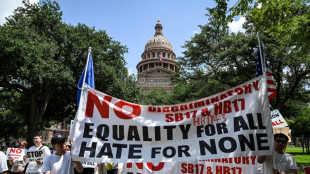 Faith and fury: Texas Senate rivals offer contrasting visions
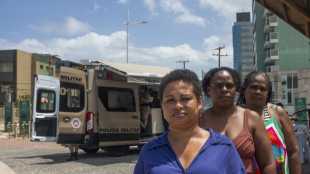 Women await justice for police killings in Brazil
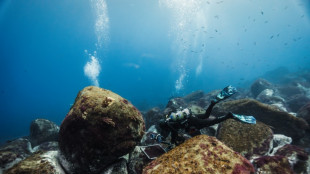
 The painstaking task of cataloguing the world's species

Like many people near the border between Moldova and its breakaway region of Transnistria, Victoria is worried.
A string of attacks this week in Transnistria -- a Moscow-backed separatist region of Moldova -- have sparked fears that Moldova could be dragged into conflict following Russia's invasion of neighbouring Ukraine.
No one has claimed the attacks, but tensions are mounting.
"I'm pregnant and very worried," said Victoria, a 36-year-old medical assistant, glancing at her belly.
She lives on the Moldovan side of the border, but crosses into Transnistria every day for work.
"I don't know what to do, I've never lived through a situation like this," she told AFP at the Varnita border post.
"If things change we will leave, obviously," she said as her 12-year-old daughter looked on from the back seat of her car.
Galina Turcanu, who owns a small family business that operates on both sides of the border, also says nerves are on edge.
"I'm concerned, we're all concerned," the 46-year-old Moldovan told AFP.
But she's staying put -- for now -- like many in the area.
"We have our parents and our whole family here," she said.
"We will stay and see which way the wind is blowing."
- Bad memories -
On Monday, Transnistria's interior ministry said government buildings in the capital Tiraspol were hit by what appeared to be a grenade-launcher attack.
In the following days, the ministry said a radio tower re-broadcasting Russian stations near the Ukrainian border was hit by explosions.
It also reported that shots were fired at a village housing a Russian arms depot after drones flew over from Ukraine.
Russia said it was "alarmed by the escalation of tensions in Transnistria", condemning the incidents as "acts of terrorism".
The self-proclaimed republic of Transnistria seceded from Moldova in 1992 after a brief war.
Around 1,500 Russian soldiers have been based there ever since.
Russia's invasion has brought unwelcome echoes of the fighting in the early 1990s which pushed many residents out of the region.
"That was difficult, we don't want that to happen again," says Turcanu.
"They aren't good memories."
- 'Concerning' -
Since the attacks, the wait to get into Transnistria has become much longer as security is ramped up, according to Moldovan policeman Vitalie, who gave only one name.
Transnistrian authorities have been conducting "more extensive checks since the explosions", he said, adding that car queues stretch to 300 metres (985 feet) at times.
But at the Moldovan checkpoint a few kilometres away, security forces are simply waving people through.
Moldova's pro-EU President Maia Sandu has said security measures will be boosted, but in the streets of the capital Chisinau and the road towards Transnistria there is only a low-key police and military presence.
In the wake of this week's incident in Transnistria, Ukraine has accused Russia of trying to "destabilise" the breakaway region.
Moldova's Deputy Prime Minister, Oleg Serebrian, has played down the possibility of direct Russian interference.
He told France Info radio the cause of the clashes was "not clear", citing possible "internal clashes" between pro-Ukrainian and pro-Russian factions in Transnistria rather than "external influence".
But Serebrian admitted it was "concerning, given the regional situation and (Moldova's) economic weakness".
The country is already feeling the economic impact of the war, with supply chains disrupted.
Moldova is also "very dependent on electricity and gas networks that cross Transnistria", Serebrian said.
- 'All the passports' -
Moldova has also seen more than 400,000 Ukrainians cross its borders since the February 24 invasion, a significant number in a country of 2.6 million people, one of Europe's poorest and least populated.
While most of them have moved on elsewhere, over 91,000 have stayed, and Moldova is now bracing itself for a fresh wave of arrivals from Transnistria.
While many residents of the region have obtained Russian passports in recent years, local media have reported an uptick in people renewing their Moldovan documents as well over the past few weeks.
Turcanu is prepared.
"I've got all the passports in there", she says with a smile, pointing to a bag in her passenger seat.
H.Jarrar--SF-PST