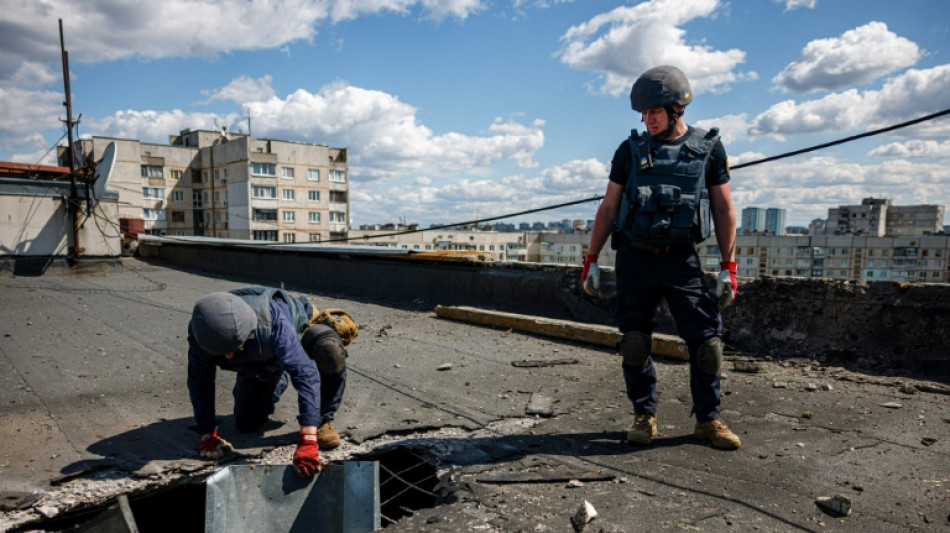
In Kharkiv, sappers search for remains of Russian rockets / Photo: Dimitar DILKOFF - AFP

 Saudi airport closure disrupts life in kingdom's capital

 Ramaphosa tells South Africa to prepare for loss of US-Africa trade deal
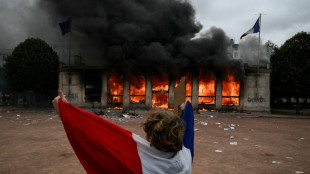
 France presses resale platforms to remove 'stolen' goods after unrest
 Yamal v PSG: Ballon d'Or backdrop to Champions League showdown

 Araujo says too soon to talk about permanent Liverpool move

 US wants to be 'strong partner' for central Asia: Rubio

 'Special' to face friend Perez in Champions League, says Liverpool's Iraola

 Monitor says Indonesia fires have burned nearly two million hectares

 French PM says could declare state of emergency over unrest 'if needed'

 Albanian PM warns of 'red line' after days of unrest

 Putin, Xi and Trump could meet at APEC summit: Kremlin

 Microsoft exits data centre deal in blow to UK AI ambitions

 European stocks retreat as France violence spreads

 North Korea warns 'grave situation' prevailing along border
 Raya proud of Arsenal's 'incredible' reaction after third straight win

 Indonesia fires have burned nearly two million hectares: monitor

 Australian lawmaker 'critically' hurt in attack, officials say

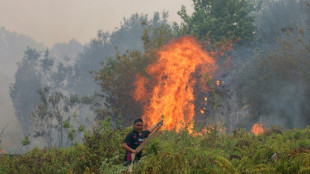 Indonesia fires burned over 1.9 mn hectares through September: monitor
 Asian tech stocks mixed after Wall St losses, eyes on earnings

 China's third-quarter growth narrowly beats forecasts

 Asian stocks start week on back foot, tracking tech-led Wall St losses

 China growth narrowly beats forecasts

 Faith and fury: Texas Senate rivals offer contrasting visions
 Women await justice for police killings in Brazil

 The painstaking task of cataloguing the world's species

In Ukraine's second city Kharkiv, which has been repeatedly battered by Moscow's forces, a team of bomb disposal experts scours the streets to remove the remains of Russian rockets.
Just a dozen kilometres (seven miles) from the Russian border, Kharkiv suffered major destruction in the first days of President Vladimir Putin's invasion.
Although Kyiv managed to retain control of the city, it still faces daily attacks, with its bomb disposal experts on constant call to remove twisted remains of Russian ordnance.
"We receive more than 50 calls every day," says Igor, the lieutenant colonel who heads the team ridding Kharkiv's streets of this dangerous debris.
"On Wednesday, we had 82 calls," he told AFP.
Residential districts in Kharkiv's northeast are hit daily by random strikes that can happen at any time day or night and are often deadly.
Residents then call 101 or 112 to reach Igor's crew of experts who come over and remove the rocket remains.
On Thursday, their first job was at a school.
Inside an office on the first floor, sunlight shines through a gaping hole punched in the roof by a rocket, its diameter over a metre wide (3.2 foot). The windows are shattered, and a pile of rubble covers the floor.
"There was shelling in the neighbourhood, and it hit the roof," says a woman who brought them into the school but did not want to give her name.
- 'So scared' -
"We were so scared. We did not know if it had exploded or not."
Kicking through the rubble with their feet, they find nothing, but outside they find part of the rocket.
Barely 300 metres away, they find another piece, the blackened tail sticking out of the concrete of a path between the Soviet-era buildings.
One of the crew tries to pull it out but the metal tube doesn't budge, so they use a shovel to dig around it until they can prise it loose.
They identify it as the remains of a projectile fired by a Soviet BM21 Grad rocket launcher with a range of five to 45 kilometres.
The truck-mounted Grad launcher can fire 40 of these rockets in very quick succession.
Two blocs on, their next call is 11 floors up where they use a small ladder to reach the roof of a Soviet-era block so typical of these neighbourhoods.
From their vantage point up high, they have a clear view over Kharkiv and can see a forest to the northeast from where Russian soldiers shell the city.
The frontline is less than five kilometres away.
On the roof, there is just a huge hole, so they have to go down into the building's dusty attic to find the rocket's remains.
Like the other bits of charred metal they have recovered, it all goes into the boot of their 4x4.
- 'Don't pick it up' -
Outside, a man approaches them holding a chunk of rusted metal.
"Next time, it's better to call us and we'll come and get it," one of the experts tells him.
"Don't pick it up yourself."
Next they're off to the eastern part of the city near the ring road which has become a no-man's land between the two sides.
Here a five-storey building was hit, its concrete facade punctured by a blackened hole between the second and third floors.
Inside, they find a long piece of the Grad rocket embedded in the bathroom of a flat on the first floor, home to a woman called Antonina who luckily was out when it hit.
"When I came home, everything was destroyed. It happened yesterday," she told AFP, saying she was afraid having the remains of a rocket in her home.
"It was scary, so for my safety, I called them."
During their three-hour search of the neighbourhood, the pounding of Ukrainian artillery echoes overhead as they respond to Russian rocket attacks.
The same day, one person died and two others were wounded in an attack on Kharkiv's northeast, the same toll as the day before.
S.Abdullah--SF-PST