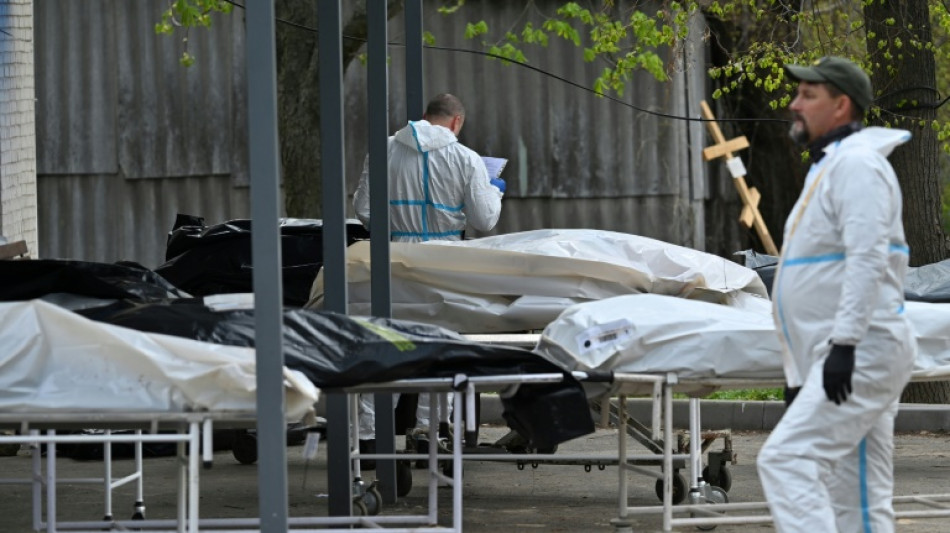
Bucha survivors haunted by 'nightmare' of Russian occupation / Photo: Genya SAVILOV - AFP

 Saudi airport closure disrupts life in kingdom's capital

 Ramaphosa tells South Africa to prepare for loss of US-Africa trade deal
 France presses resale platforms to remove 'stolen' goods after unrest
 Yamal v PSG: Ballon d'Or backdrop to Champions League showdown
 Araujo says too soon to talk about permanent Liverpool move

 US wants to be 'strong partner' for central Asia: Rubio
 'Special' to face friend Perez in Champions League, says Liverpool's Iraola
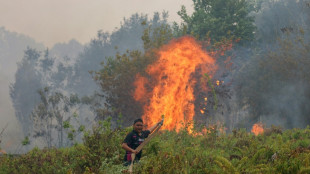 Monitor says Indonesia fires have burned nearly two million hectares

 French PM says could declare state of emergency over unrest 'if needed'
 Albanian PM warns of 'red line' after days of unrest
 Putin, Xi and Trump could meet at APEC summit: Kremlin
 Microsoft exits data centre deal in blow to UK AI ambitions

 European stocks retreat as France violence spreads

 North Korea warns 'grave situation' prevailing along border
 Raya proud of Arsenal's 'incredible' reaction after third straight win

 Indonesia fires have burned nearly two million hectares: monitor
 Australian lawmaker 'critically' hurt in attack, officials say

 Indonesia fires burned over 1.9 mn hectares through September: monitor
 Asian tech stocks mixed after Wall St losses, eyes on earnings

 China's third-quarter growth narrowly beats forecasts
 Asian stocks start week on back foot, tracking tech-led Wall St losses
 China growth narrowly beats forecasts

 Faith and fury: Texas Senate rivals offer contrasting visions
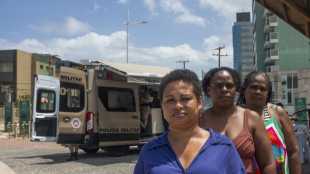 Women await justice for police killings in Brazil

 The painstaking task of cataloguing the world's species

When Vitaliy Zhyvotovskyi closes his eyes, he sees captives wearing white bags over their heads just like the people that Russian troops led into his house at gunpoint.
His home in the town of Bucha, now synonymous with accusations of war crimes, became the base for some of Moscow's soldiers and a hellish prison for him, his daughter and a neighbour whose husband was killed.
"We were trembling not because of the cold, but due to fear because we could hear what the Russians did to the captives," he told AFP standing in front of his burned home.
"We had no hope," he said, recalling the sound of the victims' screams.
Their city drew worldwide attention after the discovery of at least 20 bodies in civilian clothes on a stretch of its Yablunska (Apple Tree) Street.
Many more locals survived, however, and what they witnessed and lived through will haunt them forever.
"What can you feel? Just horror," said Viktor Shatylo, 60, who documented the violence from his garage window in pictures. "It's a nightmare, simply a nightmare."
Before Russian troops captured Bucha, days into their invasion of Ukraine, it was a small but steadily growing town near Kyiv's north-western edge that became a key prize on the way to the capital.
Days into the attack, a Russian armoured vehicle roared into Zhyvotovskyi's yard on February 27 and began shelling a neighbouring apartment building, where fire subsequently ripped through its upper floors.
It was nearly a week later though that troops took control of his home and confined him and his daughter Natalia, 20, to the basement with a warning that they would be killed if they tried to leave without permission.
- 'I'll throw a grenade in' -
The soldiers ate, slept and ran a field hospital as well as an operations centre in the home built by Zhyvotovskyi's family, and which sits a minute's walk from Yablunska.
His sole focus was keeping him and his daughter alive, so the 50-year-old did things like speaking only Russian to the troops and talking about his family and belief in God to humanise himself.
It was not long before he saw the soldiers leading a hooded captive into the house, a scene he said he heard or saw on at least seven occasions –- followed by interrogations, beatings and screaming.
Traces of the occupation are everywhere in his destroyed home: Russian ration packs, a camouflage-covered combat manual and a small wooden bat with "MORAL" scrawled on it in Russian.
About midway through their ordeal, the Zhyvotovskyis' trauma intersected with that of their neighbour across the street, Lyudmyla Kizilova, 67.
Russian troops shot her husband dead on March 4 and she was left alone in her house, she told AFP.
She came to stay for several days in Zhyvotovskyi's basement after he urged the Russians to allow her safe passage across the street, while she was still dazed from a killing that she heard take place.
It happened when her husband, Valerii Kizilov, 70, emerged from their cellar where they had taken shelter. She heard shooting, then silence and an order shouted to her.
"If there is someone down there, come out or I'll throw a grenade in," she said, recalling the soldier's words.
- Search for slain husband -
She showed herself, but Russian troops refused to say what happened to her husband, and instead sent her back into the cellar with strict instructions not to come out –- an impossibility while her spouse was missing.
Kizilova waited until dark and then crept around her property with a light until she located his body: "He was laying there shot in the head, there was a lot of blood. But I found him."
It was Russian soldiers who buried the body in her garden on March 9, and after it was done, they poured some of the whisky they had looted from her house into one of her glasses and offered it to her –- she refused.
The next day she evacuated the area and plunged into a new life without her husband.
"I don't know how I will recover without him. Everything starts now from zero," she said. "If I was young, there would at least be hope to rebuild something."
Zhyvotovskyi and his daughter escaped the same day, but only after lying to the Russians by saying they were going to another family member's house but would be back.
When Zhyvotovskyi went upstairs to get approval he stumbled onto a horrific sight in his own kitchen -– three prisoners on their knees with bags over their heads, hands tied behind their backs.
- Never forget -
When he allowed AFP to visit his home, which was heavily damaged in a fire that started sometime after he left, there was what appeared to be a dried layer of blood in the same spot on the floor where the captives had kneeled.
For some reason the Russian troops allowed him and his daughter to leave together on the promise they return, with the threat the house would be blown up if they didn't keep their word.
"God forbid someone experience something like this," Zhyvotovskyi said. "We are alive just by chance."
For survivors across Ukraine like Zhyvotovskyi and Kizilova, the war trauma they suffered will manifest itself in personal ways and may not come immediately.
"Some people already have post-traumatic syndrome, and some others are still at the stage when they will feel it later," said Alyona Kryvulyak, a coordinator with the Ukrainian branch of La Strada, a women's rights organisation.
"But each of us will be traumatised by the war in our own way," she added.
Yet for Shatylo, the Yablunska street local who filmed the violence on his road, remembering what happened is perhaps the most important thing.
He risked his life to take photos so "children and grandchildren can see what was happening, so that they know not from television, but in real life.
"But many have already seen it and I think they will remember it for hundreds of years."
U.Shaheen--SF-PST