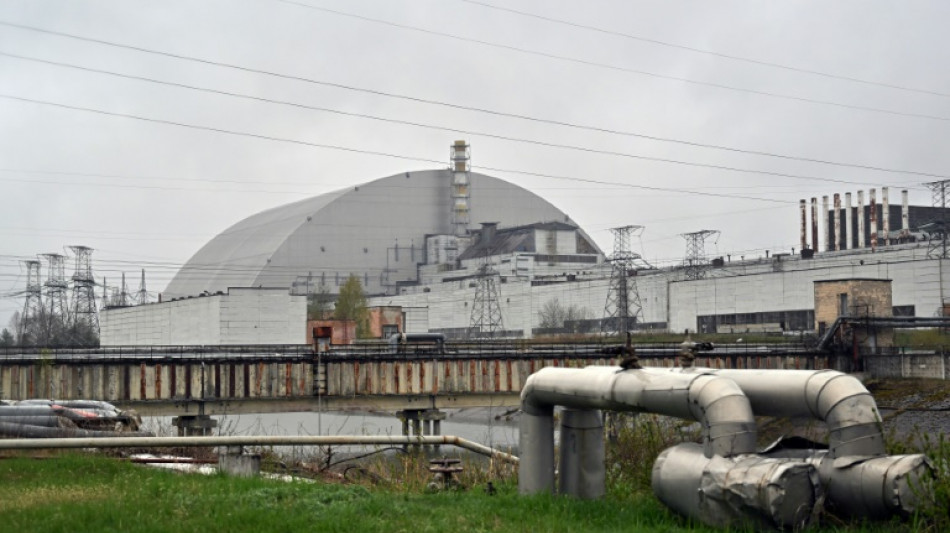
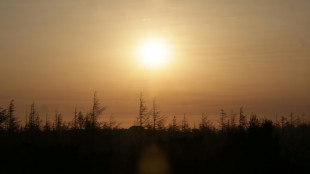
'Very dangerous': Chernobyl marks anniversary amid war / Photo: Sergei SUPINSKY - AFP

 Ronaldo handed 30-day suspension after walking out on Portugal

 Netanyahu basks in Trump endorsement week before election
 Saudi airport closure disrupts life in kingdom's capital

 Ramaphosa tells South Africa to prepare for loss of US-Africa trade deal
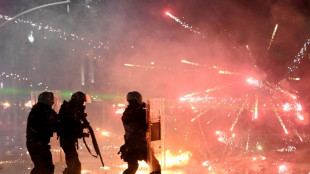
 France presses resale platforms to remove 'stolen' goods after unrest
 Yamal v PSG: Ballon d'Or backdrop to Champions League showdown

 Araujo says too soon to talk about permanent Liverpool move

 US wants to be 'strong partner' for central Asia: Rubio

 'Special' to face friend Perez in Champions League, says Liverpool's Iraola

 Monitor says Indonesia fires have burned nearly two million hectares

 French PM says could declare state of emergency over unrest 'if needed'
 Albanian PM warns of 'red line' after days of unrest
 Putin, Xi and Trump could meet at APEC summit: Kremlin

 Microsoft exits data centre deal in blow to UK AI ambitions

 European stocks retreat as France violence spreads

 North Korea warns 'grave situation' prevailing along border
 Raya proud of Arsenal's 'incredible' reaction after third straight win

 Indonesia fires have burned nearly two million hectares: monitor
 Australian lawmaker 'critically' hurt in attack, officials say

 Indonesia fires burned over 1.9 mn hectares through September: monitor
 Asian tech stocks mixed after Wall St losses, eyes on earnings

 China's third-quarter growth narrowly beats forecasts
 Asian stocks start week on back foot, tracking tech-led Wall St losses
 China growth narrowly beats forecasts

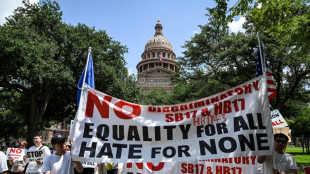 Faith and fury: Texas Senate rivals offer contrasting visions
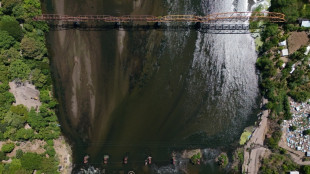
The road toward Chernobyl is still littered with Russian soldiers' discarded ration boxes and occasional empty bullet shells in a subtle but harrowing warning of the invasion's terrible risk for the infamous nuclear site.
Tuesday marked the 36th anniversary of what is considered the worst ever nuclear disaster, and there was relief the hulking so-called sarcophagus covering the reactor's radioactivity remains was back under Ukrainian control.
Soldiers cradling their assault rifles watched over checkpoints -- including one with an effigy dressed in Russian fatigues and a gas mask -- that guard the way from Kyiv to the sprawling site near the border with Belarus.
Yet concerns are far from dissipated for atomic sites in Ukraine because Russia's invasion of its neighbour is grinding on.
Authorities even said Tuesday that missiles had flown low over a nuclear power station in a close call in the southern city of Zaporizhzhia.
"They (Chernobyl staff) carried on their work, in spite (of) all of the difficulties... They got the situation stable, so to speak, in this sense the worst was of course avoided," UN atomic watchdog chief Rafael Grossi told reporters upon his arrival at Chernobyl.
"We don't have peace yet, so we have to continue. The situation is not stable. We have to be on alert," he added, noting the invasion was "very, very dangerous".
The plant, which fell into Russian hands on the day Moscow's troops began their invasion in February, suffered a power and communications outage that stirred fears of a possible new calamity at the site.
Those worries stretch back to the events of April 26, 1986, when Chernobyl's number four reactor exploded, causing the world's worst nuclear accident which killed hundreds and spread radioactive contamination west across Europe.
- 'Ice Cream Chernobyl' -
The reactor number four building is now encased in a massive double sarcophagus to limit radioactive contamination, and an area spanning 30 kilometres (18.5 miles) around the plant is considered the "exclusion zone" that is essentially uninhabited, nuclear authorities say.
Rows of ageing and abandoned-looking apartment buildings dot the road into the site and yet some have bright curtains and plants in the windows, while a kiosk labelled "Chernobyl Tour Info" greets people on their way toward the plant.
The bullet hole-shattered glass of the nuclear-yellow painted hut bears the signs of the war launched on February 24 that has prompted international condemnation of Russia and backing for Ukraine.
In a sign from a more tourist-friendly time, "Ice Cream Chernobyl" is emblazoned on the side of a refrigerator at the kiosk -- with a graphic of a vanilla cone and the radiation warning symbol side-by-side.
The Russian troops that could easily have rolled past the stand on their way south toward Kyiv had planned to stay in Chernobyl, Ukrainian officials said.
The soldiers dug trenches and set up camps, but in areas like the so-called "Red Forest", named for the colour its trees turned after being hit by a heavy dose of radiation in Chernobyl's 1986 meltdown.
"Areas with high radiation levels remain here still, but the contamination was moved around due to the actions of Russian occupiers who were using heavy military vehicles," Ukraine's Interior Minister Denys Monastyrsky told journalists visiting Chernobyl.
It's a site that has drawn significant international interest because of the scale of the disaster. The original Soviet-era sarcophagus deteriorated over the years so a new one was built over it and was completed in 2019.
But for some in the area, risk is just a fact of life.
"If they (the Russians) wanted to blow it up, they could blow it up when they ran away," noted Valeriy Slutsky, 75, who said he was present for the power station's 1986 disaster.
"Maybe I'm used to it (radiation)," he added with a shrug.
J.AbuHassan--SF-PST