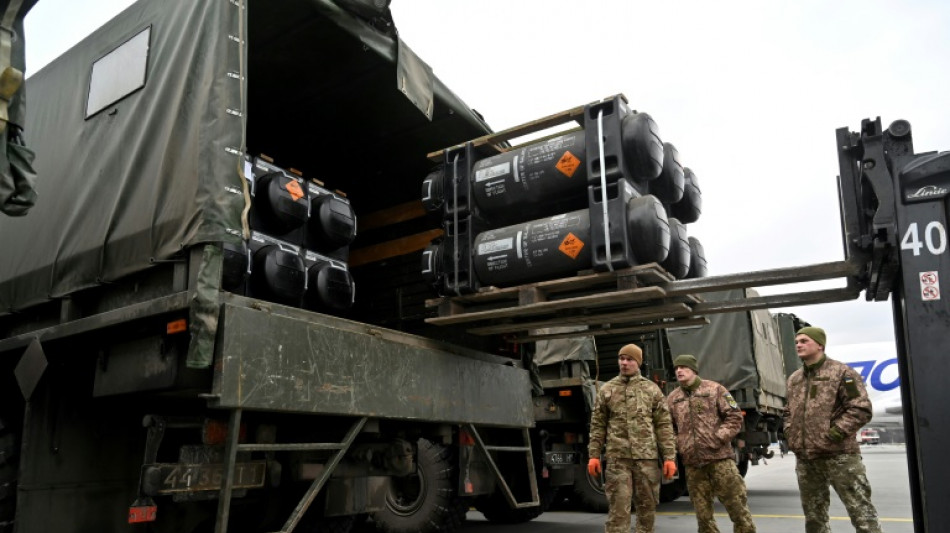
US ships artillery to Ukraine to destroy Russian firepower / Photo: Sergei SUPINSKY - AFP/File

 Ronaldo handed 30-day suspension after walking out on Portugal

 Netanyahu basks in Trump endorsement week before election

 Saudi airport closure disrupts life in kingdom's capital

 Ramaphosa tells South Africa to prepare for loss of US-Africa trade deal
 France presses resale platforms to remove 'stolen' goods after unrest

 Yamal v PSG: Ballon d'Or backdrop to Champions League showdown

 Araujo says too soon to talk about permanent Liverpool move

 US wants to be 'strong partner' for central Asia: Rubio

 'Special' to face friend Perez in Champions League, says Liverpool's Iraola

 Monitor says Indonesia fires have burned nearly two million hectares

 French PM says could declare state of emergency over unrest 'if needed'

 Albanian PM warns of 'red line' after days of unrest

 Putin, Xi and Trump could meet at APEC summit: Kremlin

 Microsoft exits data centre deal in blow to UK AI ambitions

 European stocks retreat as France violence spreads

 North Korea warns 'grave situation' prevailing along border

 Raya proud of Arsenal's 'incredible' reaction after third straight win

 Indonesia fires have burned nearly two million hectares: monitor

 Australian lawmaker 'critically' hurt in attack, officials say

 Indonesia fires burned over 1.9 mn hectares through September: monitor

 Asian tech stocks mixed after Wall St losses, eyes on earnings
 China's third-quarter growth narrowly beats forecasts

 Asian stocks start week on back foot, tracking tech-led Wall St losses

 China growth narrowly beats forecasts

 Faith and fury: Texas Senate rivals offer contrasting visions
The push by the United States to send artillery to Ukraine aims to degrade Russian forces -- not only on the immediate battlefield but over the longer term, according to US Defense Secretary Lloyd Austin and military experts.
The United States, France, Czech Republic and other allies are sending scores of the long-range howitzers to help Ukraine blunt Russia's mounting offensive in the eastern Donbas region.
Backed by better air defense, attack drones and Western intelligence, the allies hope that Kyiv will be able to destroy a large amount of Russia's firepower in the looming showdown.
After returning from Kyiv, where he met Ukraine defense chiefs and President Volodymyr Zelensky, Austin told journalists in Poland early Monday that Washington's hopes are larger than that.
Russia "has already lost a lot of military capability, and a lot of its troops, quite frankly. And we want to see them not have the capability to very quickly reproduce that capability," Austin said.
"We want to see Russia weakened to the degree that it can’t do the kinds of things that it has done in invading Ukraine."
- 'War of attrition' -
That is a shift from Washington's initial approach, when they simply hoped to help prevent Moscow's seizure of the Ukrainian capital and the overthrow of Zelensky's government.
In fact, aided by anti-aircraft and anti-armor missiles supplied by the United States and European allies, Ukrainian troops forced the Russian military to withdraw from northern Ukraine within six weeks of the February 24 invasion.
But Moscow now controls significant swathes of eastern and southern Ukraine, apparently aiming to expand to the center of the country by sending in more troops and equipment.
Their plan, experts believe, is to use long-range shelling to drive back most of Ukraine's forces and only then send in ground troops and tanks to secure the land.
Ukraine's best option is to fight back with superior artillery -- backed by protection from air assaults -- to destroy Russian firepower, according to Mike Jacobson, a US civilian expert in field artillery.
Jacobson predicted that this would lead to a "war of attrition" in which Ukraine, with ally-supplied equipment with longer ranges and more accurate targeting, could stop the Russians cold.
"I believe that superior artillery will decrease the Russians' ability to sustain this fight," Jacobson told AFP.
Phillips O'Brien, a University of St. Andrews professor of strategic studies who posts daily analyses of the war on Twitter, wrote that the coming artillery fight will resemble World War I, each side trying to wear the other down with grueling shelling.
The Russian army "is considerably smaller and suffered major equipment losses. Ukrainian army is smaller, but about to be much better armed," he said.
"Russia needs to change that dynamic or it loses the attrition war."
- Rapid deployment -
The US and allies are moving fast with the supplies to take advantage of the slow regrouping of Russian forces after their setback in northern Ukraine.
Already at least 18 of the 90 towed artillery pieces Washington promised in the past two weeks have been delivered to Ukrainian forces, and more are being rushed in early this week, according to a Pentagon official.
Washington is also supplying nearly 200,000 rounds of howitzer ammunition, and is arranging for ammunition supplies for the Russian-made artillery that Ukraine forces currently operate.
Some 50 Ukraine troops have already been trained to use the US howitzers, and more are being trained this week.
Meanwhile France is sending its ultra-advanced Caesar mobile howitzer, and the Czech Republic is delivering its older self-propelled howitzers.
Canada too is sending howitzers and advanced, guided "Excalibur" shells that can travel more than 40 kilometers and deliver munitions precisely on target.
"The fight they're in in the Donbas is going to be heavily reliant on what we call long-range fires, artillery particularly," a senior US defense official said.
"That's why we're focusing them on getting them artillery as well as tactical UAVs," the official said.
That was a reference to allies supplying "suicide drones," bomb-armed unmanned aerial vehicles that can be directed for hours to search out and then explode themselves on Russian targets.
But no one is saying such a strategy will allow Ukraine to fully drive out the Russians.
If Kyiv does prevail in the artillery showdown, it will "eventually force them (Russia) to either escalate or negotiate realistically," said Jacobson.
"Russia will be frustrated but not defeated."
A.AlHaj--SF-PST