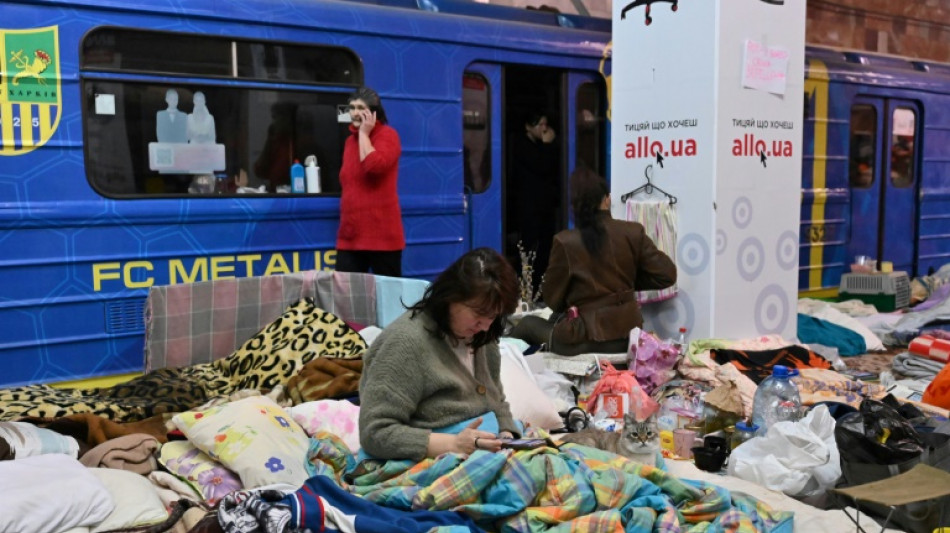
In Kharkiv's metro, families carve out a life away from the bombs / Photo: SERGEY BOBOK - AFP/File

 US to auction deep sea mining leases off American Samoa

 Australian lawmaker hurt in car attack underwent surgery overnight: PM

 Japan launches rocket for potential world first Mars moon mission

 Ethiopia PM warns Eritrea of 'severe consequences' if supports enemies

 Boland grabs opportunity for Australia as South Africa struggle in second Test

 Ronaldo handed 30-day suspension: Portuguese federation
 France announces curfews as government grapples with unrest

 Boland sets pace as South Africa struggle

 Ukraine on back foot as Kremlin moots US, China meeting
 'Stay home!': Tourists find themselves in a France convulsed by protests

 Kenyan cult leader guilty on all charges over 191 starvation deaths

 Eagles star Hurts to miss rest of NFL season: reports

 Oil-rich Alberta votes on Canada breakup

 Israel announces arrests after West Bank settler attacks on Westerners
 Guehi insists players have 'trust and belief' in Man City after charges

 UN climate panel head wants swift end to deadlock over key scientific report
 PM calls for curfews in France as govt grapples with unrest
 Man City's Semenyo out for up to eight weeks

 Australian lawmaker critically hurt in 'violent' vehicle attack

 England women's coach Wiegman signs two-year contract extension
 Louvre blocked as France grapples with unrest

 Bollywood actor Tiger Shroff shot at in Mumbai, three suspects held: police
 UN biodiversity summit opens with nature goals off track

 'Physical hell': Hong Kong hosts gruelling underwater hockey tournament
 Police 'lost control' during French protests, says interior minister

When Russian troops steamrolled through her east Ukrainian village in February, Elena Ivanovna's family packed their car before dawn and fled to Kharkiv, where they unwittingly found themselves on the front line.
Ukraine's second city has been pummelled by strikes day and night since Russian forces attempted to seize it at the start of the invasion.
The bitter fighting has rendered the city of 1.5 million a tangle of blown-out shops and smouldering apartment blocks, and forced families like Ivanovna's underground where they are sheltering in the metro.
"We thought that here (in Kharkiv) we would find salvation, but it became the front line. Helicopters and planes were bombing the city. So we decided to come to the metro," the 40-year-old kindergarten teacher said.
On February 24, the night of the invasion, Ivanovna and her family were asleep in their village Lyptsi, just 10 kilometres (six miles) from the Russian border.
"We woke at 4:30 in the morning... even the children woke and immediately realised that this was war," she said.
"Through the window, we could see that everything was on fire, our house was shaking."
Ivanovna, her husband and their children, aged eight, 10 and 17, dressed quickly, grabbed a handful of belongings and initially took refuge in their own basement.
"After 15 minutes, it got quieter, so we ran to our car and drove towards Kharkiv... as fast as we could."
As they drove, they saw missiles "falling everywhere", she said.
When they got to the city to join Ivanovna's mother, they found it too was under fire.
So, once again, the family crowded into a cellar as the strikes rained over them.
After six days, they knew they needed somewhere safer, so they joined hundreds of others in one of the stations.
- Living in the metro -
Two months later, about 700 people are still living in the various metro stations that punctuate Kharkiv.
Close to the Russian border, the city saw heavy fighting at the start of Moscow's offensive but has always remained under Ukrainian control.
"The first week, people slept on top of each other. There was no humanitarian aid. No one understood what was going on," said Iolia, one of the volunteers helping the displaced.
To create a semblance of privacy, the families have divvied up the station's long platform.
Mattresses, blankets, beds, tables and chairs have been brought into the station, while volunteers regularly clean the passageways and ensure the electricity works.
In the calmer moments, the station residents occupy themselves as best as they can. Some read, some sleep, while others talk or pace the alleys.
"Volunteers bring us food three times a day, even hot meals, sweets for the children... gifts, toys, pencils," Ivanovna said.
Sitting on a mattress, one of Ivanovna's daughters explored a large princess castle that just arrived.
For the past month, children have even been able to resume their studies underground, with a mix of face-to-face lessons and online study.
To keep the residents occupied, volunteers have put on theatre performances, concerts, puppet shows and led physical exercise classes.
"There was an animal show, (as well as) painting and games so that our children could feel better mentally and physically," said Ivanovna.
On the Friday before Easter, volunteers handed out "paska", a traditional bun coated in icing and colourful sprinkles.
But the conflict raging above them is never far away for long.
When the rockets strike, the children still "wake up, tremble and ask for medicine".
"Our life is frightening, difficult. But we wait and we hope," said Ivanovna.
She added that she longs for the day when "all the Russian soldiers leave, when we no longer hear any missile strikes and we no longer see any rockets".
K.AbuTaha--SF-PST