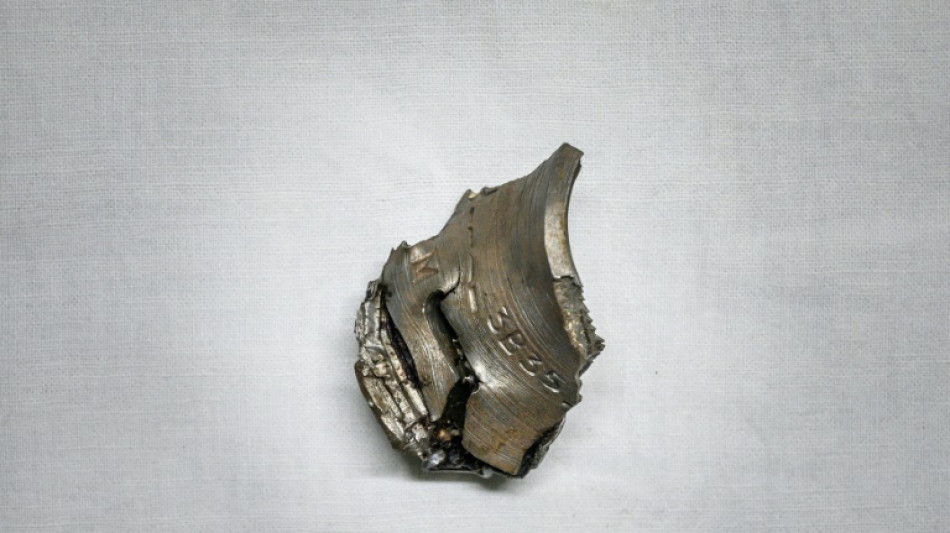
Shrapnel: The terrible fragments of war / Photo: Ed JONES - AFP

 How recent controversies have rocked the US death penalty debate
 Adams facing long injury layoff as Rams' problems deepen
 US judge orders Saudi engineer held in OpenAI case
 Maddison sparkles as Spurs end Premier League winless run
 Maddison sparkles on Spurs return as win drought ends
 Trump says ready to meet with Putin and Xi in China
 The young lawmaker making Brazil's Lula 'king of the selfie'
 Christiane Amanpour to leave CNN after 43 years

 Ronaldo handed 30-day suspension after walking out on Portugal

 Netanyahu basks in Trump endorsement week before election
 Saudi airport closure disrupts life in kingdom's capital

 Ramaphosa tells South Africa to prepare for loss of US-Africa trade deal
 France presses resale platforms to remove 'stolen' goods after unrest
 Yamal v PSG: Ballon d'Or backdrop to Champions League showdown
 Araujo says too soon to talk about permanent Liverpool move

 US wants to be 'strong partner' for central Asia: Rubio

 'Special' to face friend Perez in Champions League, says Liverpool's Iraola

 Monitor says Indonesia fires have burned nearly two million hectares

 French PM says could declare state of emergency over unrest 'if needed'

 Albanian PM warns of 'red line' after days of unrest
 Putin, Xi and Trump could meet at APEC summit: Kremlin

 Microsoft exits data centre deal in blow to UK AI ambitions

 European stocks retreat as France violence spreads

 North Korea warns 'grave situation' prevailing along border
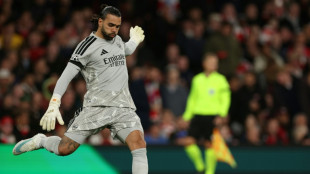 Raya proud of Arsenal's 'incredible' reaction after third straight win

They differ in size and colour and some still have skin attached: the shrapnel extracted from the wounded at a military hospital in southern Ukraine are the cold reality of the country's war.
In this closely guarded building in the city of Zaporizhzhia, the windows are covered in tarpaulin to avoid drawing Russian fire and to protect patients if the windows shatter from a blast.
There is therefore near total darkness as surgeons come out of an operating theatre with their metallic haul -- two jam jars filled with the shrapnel taken out of soldiers and civilians undergoing treatment at the facility.
Some fragments are bottle green, others grey or brown.
"That's from a mine," said one of the doctors, Yury, pointing to a shard four or five centimetres long.
Every scrap of metal has a story.
Pointing to a particularly sharp shard, Yury said: "We took that one out of a leg. The soldier was in a stable condition and the operation was a success".
On his phone, he showed an X-ray of the wound as it was before the operation. The piece of metal stands out whiter than the muscle in which it was embedded.
Other X-rays show a bullet lodged in someone's jaw or a piece of shrapnel lodged in a pelvis.
- 'We basically live here' -
"Our men are very strong. A large majority of the ones that we treat here, even those who are seriously injured, want to return to the frontline with their friends to support them," Yury said.
An orthopaedic surgeon, Farad Ali-Shakh, said that none of the wounded had died at the hospital and there had only been two limb amputations.
"Their injuries were putting their life in danger," he said.
He too showed a picture on his phone of a blown-off foot, attached to the rest of the body by some skin.
"We managed to restore the vessels and then fix the extremities," said the surgeon.
Ali-Shakh said he is working 20 hours a day.
"We basically live here," he said. "Sometimes I get home at 2 or 3 in the morning and then I come back".
Since the start of Russia's invasion on February 24, the hospital has treated more than 1,000 wounded, including both military and civilians, according to hospital director Viktor Pysanko.
The conflict that began in 2014 with Russia-backed separatists in eastern Ukraine had been "low intensity" and wounds were relatively simple.
The injuries are now much more complex and reflect the range of ordnance being used, Pysanko said, angrily branding Russian soldiers "animals".
Q.Jaber--SF-PST