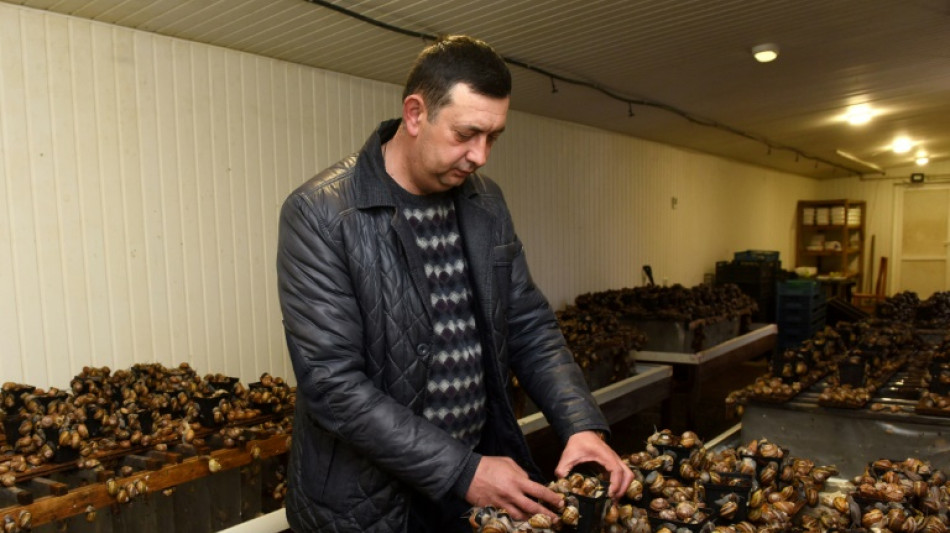
In war-torn Ukraine, dimmed hopes for escargot exports / Photo: Yuriy Dyachyshyn - AFP

 How recent controversies have rocked the US death penalty debate

 Adams facing long injury layoff as Rams' problems deepen

 US judge orders Saudi engineer held in OpenAI case

 Maddison sparkles as Spurs end Premier League winless run
 Maddison sparkles on Spurs return as win drought ends

 Trump says ready to meet with Putin and Xi in China

 The young lawmaker making Brazil's Lula 'king of the selfie'

 Christiane Amanpour to leave CNN after 43 years

 Ronaldo handed 30-day suspension after walking out on Portugal

 Netanyahu basks in Trump endorsement week before election
 Saudi airport closure disrupts life in kingdom's capital

 Ramaphosa tells South Africa to prepare for loss of US-Africa trade deal

 France presses resale platforms to remove 'stolen' goods after unrest
 Yamal v PSG: Ballon d'Or backdrop to Champions League showdown

 Araujo says too soon to talk about permanent Liverpool move

 US wants to be 'strong partner' for central Asia: Rubio

 'Special' to face friend Perez in Champions League, says Liverpool's Iraola

 Monitor says Indonesia fires have burned nearly two million hectares

 French PM says could declare state of emergency over unrest 'if needed'
 Albanian PM warns of 'red line' after days of unrest

 Putin, Xi and Trump could meet at APEC summit: Kremlin

 Microsoft exits data centre deal in blow to UK AI ambitions

 European stocks retreat as France violence spreads

 North Korea warns 'grave situation' prevailing along border

 Raya proud of Arsenal's 'incredible' reaction after third straight win

Ivan Yuskevych used to export truckloads of edible snails from his Ukrainian farm to western Europe, but first coronavirus and now war have dashed production and emptied his restaurant.
As thousands of snails mated in a dark and humid room nearby, the former engineer recounted how he started the business with his wife in 2016 after tasting his first escargots on holiday in Greece.
"Before Covid, our farm produced 36 tonnes each season," he said in a village outside the western city of Lviv, a rooster crowing in the background.
"We focused mainly on exports" to Italy, but also France and Spain, he said.
But with the coronavirus, "demand fell and so did prices, reducing our plan for Europe to zero".
Yuskevych said they were just gearing up for a better season this year when Russia invaded in late February, sending the country's economy into a tailspin.
Ukraine's output is expected to shrink by 45 percent this year, the World Bank says.
The war has killed thousands of people, but also ravaged infrastructure, displaced millions from their homes, and drawn many men away from their jobs to the front.
- Snail caviar -
Agricultural exports decreased four-fold in March compared to February, the economy ministry has said, in a country famed for its wheat and sunflower oil.
In the relatively sheltered west of the country, authorities have called on businesses to reopen and make money to support the war effort.
But in the agrotourism section of his farm, Yuskevych said he was only planning to produce half the snails he had hoped for this year, and far less than in its heyday.
After his wife and son escaped abroad, he thought about halting production altogether.
Then he saw that staff from a sister farm in eastern Ukraine had fled their homes and wanted to work, and so he invited them to join him.
In the steamy room where his snails lay their spawn, it is now Iryna Yablinska's job to delicately extract some of the white eggs from coconut peat, salt them, and turn them into caviar.
The rest will be relocated into polystyrene boxes to become larvae, and then into the garden to grow into fully-fledged adults.
Yablinska, her husband and two children -- aged six and two -- used to live in Kramatorsk close to the eastern front line, but fled on February 24 when they heard the first rockets.
- Chickens and war planes -
Today the farm may be empty of tourists, but at least the west of the country is more stable and her six-year-old is able to attend school online.
"We feel safe here," she said.
In the garden, Yuskevych showed off a brood of black Silkie chickens, once a key attraction for visiting children.
Like past diners in the restaurant, they too sometimes eat escargots, he said.
When he and his wife returned from Greece all those years ago, they discovered that people were foraging for snails in Ukraine, and sending them to Lithuania to be processed then sold in western Europe as a Lithuanian product, he said.
They thought they could cut out the middleman.
But it turned out the local variety was not really suitable for fine cuisine, so today their gastropods hail from North Africa.
As Yuskevych stood between his snail nursery and the chicken coops, a war plane flew low across the wintry April skyline.
He said planes and helicopters often dashed over the quiet village these days.
"Thank God they're all Ukrainian," he said.
L.AbuTayeh--SF-PST