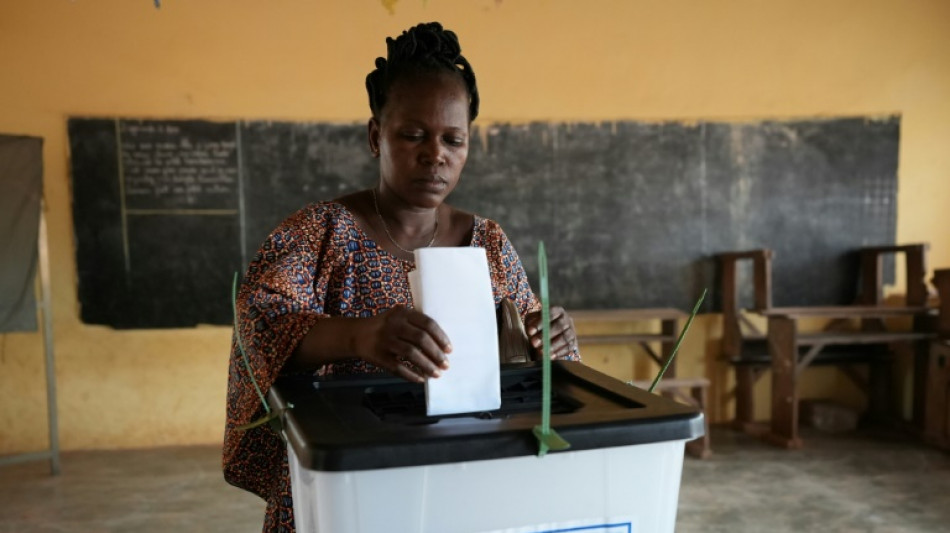
Togo votes in key parliament ballot after divisive reform / Photo: Emile KOUTON - AFP

 Oil up, Wall Street dips after Trump rejects Iran truce offer

 Gakpo withdraws from Netherlands squad

 SpaceX puts Starship megarocket in orbit for first time
 Iran denies link to suspected bomb plot at UK airbase used by US
 Ex-boss Mancini says City charges 'not my concern'
 Berlin Marathon winner Assefa finished race with torn Achilles

 Comedian convicted for Erdogan 'insult' but freed pending appeal

 French prosecutors seek two-year sentence for ex-minister Dati in graft case
 Eala makes fast start as weather and transport woes hit Asian Games
 Hurricane Polo approaches Mexico, threatens severe damage
 Energy markets rally after Trump rejects Iran truce offer
 Japanese convenience store enlists Lady Gaga to bolster recruitment
 Seoul summons Ukraine envoy in row over North Korean POWs
 Ireland 'raised awareness worldwide' in Israel game: Hallgrimsson
 Colombian police capture wife, daughter of Ecuador drug lord
 More Asian Games woes as bus takes Pakistan team to wrong venue

 Radio frequencies vital to Earth observation must be protected: UN
 Comedian on trial for insulting Erdogan in standup show
 Women's Fashion Week kicks off in Paris
 Pope arrives in French border city to speak on united Europe
 The wildfires choking Indonesia, sparking regional haze
 PU Prime Deepens Argentina Presence Through FX Expo Buenos Aires 2026

 Nothing to seal here: NZ police help stranded pup home
 White House releases list of products US, China could tax less
 'Pseudo-journalism': Partisan 'news' sites target US midterms

Togolese voted in legislative elections on Monday after a divisive constitutional reform that opponents say allows President Faure Gnassingbe to extend his family's decades-long grip on power.
The ballot comes after lawmakers this month approved the reform creating a new prime minister-style post opponents believe is tailored for Gnassingbe to avoid presidential term limits and stay in office.
In power for nearly 20 years, Gnassingbe succeeded his father Gnassingbe Eyadema, who ruled for almost four decades in the small coastal West African state wedged between Benin and Ghana.
Early turnout at polling stations in the capital had been slow, but the streets were calm and there no incidents reported.
Polls were to close at 1600 GMT and results will be released within the next six days.
Monday's vote will elect 113 lawmakers and also for the first time 179 regional deputies from the country's five districts who along with municipal councillors will elect a newly created Senate.
For Gnassingbe's ruling UNIR party this makes Togo more representative, but opposition parties have mobilised supporters to vote against what they say is an "institutional coup".
Gnassingbe, 57, has already won four elections, all contested by the opposition as flawed. He would have only been able to run one more time as president in 2025 under the previous constitution.
"We had a good electoral campaign. We denounced the flaws of the system and the Togolese are listening, they will do the job," Jean-Pierre Fabre, leader of the main opposition party, National Alliance for Change, said after voting.
The main opposition boycotted the last parliament election in 2018, citing irregularities.
With a population of nearly nine million, more than half under the age of 25, Togo's economy is mainly agrarian. But Lome has one of the busiest deep sea ports in West Africa, helping Togo weather the fallout of the Ukraine war and the pandemic.
The government has built infrastructure and expanded access to electricity, but poverty levels are still around 40 percent, according to the World Bank.
Like its Gulf of Guinea neighbours, Togo also faces a risk of spillover from jihadist conflicts to the north in the Sahel. Officials reported 30 deaths from "terrorist" incidents in the country's north last year.
- New post, new power -
Gnassingbe voted in the Maman N'Danida de Pya school in Pya, his father's hometown, about 420 kilometres (260 miles) north of Lome, according to the president's communication office.
"Rejoicing the peaceful conduct of the vote across the nation, I urge my fellow citizens to fulfill their civic duty in serenity for the consolidation of our democratic achievements," Gnassingbe said on X, formerly Twitter.
According to the new constitution adopted by lawmakers on April 19, Togo's president assumes a mostly ceremonial role elected by parliament, and not the people, for a four-year term.
Togo's shift from a presidential to a parliamentary system means power now resides with the new president of the council of ministers, a sort of super-Prime Minister, who automatically will be the leader of the majority party in the new assembly.
Gnassingbe's Union for the Republic, or UNIR party, already dominates parliament. If the ruling party wins, he can assume that new post.
Regional West African body ECOWAS said it would send a team of observers to Togo for the vote. The run-up to the election has seen a tightening of controls.
Opposition attempts to organise protests against the reforms were blocked by authorities.
Togo's Electoral Commission refused to allow the Togolese Bishops' Conference to deploy election observers across the country, according to a document seen by AFP.
Togo's High Authority for Audiovisual and Communication (HAAC) also temporarily suspended all accreditation for the foreign press to cover the elections.
Rights group Amnesty International called for the government to end its "escalating crackdown".
"In Togo, dissenting voices can no longer enjoy their rights to freedom of expression and peaceful assembly," Samira Daoud, Amnesty's director for West and Central Africa.
"It has been difficult, if not impossible, to contribute freely to the debate on the new constitution without fear of reprisals."
In Togo, all presidential elections since the start of democracy in 1990 have been challenged by the opposition, often with outbreaks of violence, especially during the April 2005 ballot when the UN estimates 400 to 500 people died.
E.Qaddoumi--SF-PST