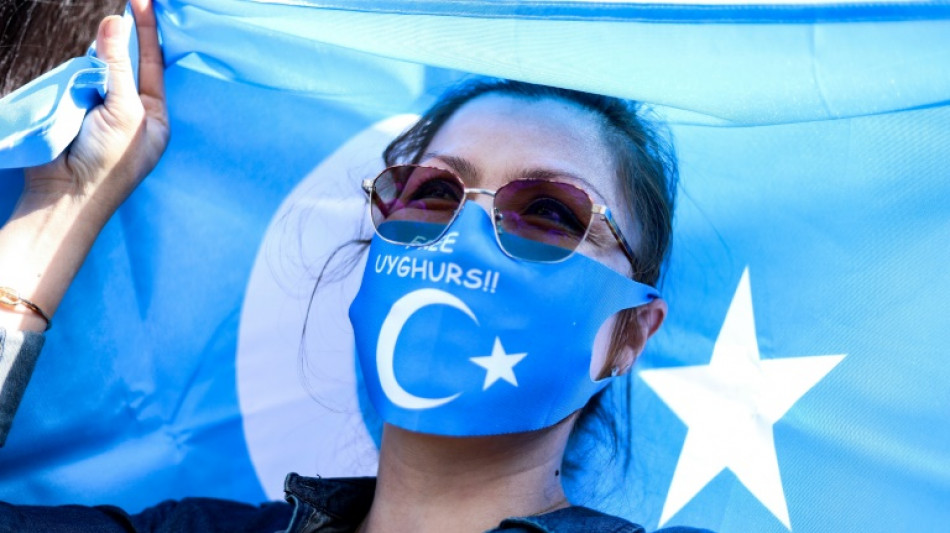
EU parliament votes forced labour ban with China in its sights / Photo: Kenzo TRIBOUILLARD - AFP

 Rose, Scott among 2027 World Golf Hall of Fame finalists

 Brunson says NBA champion Knicks can't get satisfaction
 France puts out largest wildfire since 1949
 Real Madrid's Perez summoned over Barcelona referee payments comments
 Oil takes off again, Wall Street dips after Trump rejects Iran truce offer
 AlgoQuant Asset Management Selects Liquid Mercury to Enhance Digital Asset Trading Infrastructure

 UK to reopen refugee resettlement scheme to push 'safe' migration

 Pope urges Europe to help combat 'lies and deceit' in world affairs
 Iranian lawyer Nasrin Sotoudeh wins Council of Europe's rights prize
 French far-right's Bardella denies alleged 2013 antisemitic comments
 Oil up, Wall Street dips after Trump rejects Iran truce offer

 Gakpo withdraws from Netherlands squad

 SpaceX puts Starship megarocket in orbit for first time
 Iran denies link to suspected bomb plot at UK airbase used by US
 Ex-boss Mancini says City charges 'not my concern'
 Berlin Marathon winner Assefa finished race with torn Achilles

 Comedian convicted for Erdogan 'insult' but freed pending appeal
 French prosecutors seek two-year sentence for ex-minister Dati in graft case
 Eala makes fast start as weather and transport woes hit Asian Games

 Hurricane Polo approaches Mexico, threatens severe damage
 Energy markets rally after Trump rejects Iran truce offer
 Japanese convenience store enlists Lady Gaga to bolster recruitment

 Seoul summons Ukraine envoy in row over North Korean POWs
 Ireland 'raised awareness worldwide' in Israel game: Hallgrimsson

 Colombian police capture wife, daughter of Ecuador drug lord
EU lawmakers voted on Tuesday to ban products made using forced labour which supporters hope will be used to block goods from China, at the risk of raising tensions with Beijing.
The law does not directly mention China, but many lawmakers hope it will be used to block imports from China involving the region where the Uyghur Muslim minority lives.
Human rights groups say at least one million people, mostly members of Muslim minorities, have been detained in China's northwestern Xinjiang region and face a series of abuses, including forced sterilisation of women and coerced labour.
The legislation, backed in a vote by 555 EU lawmakers, with six against and 45 abstaining, will become law following final approval by the EU's 27 member states.
The EU has deployed an array of trade tools against China, including anti-subsidy investigations into Chinese state support for green tech such as solar panels.
The latest law seeks to eradicate forced labour from European markets.
Under the rules, EU states can remove products found to have been made using forced labour as well as goods made in the bloc comprising material made abroad using forced labour.
"This regulation is groundbreaking and it's unique. It's inclusive, broad, and together with several other regulations and directives... (it's) a real game changer," Dutch lawmaker Samira Rafaela, who pushed the text through parliament, said.
"Companies, industries, whole sectors and their respective contractors will need to make a serious effort to ensure their conduct is sustainable and ethical, respecting human rights throughout their entire supply chain," she told reporters after the vote.
Some 27.6 million people were engaged in forced labour in 2021, including around 3.3 million children, according to the International Labour Organization.
- Power to seize goods -
The new rules give the European Commission the power to launch investigations when there are suspicions about the supply chains in countries outside the EU.
If the use of forced labour is proved, officials will seize the products at the borders and order their withdrawal from the European market and online retailers.
If the risk is in one member state, the local authority in that country will investigate the products allegedly made using forced labour.
For some goods deemed to be at risk, importers will be forced to provide detailed information on the manufacturers.
The EU will also create a regularly updated database about forced labour risks that will include international reports to aid the commission and national bodies in assessing possible violations of the law.
Critics have pointed out that the law does not go as far as one adopted by Washington.
The United States in 2021 banned the importation of products from Xinjiang unless businesses could prove their production did not involve forced labour.
Maria Manuel Leitao Marques, another EU lawmaker who spearheaded the law through parliament, pointed to the concerns about products in Europe made by Uyghurs.
"It could be that what you are using today or consuming today, such as cotton might not come from Turkmenistan, but from China, where the Uyghurs are being forced to work, where they're the victims of forced labour," she said during a debate on Monday.
E.Qaddoumi--SF-PST