Crises slowing economic growth worldwide: IMF chief / Photo: Daniel LEAL - AFP/File

 Middle East fuel crunch drives solar push in tiny Fiji
 Indian rappers use music to sound climate alarm

 Japan probe on its way to Mars moon
 Lula or Bolsonaro's son? Brazil makes a final choice

 EU unveils strategy to boost Arctic presence

 How recent controversies have rocked the US death penalty debate
 Adams facing long injury layoff as Rams' problems deepen
 US judge orders Saudi engineer held in OpenAI case
 Maddison sparkles as Spurs end Premier League winless run

 Maddison sparkles on Spurs return as win drought ends

 Trump says ready to meet with Putin and Xi in China
 The young lawmaker making Brazil's Lula 'king of the selfie'
 Christiane Amanpour to leave CNN after 43 years

 Ronaldo handed 30-day suspension after walking out on Portugal

 Netanyahu basks in Trump endorsement week before election

 Saudi airport closure disrupts life in kingdom's capital

 Ramaphosa tells South Africa to prepare for loss of US-Africa trade deal
 France presses resale platforms to remove 'stolen' goods after unrest
 Yamal v PSG: Ballon d'Or backdrop to Champions League showdown

 Araujo says too soon to talk about permanent Liverpool move

 US wants to be 'strong partner' for central Asia: Rubio

 'Special' to face friend Perez in Champions League, says Liverpool's Iraola

 Monitor says Indonesia fires have burned nearly two million hectares
 French PM says could declare state of emergency over unrest 'if needed'
 Albanian PM warns of 'red line' after days of unrest
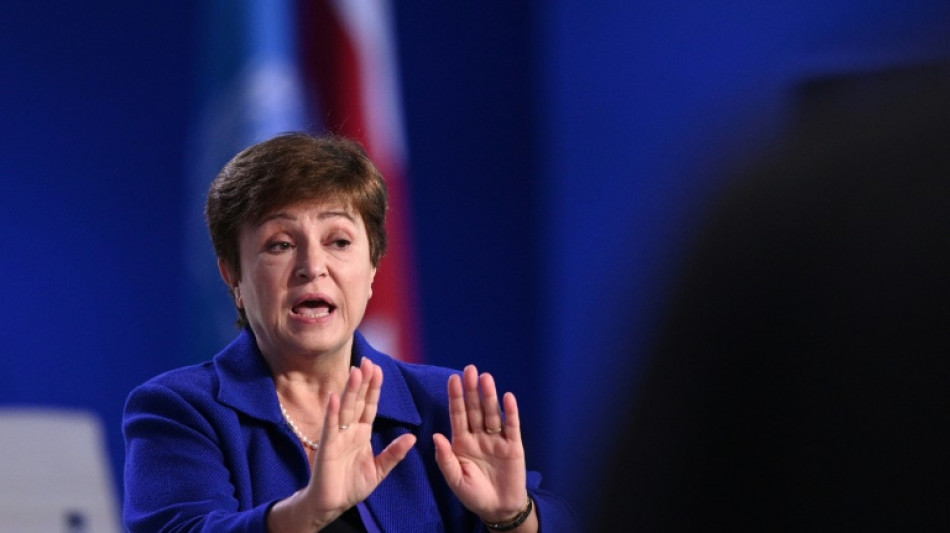
The war in Ukraine has undercut the global recovery, slowing expected economic growth in most countries in the world, IMF Managing Director Kristalina Georgieva said Thursday.
And beyond the humanitarian tragedy and economic crises, the war has exposed fractures in the international system at a time when global cooperation is the only solution, she said.
The war hit as the world was struggling to recover from the ongoing impact of the Covid-19 pandemic, and has caused an acceleration of inflation that endangers the gains of the past two years.
"To put it simply: we are facing a crisis on top of a crisis," Georgieva said in a speech ahead of the spring meetings of the IMF and World Bank.
"The economic consequences from the war spread fast and far, to neighbors and beyond, hitting hardest the world's most vulnerable people," she said.
Families already were struggling with higher energy and food prices and "the war has made this much worse."
The IMF is due to release its updated economic forecasts on Tuesday, which Georgieva said will further downgrade the estimate for global growth that was cut to 4.4 percent in January.
"Since then, the outlook has deteriorated substantially, largely because of the war and its repercussions," she said, and 143 countries will suffer downgrades.
While most will still achieve positive growth, the future is "extraordinarily uncertain," and she warned of a deep divide between rich and poor countries.
- 'Clear and present danger' -
After a decade of low inflation, prices worldwide have surged amid strong demand for goods that outstripped supply as economies began to return to normal, but the Russian invasion of Ukraine in late February and the sanctions imposed on Moscow pushed fuel and food prices up sharply.
Ukraine and Russia are major grain producers, and Russia also is a key source of energy for Europe.
"The root cause of what we face today is the war and it is the war that must end," Georgieva said in a discussion following her speech to the Carnegie Endowment for International Peace.
Inflation, which has hit a four-decade high the United States, "has become a clear and present danger," she said, noting the trend will likely last longer than expected.
"This is a massive setback for the global recovery," she said.
It also complicates policymaking: major central banks are raising interest rates to contain prices, but that increases borrowing costs for emerging markets and developing nations, which face high debt burdens.
"This is the most universally complex policy environment of our lifetime," she said.
- 'Fragmentation' -
Ending the war and the pandemic are top priorities, but can only be addressed through international cooperation, said Georgieva, who warned of the growing "fragmentation of the world economy into geopolitical blocs."
The IMF leader, who grew up in Cold War-era Bulgaria, lamented, "I have never thought that I would live to see another war in Europe of the magnitude of the tragedy that is happening in Ukraine."
She noted that the end of the Cold War ushered in "a new era of rapidly increasing prosperity... because of an integrated global economy."
Fractures in that system impair the ability to address the current crises and future challenges, but also could cause a "tectonic shift" that would reshape global supply chains.
"The threat to our collective prosperity from a breakdown in global cooperation cannot be overstated," she said.
J.AbuShaban--SF-PST