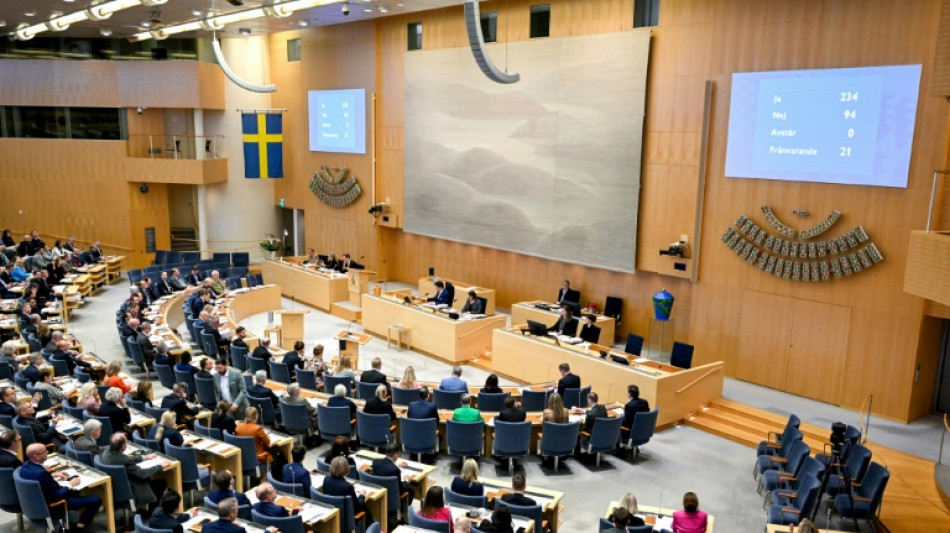
Sweden passes disputed gender reassignment law / Photo: Jessica Gow/TT - TT NEWS AGENCY/AFP

 Kuwait and Egypt Sign Eight Agreements to Expand Strategic Partnership

 تقارير إسرائيلية تكشف عن محاولات نتنياهو وزملائه للتأثير على نتائج الانتخابات عبر استهداف الفلسطينيين

 بنك القدس يتعهد بتأمين احتياجات مرضى السكري خلال أمسية توعوية في رام الله

 AI Job Losses at NAB, Qantas, Canva and Atlassian Signal Market Shift, Not Workforce Collapse
 Owner Review: 2023 Volvo XC60 Recharge Exceeds Expectations for Calgary Driver

 Indiana River Otters Make Comeback After Decades of Conservation Efforts

 Tamil Film 'Arivu' Selected for 57th International Film Festival of India

 أسعار الديزل في الولايات المتحدة تنخفض دون 6 دولارات لأول مرة منذ شهرين

 Why Wind Farms Paint One Turbine Blade Black to Protect Birds
Sweden's parliament on Wednesday passed a controversial law lowering the minimum age to legally change gender from 18 to 16 and making it easier to get access to surgical interventions.
The law passed with 234 votes in favour and 94 against in Sweden's 349-seat parliament.
While the Nordic country was the first to introduce legal gender reassignment in 1972, the proposal, aimed at allowing so-called "self-identification" and simplifying the procedure, sparked an intense debate in the country.
The debate has also weakened conservative Prime Minister Ulf Kristersson's standing, after he admitted to caving into pressure from party members on the issue.
"The great majority of Swedes will never notice that the law has changed, but for a number of transgender people the new law makes a large and important difference," Johan Hultberg, an MP representing the ruling conservative Moderate Party, told parliament.
Beyond lowering the age, the new legislation is aimed at making it simpler for a person to change their legal gender.
"The process today is very long, it can take up to seven years to change your legal gender in Sweden," Peter Sidlund Ponkala, president of the Swedish Federation for Lesbian, Gay, Bisexual, Transgender, Queer and Intersex Rights (RFSL), told AFP.
Two new laws will go into force on July 1, 2025: one regulating surgical procedures to change gender, and one regulating the administrative procedure to change legal gender in the official register.
- No diagnosis needed -
People will be able to change their legal gender as of age 16, though those under 18 will need the approval of their parents, a doctor, and the National Board of Health and Welfare.
A diagnosis of "gender dysphoria" -- where a person may experience distress as a result of a mismatch between their biological sex and the gender they identify as -- will no longer be required.
Surgical procedures to transition would, like now, be allowed from the age of 18, but would no longer require the Board of Health and Welfare's approval.
The removal of ovaries or testes will however only be allowed from the age of 23, unchanged from today.
A number of European countries have already passed laws making it easier for people to change their legal gender.
Citing a need for caution, Swedish authorities decided in 2022 to halt hormone therapy for minors except in very rare cases, and ruled that mastectomies for teenage girls wanting to transition should be limited to a research setting.
Sweden has seen a sharp rise in gender dysphoria cases.
The trend is particularly visible among 13- to 17-year-olds born female, with an increase of 1,500 percent since 2008, according to the Board of Health and Welfare.
While tolerance for gender transitions has long been high in the progressive and liberal country, political parties across the board have been torn by internal divisions over the new proposal, and academics, health care professionals and commentators have come down on both sides of the issue.
- 'Deplorable' -
A poll published this week suggested almost 60 percent of Swedes oppose the proposal, while only 22 percent back it.
Far-right Sweden Democrats leader Jimmie Akesson lamented the result of Wednesday's vote.
"I think it's deplorable that a proposal that obviously lacks support among the population is so casually voted through," Akesson told reporters.
Some critics had expressed concerns about biological males in women's locker rooms and prisons, and fear the simplified procedure to change legal gender will encourage confused youths to embark down the path toward surgical transitions.
Others had insisted that more study was needed given the lack of explanation for the sharp rise in gender dysphoria.
In a sign of the strong feelings it stirred, members of parliament spent six hours debating the proposal.
"There is a clear correlation with different types of psychiatric conditions or diagnoses, such as autism," Annika Strandhall, head of the women's wing of the Social Democrats (S-kvinnor), told Swedish news agency TT ahead of the vote.
"We want to pause this (age change) and wait until there is further research that can explain this increase" in gender dysphoria cases.
Kristersson, the prime minister, had defended the proposal as "balanced and responsible".
V.AbuAwwad--SF-PST