Media under watch on EU's frozen eastern frontier

 Japan deploys bear cameras in moutains as attacks surge

 Germany's Infineon opens major chip plant as EU seeks tech autonomy
 Biggest ever Russian barrage on Kyiv kills at least 13
 EU top court upholds record 4.1 bn euro Google fine
 Italy name two debutants to face Japan in Nations Championship opener
 Wallabies' Schmidt rules out another coaching job
 India asks Meta to hold WhatsApp username rollout over fraud fears
 Deadly Russian barrage on Kyiv kills at least 13
 Next indirect US-Iran talks after Khamenei funeral: mediators
 Reviving Montenegro's 'ancient' olive tree
 Resource rich PNG leaving its Pacific people behind: World Bank
 Papal envoy presides over first Vietnam beatification rite
 LeBron James praises Balogun after 'Silencer' celebration
 Farrell names Leinster-heavy side to face Wallabies
 Most Asia markets down as tech firms take fresh blow
 South Korean school baseball team suspended over 'Tank Day' chants
 Ceuzany, Cape Verde's golden voice with volcanic emotion
 Balogun scores and sees red as US beat Bosnia 2-0
 EU top court to rule on record 4.1 bn euro Google fine
 'Job forever': trade schools are all the rage in the AI era
 Celtics reportedly trading Brown to Sixers in NBA blockbuster
 Kane saves England after DR Congo scare; Belgium comeback stuns Senegal
 Celtics to trade Jaylen Brown to 76ers for Paul George: report
 Streamex is making digital gold accessible
 Mixed US auto sales in Q2 amid high gas prices
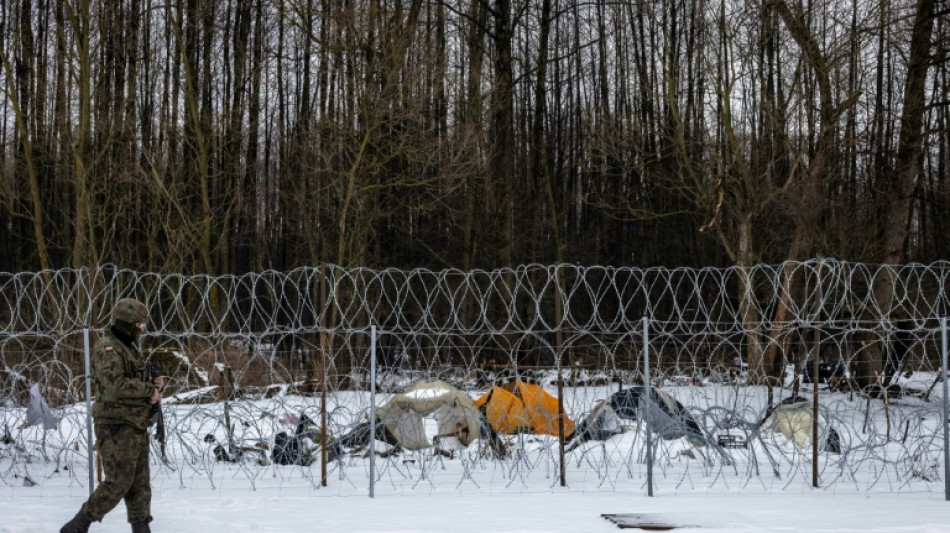
Squeezed into the back of a military jeep driving along frozen unpaved roads on the Poland-Belarus border, a group of journalists is being taken into a restricted zone under strict surveillance.
Soldiers with assault rifles slung over their shoulders can be seen spaced out along the EU's eastern border, patrolling lines of razor wire that stretch out as far as the eye can see.
A makeshift shelter partially covered in tarpaulin and wooden planks of wood offers some respite for the soldiers, who were deployed to the area following a sharp rise in migrant arrivals.
Nearby, a car mounted with speakers blares out a message in several languages urging migrants to stay on or return to the Belarusian side.
"Migrants are still trying to cross the border in groups of 10 or 20. Last year, it was groups of hundreds of people," said Krystyna Jakimik-Jarosz, a spokeswoman for the border guards.
The West accused the Belarusian regime of orchestrating a migrant crisis last year as a form of retaliation against EU sanctions.
Belarus has denied this and urged the EU to take the migrants in, although it has since repatriated several thousand back to the Middle East.
Confronted with a sharp increase in arrivals, Poland in September banned media and aid groups from the immediate border area citing security reasons, and put up razor wire and deployed soldiers.
Aid groups have since accused both Poland and Belarus of violating migrants' rights and media rights groups have criticised the restrictions.
The Polish Supreme Court has also declared the ban on the media "incompatible" with the law.
- 'Protect' from journalists -
Facing criticism, Poland's populist government in December began organising trips for journalists to the restricted area but only under strict controls.
"We want to show what the situation on the border looks like," Jakimik-Jarosz said, who shadowed the media group along with two border guards who hid their faces so as not to reveal their identity.
Around 100 journalists have so far been allowed in.
"At the beginning it was above all Polish media who could visit the zone. Foreign journalists had to be specially verified," the spokeswoman said.
Coverage of the start of construction this week of a border wall being built by Poland along 186 kilometres (115 miles) of frontier was also heavily restricted.
"This is about your security and ours. If something were to happen, we would be responsible," Jakimik-Jarosz said.
"But it is also to protect ourselves to ensure that we can do our job of protecting the border."
She said soldiers and border guards last year found themselves "having to protect themselves sometimes from journalists who pointed cameras in their faces and asked them to identify themselves".
Of the media ban, she added: "I understand that this is not always satisfactory for everyone".
V.Said--SF-PST