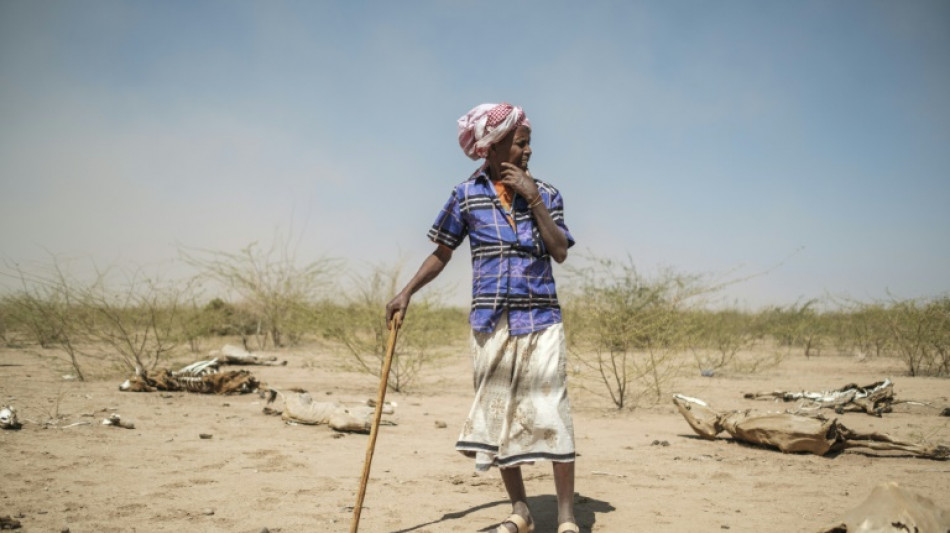
UN says $1 billion aid urgently needed for crisis-hit Ethiopia / Photo: EDUARDO SOTERAS - AFP/File

 Kuwait and Egypt Sign Eight Agreements to Expand Strategic Partnership

 تقارير إسرائيلية تكشف عن محاولات نتنياهو وزملائه للتأثير على نتائج الانتخابات عبر استهداف الفلسطينيين

 بنك القدس يتعهد بتأمين احتياجات مرضى السكري خلال أمسية توعوية في رام الله

 AI Job Losses at NAB, Qantas, Canva and Atlassian Signal Market Shift, Not Workforce Collapse

 Owner Review: 2023 Volvo XC60 Recharge Exceeds Expectations for Calgary Driver
 Indiana River Otters Make Comeback After Decades of Conservation Efforts

 Tamil Film 'Arivu' Selected for 57th International Film Festival of India

 أسعار الديزل في الولايات المتحدة تنخفض دون 6 دولارات لأول مرة منذ شهرين

 Why Wind Farms Paint One Turbine Blade Black to Protect Birds
The UN appealed Tuesday for pledges to address the "critical" humanitarian situation in Ethiopia, where more than 21 million people need aid, and a dire food crisis is deepening.
A donor conference at the United Nations' European headquarters Tuesday afternoon aims to raise significant pledges towards the $1 billion urgently needed to cover aid for just the next three months.
"We need to mobilise," Ramiz Alakbarov, the UN humanitarian coordinator in Ethiopia, told AFP ahead of the conference.
"The people of Ethiopia need our solidarity and our support."
Ethiopians are facing rumbling internal conflicts amid economic and climate shocks and an increasingly dire food and malnutrition crisis.
The UN has said a whopping $3.24 billion is needed this year alone, including to assist some four million internally displaced people.
But so far that plan is less than five percent funded.
"The gap remains very wide... We have really to act before it is too late," Shiferaw Teklemariam, commissioner of the Ethiopian Disaster Risk Management Commission, told reporters in Geneva.
The Ethiopian government had committed $250 million for food support over coming months, the commissioner added.
The UN said an initial $1 billion was needed for the urgent aid response through the end of June.
It is also needed to prepare for the lean season, from July to September, when around 11 million people are projected to be critically food insecure.
"The humanitarian situation in Ethiopia is critical -- but there is a window to act right now to break the downward spiral," UN humanitarian agency OCHA said.
The event, co-hosted by the governments of Ethiopia and Britain, comes a day after a similar pledging conference for Sudan, held in Paris, raised $2.1 billion.
UK deputy foreign minister Andrew Mitchell said the situation was "extremely worrying".
He spoke of "increasingly worrying famine conditions", but stressed "the international community working very closely with the government of Ethiopia was in a position to head it off".
- 'Not enough aid to distribute' -
Britain, he said, would pitch in £100 million ($125 million) in additional funding, bringing its total for the year to £198 million, "our biggest programme anywhere in the world".
A strong emphasis has been placed on ensuring that all aid donated reaches its intended destination.
Last year, USAID and the UN's World Food Programme temporarily halted all food aid to Ethiopia, alleging a "widespread and coordinated" campaign to divert donated supplies -- something Ethiopia's government denied.
Ramiz stressed that distribution had since resumed, following stringent reforms and the introduction of "one of the most detailed, and the most verified processes I have ever observed in my life".
He voiced confidence the system was working and all aid would reach its intended destination. "The problem is that we don't have enough to distribute."
F.AbuZaid--SF-PST