'Go home': Overtourism sparks backlash in Spain / Photo: DESIREE MARTIN - AFP

 Dodgers eye three-peat, Red Sox face Yankees as MLB playoffs begin
 Certification of Boeing 737 MAX delayed by software bug

 Celine Dion wows Paris Fashion Week with surprise gig

 AMD buys firm founded by AI 'godmother' Fei-Fei Li

 Italy rebound in Turkey as France win late in Belgium

 Pope says concerns about AI 'should be taken seriously'

 Hurricanes to hoist title banner as NHL season begins

 Justice Alito steps aside from major US climate case

 Willis happy with England exile after retains Top 14 player award

 Spain housing protests keep heat on government as PM seeks new law

 Wissa spoils Zimbabwe homecoming as DR Congo win AFCON qualifier

 UK police release on bail five men held over airbase incident

 Ex-All Black Plummer 'sure' New Zealand will find Super Rugby solution

 Shein sees 1% revenue growth in first half of 2026

 Netherlands regrets Israel retaliation in settlements row

 Moscow seizes Russian assets of German food retailer Metro

 Bulgarian spirits inflamed by new rakia rules

 Documentary turns camera on architect Peter Zumthor

 UK police say releasing on bail five men held over airbase incident
 Trump admin finalizes reversal of US fuel economy standards

 US says no China arms sale plans after envoy cites Trump offer

 Dozens kidnapped in two weekend attacks in northern Nigeria

 Next stop the world: Pathirage wins Asian Games javelin gold

 Aster Launches Perpetual Grid Trading 2.0 with Up to 140,000 $ASTER Liquidity Mining Campaign

 Seoul says North Korean mines 'highly suspected' as cause of DMZ blast

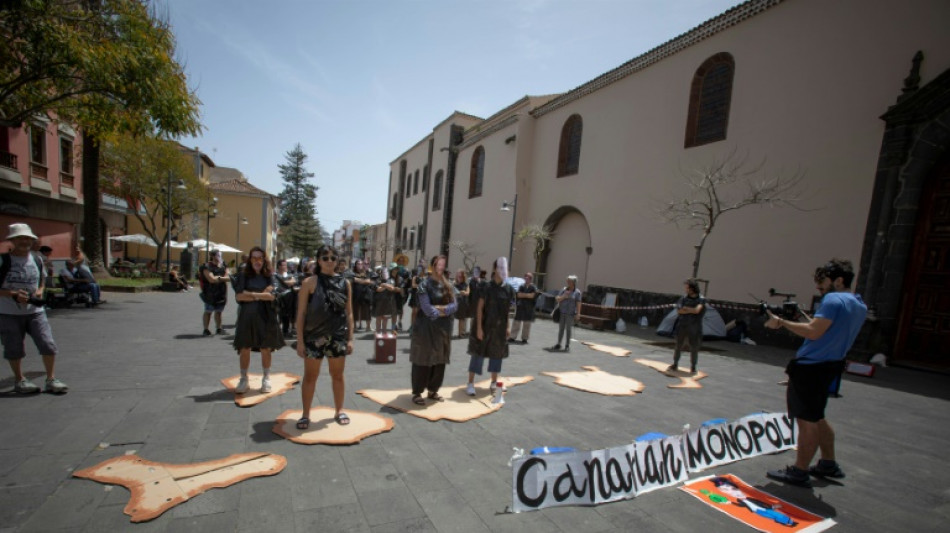
Anti-tourism movements are multiplying in Spain, the world's second most visited country, prompting authorities to try and reconcile the interests of locals and the lucrative sector.
Rallying under the slogan "The Canaries have a limit", a collective of groups on the archipelago off northwest Africa are planning a slew of protests on Saturday.
The Canaries are known for volcanic landscapes and year-round sunshine and attracts millions of visitors from all over the world.
Groups there want authorities to halt work on two new hotels on Tenerife, the largest and most developed of the archipelago's seven islands.
They are also demanding that locals be given a greater say in the face of what they consider uncontrolled development which is harming the environment.
Several members of the collective "Canaries Sold Out" also began an "indefinite" hunger strike last week to put pressure of the authorities.
"Our islands are a treasure that must be defended," the collective said.
The Canaries received 16 million visitors last year, more than seven times its population of around 2.2 million people.
This is an unsustainable level given the archipelago's limited resources, Victor Martin, a spokesman for the collective told a recent press briefing, calling it a "suicidal growth model".
- 'Go home' -
Similar anti-tourism movements have sprung up elsewhere in Spain and are active on social media.
In the southern port of Malaga on the Costa del Sol, a centre of Spain's decades-old "soy y playa" or "sun and beach" tourism model, stickers with unfriendly slogans such as "This used to be my home" and "Go home" have appeared on the walls fn doors of tourist accommodations.
In Barcelona and the Balearic Islands, activists have put up fake signs at the entrances to some popular beaches warning in English of the risk of "falling rocks" or "dangerous jellyfish".
Locals complain a rise in listings of accommodation on short-term rental platforms such as Airbnb have worsened a housing shortage and caused rents to soar, especially in town centres.
The influx of tourists also adds to noise and environmental pollution and taxes resources such as water, they add.
In the northeastern region of Catalonia, which declared a drought emergency in February, anger is growing over the pressure exerted on depleted water reserves by hotels on the Costa Brava.
"There are tourist destinations that are at the limits of their capacity," said Jose Luis Zoreda, the vice president of tourism association Exceltur .
"It's a problem that appears occasionally in the high season and in certain parts of the country, but it's getting worse".
- Loudspeaker ban -
Before the Covid-19 pandemic brought the global travel industry to its knees in 2020, protest movements against overtourism had already emerged in Spain, especially in Barcelona.
Now that pandemic travel restrictions have been lifted, tourism is back with a vengeance -- Spain welcomed a record 85.1 million foreign visitors last year.
In response, several cities have taken measures to try to limit overcrowding.
The northern seaside city of San Sebastian last month limited the size of tourist groups in the centre to 25 people and banned the use of loudspeakers during guided tours.
The southern city of Seville is mulling charging non-residents a fee to enter its landmark Plaza de Espana while Barcelona had removed a bus route popular with tourists from Google Maps to try to make more room for locals.
Housing Minister Isabel Rodriguez said over the weekend that "action needs to be taken to limit the number of tourist flats" but stressed the government is "aware of the importance of the tourist sector", which accounts for 12.8 percent of Spain's Gross Domestic Product.
O.Farraj--SF-PST