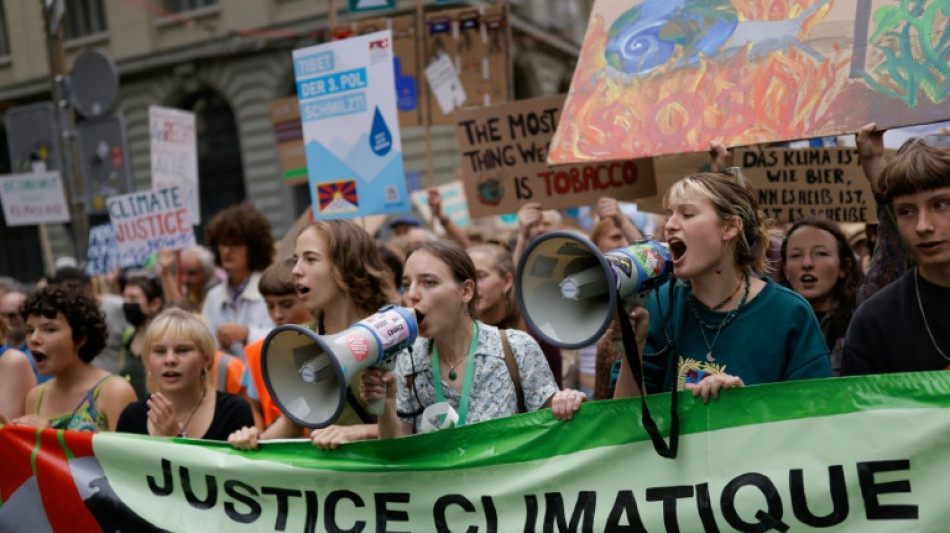
Swiss climate policy in spotlight after court ruling / Photo: Valentin Flauraud - AFP

 Flooding, power cuts and evacuations as Hurricane Polo slams Mexico

 Dodgers eye three-peat, Red Sox face Yankees as MLB playoffs begin
 Certification of Boeing 737 MAX delayed by software bug

 Celine Dion wows Paris Fashion Week with surprise gig

 AMD buys firm founded by AI 'godmother' Fei-Fei Li

 Italy rebound in Turkey as France win late in Belgium

 Pope says concerns about AI 'should be taken seriously'

 Hurricanes to hoist title banner as NHL season begins

 Justice Alito steps aside from major US climate case

 Willis happy with England exile after retains Top 14 player award

 Spain housing protests keep heat on government as PM seeks new law

 Wissa spoils Zimbabwe homecoming as DR Congo win AFCON qualifier

 UK police release on bail five men held over airbase incident

 Ex-All Black Plummer 'sure' New Zealand will find Super Rugby solution

 Shein sees 1% revenue growth in first half of 2026
 Netherlands regrets Israel retaliation in settlements row

 Moscow seizes Russian assets of German food retailer Metro

 Bulgarian spirits inflamed by new rakia rules

 Documentary turns camera on architect Peter Zumthor

 UK police say releasing on bail five men held over airbase incident
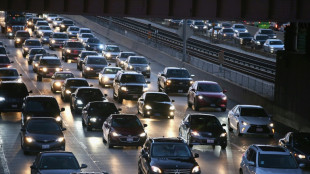 Trump admin finalizes reversal of US fuel economy standards

 US says no China arms sale plans after envoy cites Trump offer

 Dozens kidnapped in two weekend attacks in northern Nigeria

 Next stop the world: Pathirage wins Asian Games javelin gold

 Aster Launches Perpetual Grid Trading 2.0 with Up to 140,000 $ASTER Liquidity Mining Campaign

Switzerland, known for pristine countryside and snow-capped peaks, is facing scrutiny of its environmental policies after becoming the first country faulted by an international court for failing to do enough against climate change.
The European Court of Human Rights's ruling last week highlighted a number of failings in Swiss policies, but experts stressed that the wealthy Alpine country was not necessarily doing much worse than its peers.
"The judgement made it really clear that there are critical gaps in the Swiss domestic regulatory framework," said Tiffanie Chan, a policy analyst at the London School of Economics and Political Science specialising in climate change laws.
"But it's definitely not a Switzerland-only case," she told AFP.
Corina Heri, a postdoctoral researcher with the Climate Rights and Remedies Project at Zurich University, agreed.
"This doesn't mean in any way that ... only Switzerland has a problem," she told AFP.
The court last Tuesday ruled in favour of the Swiss association Elders for Climate Protection -- 2,500 women above the age of 64 -- who had complained Swiss authorities' "failings" on climate protection could "seriously harm" their health.
Elderly women are particularly vulnerable to the effects of heatwaves, which due to climate change are becoming more frequent and intensifying, they argued.
The court agreed, ruling that the Swiss state's climate policy failures violated Article 8 of the European rights convention, which guarantees the "right to respect for private and family life".
- 'Insufficient' -
The 2015 Paris Agreement set ambitious targets for governments to reduce greenhouse gas emissions, with the aim of preferably limiting warming to below global temperature rises to 1.5 degrees Celsius above pre-industrial levels.
To help meet that goal, Switzerland has said it will cut emissions by 50 percent by 2030, compared to 1990-levels, and reach net zero by 2050.
That target is "average" on a global scale, according to independent monitor Climate Action Tracker (CAT) -- which nonetheless deems Switzerland's climate targets, policies and finance as "insufficient" to help reach the Paris goals.
"Switzerland's climate policies and action until 2030 need substantial improvements to be consistent with limiting warming to 1.5C," it says.
To reach its 2030 target, Switzerland would need to slash emissions by at least 35 percent by next year, according to Geraldine Pflieger, head of Geneva University's science and environment institute.
But for now, Switzerland has cut emissions by less than 20 percent, which was the target it had set, and missed, for 2020.
"Switzerland is not on a favourable trajectory," Pflieger told AFP.
By comparison, the European Union as a whole has cut emissions by 31 percent, while experts believe it is on track to reach over 60 percent by 2030, Pflieger pointed out.
- 'Highly problematic' -
But Chan stressed that many individual countries within the EU have also missed their 2020 targets.
"There are many challenges across Europe, which are similar to this case."
The comparison however looks worse for Switzerland when considering its heavy reliance on carbon offset projects abroad towards its promised cuts, experts say.
It does not quantify how much it plans to rely on such offsets to reach its targets, something CAT described as "highly problematic".
"The extent to which Switzerland relies on those is just huge," Charlotte Blattner, a senior lecturer and climate law expert at the University of Bern, told AFP.
Such projects, she lamented, typically "lack traceability, they are not really verifiable".
In addition, relying on them means "Switzerland misses a chance to basically transform its own infrastructure in a way that would align with climate policies".
- Direct democracy dilemma -
A major issue separating Switzerland from its peers is its direct democracy system, which allows popular votes on a vast array of issues, sometimes slowing down or derailing policies approved by government and parliament.
In 2021, voters rejected a new CO2 law, delaying implementation.
Finally last year, voters backed a new climate bill aimed at steering the country towards carbon neutrality by 2050.
"Direct democracy has not been a good friend for putting in place Swiss climate policies," Pflieger said.
Blattner however stressed that Switzerland's government can act fast in some cases.
She pointed to how it took emergency measures last year over the course of a weekend to rescue the country's second largest bank Credit Suisse from going belly-up.
"Here, no democratic vote of the people was necessary," she said.
"I think government should think more... of instituting effective climate change (action) rather than hiding behind excuses."
I.Yassin--SF-PST