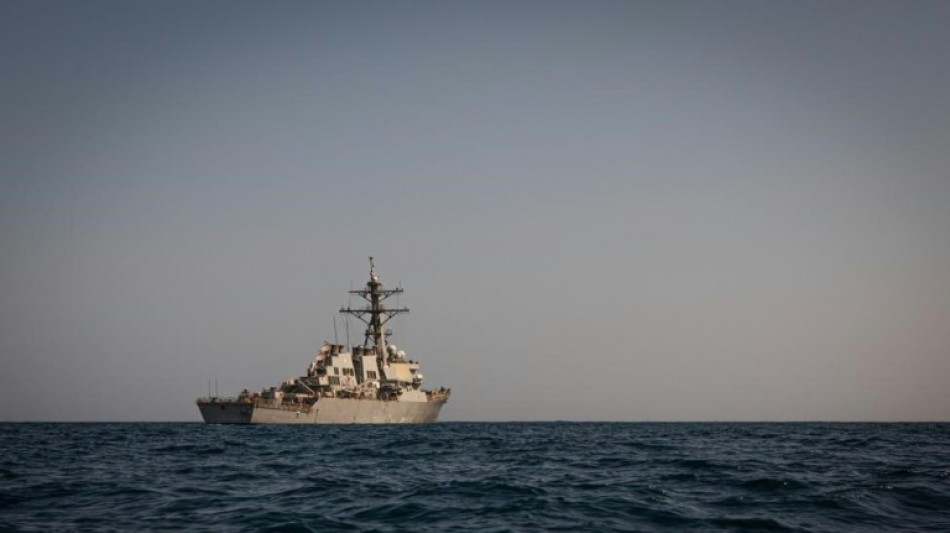
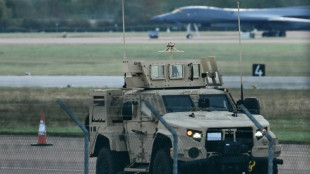
How the US helped counter Iran's attack on Israel / Photo: Aaron Lau - US Department of Defense/AFP/File

 Flooding, power cuts and evacuations as Hurricane Polo slams Mexico

 Dodgers eye three-peat, Red Sox face Yankees as MLB playoffs begin

 Certification of Boeing 737 MAX delayed by software bug

 Celine Dion wows Paris Fashion Week with surprise gig

 AMD buys firm founded by AI 'godmother' Fei-Fei Li
 Italy rebound in Turkey as France win late in Belgium

 Pope says concerns about AI 'should be taken seriously'
 Hurricanes to hoist title banner as NHL season begins
 Justice Alito steps aside from major US climate case

 Willis happy with England exile after retains Top 14 player award

 Spain housing protests keep heat on government as PM seeks new law

 Wissa spoils Zimbabwe homecoming as DR Congo win AFCON qualifier

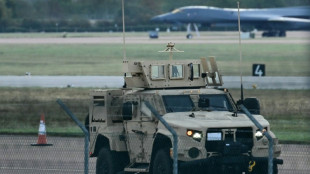 UK police release on bail five men held over airbase incident

 Ex-All Black Plummer 'sure' New Zealand will find Super Rugby solution

 Shein sees 1% revenue growth in first half of 2026
 Netherlands regrets Israel retaliation in settlements row

 Moscow seizes Russian assets of German food retailer Metro
 Bulgarian spirits inflamed by new rakia rules

 Documentary turns camera on architect Peter Zumthor

 UK police say releasing on bail five men held over airbase incident

 Trump admin finalizes reversal of US fuel economy standards

 US says no China arms sale plans after envoy cites Trump offer

 Dozens kidnapped in two weekend attacks in northern Nigeria
 Next stop the world: Pathirage wins Asian Games javelin gold

 Aster Launches Perpetual Grid Trading 2.0 with Up to 140,000 $ASTER Liquidity Mining Campaign
Iran's unprecedented attack on Israel with hundreds of drones and missiles marked the culmination of a tense two weeks in which Washington engaged in whirlwind efforts to prepare for the expected violence.
American aircraft and planes downed dozens of drones and missiles when Iran launched the attack on Saturday, after Tehran repeatedly threatened to hit back in response to an Israeli strike on its consulate in Damascus that killed two top officers at the beginning of the month.
Senior US officials detailed the role Washington played -- both militarily and diplomatically -- in countering the attack:
- Iranian attack -
Iran launched a barrage of more than 100 medium-range ballistic missiles, more than 30 land-attack cruise missiles and more than 150 attack drones at Israel, a senior US military official said.
Two American warships -- the USS Arleigh Burke and the USS Carney -- destroyed between four and six ballistic missiles, while US aircraft shot down more than 70 Iranian drones, the military official said.
A Patriot missile battery also shot down a ballistic missile that was headed toward Israel in the area of the northern Iraq city of Arbil.
President Joe Biden spent Saturday evening receiving real-time updates in the Situation Room at the White House as the attack unfolded.
"At one point, we knew there were over 100 ballistic missiles in the sky" and "the results of the defenses of course were unclear until all was said and done," a senior administration official said, describing the tense atmosphere.
- The catalyst -
Israel carried out a strike on Iran's consulate in Damascus on April 1, killing seven Revolutionary Guards including two generals and prompting warnings from Tehran that it would respond.
Top US officials were pulled aside and informed of details about the strike during a visit by the Israeli ambassador and defense attache at the White House, the senior administration official said.
"We were not a part of that strike" but "we knew that that would have repercussions," the official said.
A few days later, Biden instructed the government "to defend Israel to the maximum extent possible" and to ensure that all necessary authorities and assets were in place to do so -- a directive that sent officials into action.
- US preparations -
Ahead of the attack, US officials including Secretary of Defense Lloyd Austin and Secretary of State Antony Blinken were in "constant, ongoing, continuous contact" with the Israelis, as well as with other countries in the Middle East.
General Erik Kurilla, the head of the US military command responsible for the region, was dispatched to the region and provided real-time updates as well as coordinating with the Israelis and other partners.
The United States was in touch with Iran as well, sending "a series of direct communications through the Swiss channel," the senior administration official said.
Washington also deployed additional military assets to the region "to bolster regional deterrence efforts and increase force protection for US forces," a US defense official said last week.
- What comes next? -
The US goal since the start of the latest round of conflict between Israel and Hamas six months ago has been to prevent it from spiraling into a broader regional conflict, and Washington is keen to lower the temperature in the region.
"We would not be a part of any response they do," the senior administration official said of possible Israeli action after the attack. "We would not envision ourselves participating in such an act."
Israel has meanwhile "made clear to us they're not looking for a significant escalation with Iran," but "a big question is not only whether, but what Israel might choose to do," the official said.
P.Tamimi--SF-PST