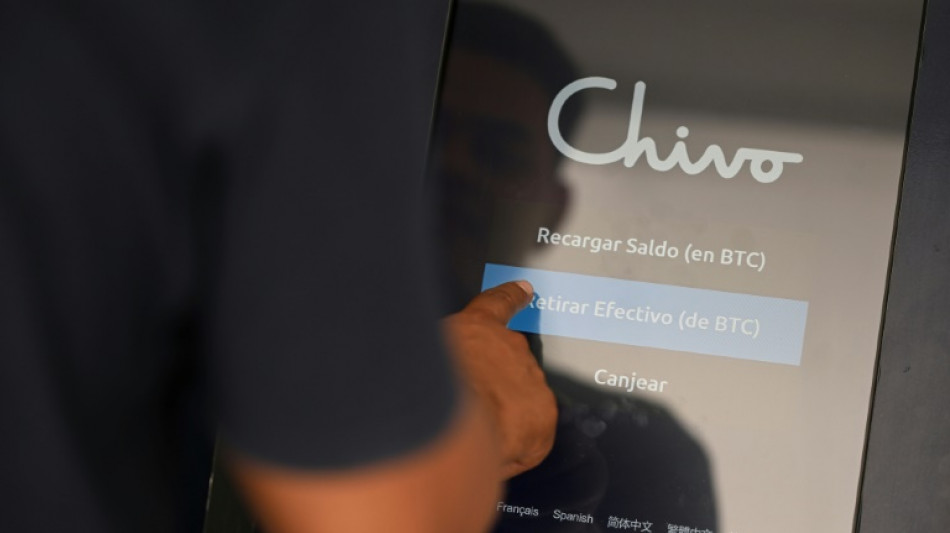
Record remittances provide lifeline in Central America / Photo: Marvin RECINOS - AFP

 OpenAI cancels release of newest model due to safety concerns

 AI bosses head to White House as safety pressure builds

 Batista sacked as Costa Rica coach after six months
 Flooding, power cuts and evacuations as Hurricane Polo slams Mexico

 Dodgers eye three-peat, Red Sox face Yankees as MLB playoffs begin
 Certification of Boeing 737 MAX delayed by software bug

 Celine Dion wows Paris Fashion Week with surprise gig

 AMD buys firm founded by AI 'godmother' Fei-Fei Li

 Italy rebound in Turkey as France win late in Belgium

 Pope says concerns about AI 'should be taken seriously'

 Hurricanes to hoist title banner as NHL season begins

 Justice Alito steps aside from major US climate case

 Willis happy with England exile after retains Top 14 player award

 Spain housing protests keep heat on government as PM seeks new law

 Wissa spoils Zimbabwe homecoming as DR Congo win AFCON qualifier

 UK police release on bail five men held over airbase incident

 Ex-All Black Plummer 'sure' New Zealand will find Super Rugby solution

 Shein sees 1% revenue growth in first half of 2026

 Netherlands regrets Israel retaliation in settlements row

 Moscow seizes Russian assets of German food retailer Metro

 Bulgarian spirits inflamed by new rakia rules

 Documentary turns camera on architect Peter Zumthor

 UK police say releasing on bail five men held over airbase incident

 Trump admin finalizes reversal of US fuel economy standards

 US says no China arms sale plans after envoy cites Trump offer

Money sent home by migrants in the United States to Central America has risen to record levels, providing a lifeline for many of their relatives like Salvadoran mother of three Marta Alvarado.
Such remittances are now equivalent to a quarter of the combined economic output of the poverty-afflicted nations of El Salvador, Guatemala, Honduras and Nicaragua.
Alvarado described the money transfers as "a blessing" for her family.
"What my brothers send month after month helps not only me but also my mother and father, who are now elderly," said the 54-year-old, who works as a secretary in a health clinic.
"It helps them to support themselves, buy their food, clothing and medicine, and to do home improvements," she told AFP.
El Salvador, Guatemala, Honduras and Nicaragua together received almost $42 billion in family remittances in 2023, according to official data from central banks and the intergovernmental Central American Monetary Council.
The remittances even exceed the amounts generated by foreign investment, tourism or exports.
They are a key factor in boosting trade and consumer spending in nations with high poverty rates, according to experts.
- 'Life preserver' -
Remittances to the four countries increased from $19.0 billion in 2017 to $41.8 billion in 2023 -- a rise that experts attribute to greater migration, in particular to the United States.
The exact number of Central Americans living abroad is unknown, since many are irregular migrants.
But according to estimates by international and non-governmental organizations, the figure is around 10 million, or a quarter of the combined population of El Salvador, Guatemala, Honduras and Nicaragua, where most migrants hail from.
"People who don't find opportunities in their country are forced to leave," Henry Rodriguez, an economist at the National Autonomous University of Honduras, told AFP.
Remittances now represent almost 27 percent of the gross domestic product (GDP) in Honduras, 26 percent in Nicaragua, 24 percent in El Salvador and almost 20 percent in Guatemala.
They are "and will continue to be a life preserver for the Salvadoran economy for a long time," economist Carlos Acevedo, a former president of El Salvador's central bank, said.
"Without remittances we would have sunk a long time ago," he told AFP.
"If dollars do not enter, the financial system does not work -- nothing works in the country. And remittances are one of the main sources of dollar inflows," Acevedo said.
- Breaking cycle of poverty -
In Nicaragua, 17-year-old student Ligia Hurtado receives money sent by two aunts from Spain, which she uses to pay for university fees, housing, food and transportation.
In El Salvador, 61-year-old retiree Emerita Coto said her brother sends her $400 every month from New York, money that she uses to pay for a plot of land that she acquired on credit.
In contrast, money transfers are less important for countries with little emigration, and represent only around one percent of GDP in Panama and Costa Rica.
Multilateral organizations such as the World Bank and the Inter-American Development Bank promote the productive use of remittances, rather than for consumption.
They encourage investment in small businesses to support the development of nations with small economies and high poverty rates.
It is a view shared by Guatemala's new president, Bernardo Arevalo.
"Remittances can contribute more efficiently to breaking the cycle of poverty that motivates migration," he said.
Gustavo Juarez, who heads an association of Guatemalans deported from the United States, agrees.
"It would be good for a remittance to be invested in a business or a small enterprise," he told AFP.
In El Salvador's capital, Alvarado's 71-year-old mother Ester plans to open a store with some of the money that her children send.
"Soon she will have a business that can help her to have other income," Alvarado said.
I.Saadi--SF-PST