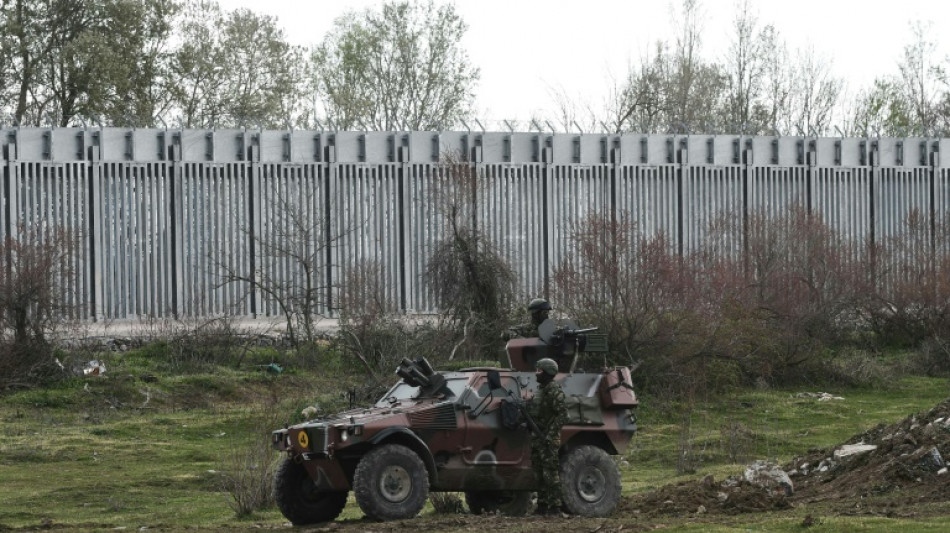
EU nears final vote on landmark asylum reform / Photo: Sakis MITROLIDIS - AFP/File

 All Blacks name veteran Taylor captain as Mo'unga seizes 10 jersey
 Race against time as Asian Games cricket quarter-finals washed out

 India turns to corals and seagrass to shield against rising seas

 Manchester City's Premier League charges: What comes next?

 Brazil's cellphone crime: a security nightmare in every pocket

 Russia pummels Kyiv in latest deadly attack

 NFL Giants obtain QB McCarthy from Vikings

 Deal for evicted Spanish pensioner as PM seeks new housing law

 Clippers apologize, warn fans of 'challenges' after Leonard scandal

 Turkish comedian convicted for Erdogan 'insult' freed pending appeal

 Trump announces 'biggest' US steel plant in battleground Iowa

 Olise wonder strike gives Zidane's France win in Belgium

 US stocks fall, bond yields rise as Middle East war drags on

 Trump denies offering to sell arms to China's Xi
 Wemby ready for NBA Spurs to move rivals in climb to top

 Ukraine to postpone some spending amid delays in aid: PM
 Tuchel says Czech Republic game 'not yet a must-win'

 MaXhosa puts South Africa on the Paris fashion map

 Rose, Scott among 2027 World Golf Hall of Fame finalists

 Brunson says NBA champion Knicks can't get satisfaction

 France puts out largest wildfire since 1949

 Real Madrid's Perez summoned over Barcelona referee payments comments

 Oil takes off again, Wall Street dips after Trump rejects Iran truce offer

 AlgoQuant Asset Management Selects Liquid Mercury to Enhance Digital Asset Trading Infrastructure

 UK to reopen refugee resettlement scheme to push 'safe' migration

The EU will vote Wednesday on a vast overhaul of its immigration policies that would notably harden entry procedures for asylum-seekers and require all the bloc's countries to share responsibility.
The European Parliament will decide a series of laws forming the bloc's migration and asylum pact, based on a European Commission proposal first made in September 2020.
The overhaul was reached only after overcoming years of tensions and divisions among EU member countries. Once fully adopted, it would come into effect from 2026.
Alongside its passage, the European Union has been striking agreements with several outside countries to try to reduce the number of migrants leaving their territories with the goal of reaching Europe.
The backdrop of the two-pronged approach is a rise in asylum applications in the 27-nation EU, which last year reached 1.14 million, the highest level since 2016.
Irregular migrant entries into the bloc are also increasing, to 380,000 last year according to the EU's border and coast guard agency Frontex.
The migration and asylum pact has been opposed, for very different reasons, by the far right, the far left and some socialist lawmakers.
"After years of impasse, the new migration rules allow us to regain control over our external borders and reduce pressure on the EU. State authorities, not smugglers, have to decide who enters the European Union," said Manfred Weber, head of the biggest political group in the European Parliament, the centre-right European People's Party.
NGOs and migrant charities have come out against the reform, especially its provision creating border facilities to accommodate asylum-seekers and quickly send back those deemed ineligible, which they fear will lead to systematic detentions.
The reform largely retains the basic rule in force under which the first EU country in which an asylum-seeker arrives is responsible for their case.
But it adds a "solidarity mechanism" that requires all EU countries to help front-line states such as Italy and Greece when they come under pressure by either taking in some of the asylum-seekers or providing an equivalent financial contribution.
- 'Inflammatory topic' -
A French centrist lawmaker in the European Parliament, Fabienne Keller, who shepherded one of the texts, called the pact "very balanced" and "a big improvement over the current situation".
"There are better checks on flows of irregular migration through the border procedures and more solidarity," she said.
But she acknowledged it was "a hugely inflammatory topic" and criticised far-right lawmakers for "trying to panic everybody" over the changes.
The parliament's vote will not be the last step for the pact, as the technical application of its procedures still need to be defined, Keller said. They include how to organise the border centres and supply them with sufficient resources, translators and police officers.
Another controversial point is a provision to send asylum-seekers to "safe" third countries.
A left-wing lawmaker, Raphael Glucksmann of France, said "that would allow asylum-seekers likely to obtain asylum in an EU country to be sent to transit countries".
He criticised a compromise under which some EU nations would be able to offset their financial obligations under the solidarity mechanism if they helped pay for tougher border security in another EU country.
"That upholds the idea of a 'safe third country' which would apply to some countries that are 'safe' only by that label," he said. "It's another step towards the outsourcing of our borders."
On the far right, lawmaker Jean-Paul Garraud of France said "the outer borders of the EU are like sieves and nothing has been done to change that".
One of the few changes the far right favoured was a system to take the biometric data of each arriving asylum-seeker and put it into an EU database called Eurodac, he said, though he argued it would do little to stop mass irregular immigration.
"These mechanisms are just smokescreens," he said. "They will be ineffective and won't be able to be applied given the scale of the migration flows."
Q.Najjar--SF-PST