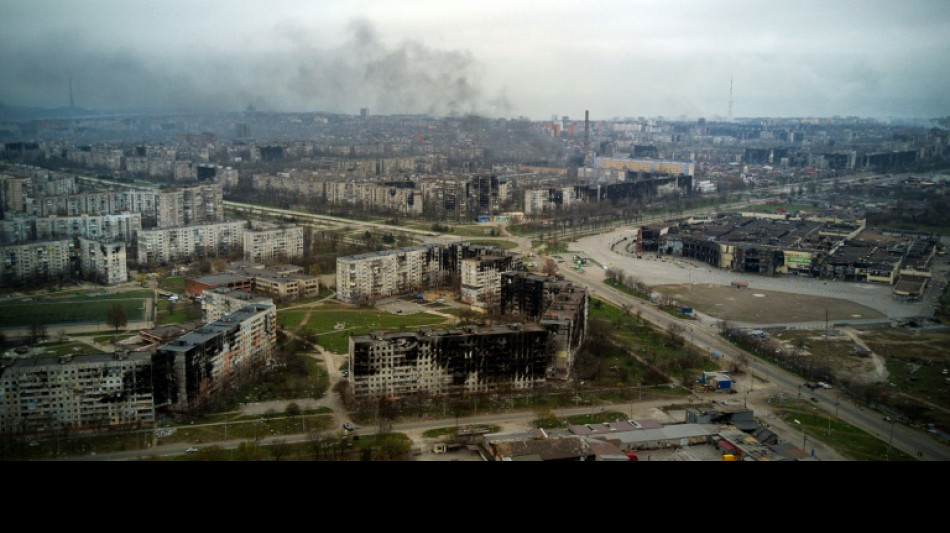
Mariupol's tunnel warriors seek to slow Russian onslaught / Photo: Andrey BORODULIN - AFP

 Rubio lands in India for 'trade diplomacy'
 China opposes US ban on govt agencies from using DeepSeek

 Near miss: Indonesia probes crash of suspected Chinese rocket fragment

 Indonesia investigates crash of suspected Chinese rocket fragment

 South Korea to withdraw some Ukraine embassy staff after POW row

 S. Korea warns of 'firm' response after North threatens fresh measures near border

 Ukraine claims US missile holdup ahead of reported talks

 Niners hold off Commanders to stay perfect in NFL

 Tech firms bear brunt of selling as Asian stocks drop

 Reese scores 30 as Dream stun Valkyries to level WNBA finals

 Horror and disbelief after lawmaker attacked in rural Australia

 Ukraine races to secure energy supplies ahead of winter

 Vote count begins in Alberta secession referedum, testing Canada unity

 Ukraine claims US missile holdup as Trump floats summit without Zelensky

 Detained Suu Kyi receives UK royal package: Myanmar govt

 Japan successfully launches probe in historic Mars moon mission

 US to auction deep sea mining leases off American Samoa

 Australian lawmaker hurt in car attack underwent surgery overnight: PM

 Japan launches rocket for potential world first Mars moon mission

 Ethiopia PM warns Eritrea of 'severe consequences' if supports enemies

 Boland grabs opportunity for Australia as South Africa struggle in second Test

 Ronaldo handed 30-day suspension: Portuguese federation

 France announces curfews as government grapples with unrest

 Boland sets pace as South Africa struggle

 Ukraine on back foot as Kremlin moots US, China meeting

As Russian forces close in on the southern Ukrainian port city of Mariupol, a small number of resistance fighters hope to slow them down using a tunnel system below a vast industrial site as their base.
Experts say the fall of the city, seen as strategically vital for Russian plans to attack eastern Ukraine, is inevitable.
But holdouts in their underground bases hope to make conquering the Sea of Azov port as hard as possible for the attackers.
The urban landscape where the Ukrainian resistance plans to take on the invaders seems almost tailor-made for guerrilla warfare, with sprawling rail lines, warehouses, coal furnaces, factories, chimneys and tunnels.
The maze-like area is a metal works complex, Azovstal, owned by Metinvest, which is run by Ukraine's richest man Rinat Akhmetov.
It has been the focus of urban fighting in Mariupol, just like the nearby Azovmash factory which makes rail components, cranes and other large metal structures.
"It's a city within a city," said Eduard Basurin, a representative for pro-Russian separatists in the eastern Donetsk region.
"There are several underground levels that date back to Soviet times which you can't bombard from above. You have to go underground to clean them out, and that will take time."
Entering the tunnels would be all but impossible for Russian troops, according to Alexander Grinberg, analyst at the Jerusalem Institute for Strategy and Security.
- 'They can try' -
"They can try, but they'll be slaughtered because the defenders of the tunnel will absolutely have the tactical upper hand," he told AFP.
Fighters have in the past used tunnel systems to great effect in their struggle against superior forces.
The Viet Cong made the vast Cu Chi tunnel system near Saigon a base for attacks against US troops and Hamas has used tunnels in their fight against the Israeli army.
The Islamic State group's tunnel system in Mosul, Iraq, allowed its fighters to surprise American troops with sudden appearances seemingly out of nowhere.
But the most memorable example dates back to World War II and the battle of Stalingrad with its fierce fighting in the Red October industrial complex.
"The Soviets used underground passages, sewers and tunnels to get behind German lines," a French military source told AFP.
A sapper unit discovered a former factory used by German troops, stacked three tonnes of explosives underneath and blew up the entire complex, burying the Germans in the rubble, the source said.
The astute use of tunnels has lost none of its effectiveness in the 80 years since, rendering enemy artillery, air strikes and snipers virtually useless.
Satellite surveillance is also of limited use against combatants hiding below ground, as is technical intelligence, the spying on enemy weapons.
However, as analysts point out, the underground system only works if the network is vast and fighters have enough ammunition, food and water, which requires meticulous advance planning.
Soldiers deployed underground also need extremely good training to be operational in this unusual combat environment, said James Rands at British defence intelligence specialists Janes.
- 'Inherent dangers' -
"The enclosed spaces mean engagements occur at shorter ranges, limiting the effectiveness of some small arms," he said.
Close-range use of weapons also carries "a significant risk of tunnel collapse and inherent dangers to the forces employing them", he said.
In addition, commanding troops underground is difficult because standard communications do not work well, and tunnel networks are not usually well mapped, he said.
The evacuation of wounded soldiers is also very cumbersome, Rands added.
Despite all the advantages for the defenders, the tunnel network can possibly still be taken if, as is likely, the Ukrainians lack key equipment in sufficient quantity, such as night-vision gear, analysts said.
It may also be difficult to counter the potential use by the Russians of large quantities of water to flood the tunnels, or of gas or chemical products to force the Ukrainians to the surface.
Although Russian President Vladimir Putin said Tuesday that Russia was pursuing its Ukraine operation "calmly", there is a chance that the tunnel wars will be anything but -- and last for some time.
V.Said--SF-PST