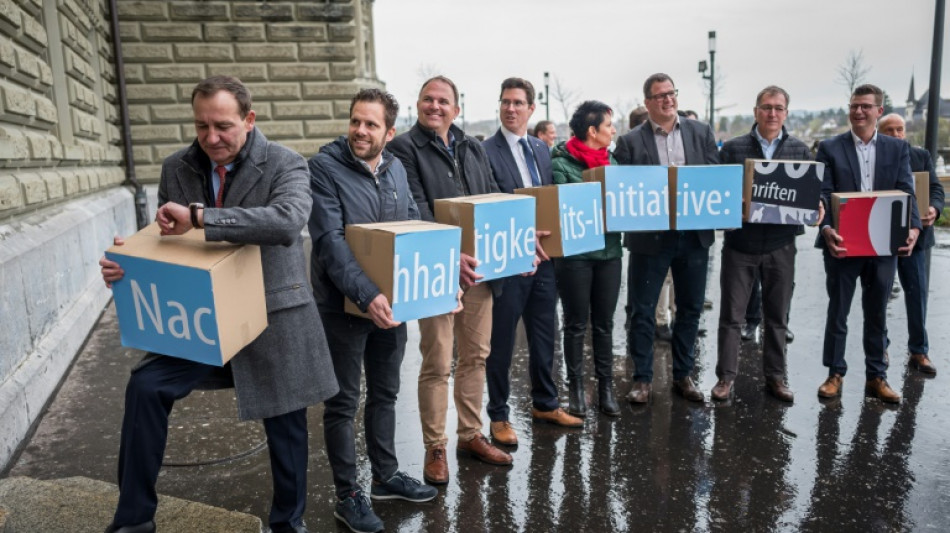
Swiss set to vote on limiting immigration / Photo: Fabrice COFFRINI - AFP

 استقرار أسعار الذهب مع ترقب المستثمرين لقرارات الفائدة الأمريكية

 Kuwait and Egypt Sign Eight Agreements to Expand Strategic Partnership

 تقارير إسرائيلية تكشف عن محاولات نتنياهو وزملائه للتأثير على نتائج الانتخابات عبر استهداف الفلسطينيين

 بنك القدس يتعهد بتأمين احتياجات مرضى السكري خلال أمسية توعوية في رام الله

 AI Job Losses at NAB, Qantas, Canva and Atlassian Signal Market Shift, Not Workforce Collapse

 Owner Review: 2023 Volvo XC60 Recharge Exceeds Expectations for Calgary Driver
 Indiana River Otters Make Comeback After Decades of Conservation Efforts

Switzerland is set to hold a vote on measures designed to limit immigration to stop the population hitting 10 million before 2050, after enough signatures were deposited Wednesday.
Under Switzerland's direct democracy system, citizens can trigger popular votes by collecting 100,000 valid signatures within 18 months.
The hard right Swiss People's Party (SVP) submitted 114,600 signatures to the Federal Chancellery in Bern on Wednesday -- collected in half the time.
"Mass immigration continues its frantic course... with devastating consequences for our small country," said the SVP, which is the biggest party in the wealthy Alpine nation.
Adopting the initiative "is urgent to protect our unique landscape, our high quality of life, our above-average prosperity and for a secure, free future for us and our children".
Once petition signatures are verified, it generally takes months, or even years, before a vote takes place.
The permanent population at the end of 2022 was 8.82 million, up from 8.54 million at the end of 2018.
Foreigners make up a quarter of the population.
- Ending European free movement -
The initiative proposes to modify the Swiss constitution, stipulating that "the permanent resident population of Switzerland must not exceed 10 million people before the year 2050".
The permanent resident population would include Swiss nationals living in the country and foreigners with either a residence permit valid for at least one year, or staying in the country for at least 12 months.
If it exceeds 9.5 million before 2050, the government and parliament "will take measures, in particular regarding asylum and family reunification, with a view to ensuring compliance".
If these measures are not enough, Switzerland would ultimately have to terminate the agreement on the free movement of people with the EU.
Switzerland is not in the European Union but has been part of the EU's Schengen open-borders area since 2008.
The move comes in the midst of negotiations for a rapprochement between Switzerland and the EU.
The SVP said the initiative was "the answer to immigration-related problems in Switzerland", citing housing shortages, rising rents, traffic jams, overcrowded public transport, falling school standards, violence and crime, electricity shortages, stagnant per capita income, higher health insurance premiums and "increasing pressure on our beautiful countryside".
- 'Too many foreigners' -
The SVP, which comfortably topped the Swiss general election in October, has come a long way from its roots as a farmers' party in the German-speaking part of Switzerland.
It became a national force focused on opposition to three things: mass immigration, closer ties with the EU, and the abandonment of Swiss neutrality.
Its new leader, 43-year-old hill farmer Marcel Dettling, is considered on the harder wing of the party on immigration.
"Today, too many foreigners are arriving, and not the right ones. We need controlled immigration that benefits our country and our population," he said after the signatures were deposited.
According to the Federal Statistical Office, in 2022, net migration accounted for a 68,800 rise in the population. Natural change -- births minus deaths -- accounted for a 7,900 increase.
FSO 2020 projections predicted the population would be 10.4 million in 2050, with a "low scenario" of 9.5 million and a "high scenario" of 11.4 million.
W.AbuLaban--SF-PST