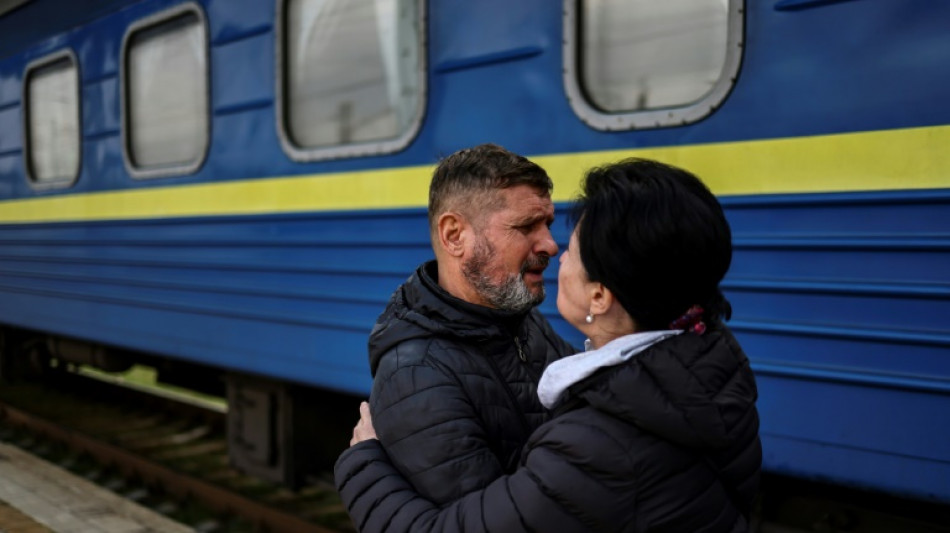
Civilians escape east Ukraine cities as Russian assault looms / Photo: RONALDO SCHEMIDT - AFP

 Rubio lands in India for 'trade diplomacy'

 China opposes US ban on govt agencies from using DeepSeek

 Near miss: Indonesia probes crash of suspected Chinese rocket fragment

 Indonesia investigates crash of suspected Chinese rocket fragment

 South Korea to withdraw some Ukraine embassy staff after POW row

 S. Korea warns of 'firm' response after North threatens fresh measures near border

 Ukraine claims US missile holdup ahead of reported talks

 Niners hold off Commanders to stay perfect in NFL

 Tech firms bear brunt of selling as Asian stocks drop

 Reese scores 30 as Dream stun Valkyries to level WNBA finals

 Horror and disbelief after lawmaker attacked in rural Australia

 Ukraine races to secure energy supplies ahead of winter

 Vote count begins in Alberta secession referedum, testing Canada unity

 Ukraine claims US missile holdup as Trump floats summit without Zelensky

 Detained Suu Kyi receives UK royal package: Myanmar govt

 Japan successfully launches probe in historic Mars moon mission

 US to auction deep sea mining leases off American Samoa

 Australian lawmaker hurt in car attack underwent surgery overnight: PM

 Japan launches rocket for potential world first Mars moon mission

 Ethiopia PM warns Eritrea of 'severe consequences' if supports enemies

 Boland grabs opportunity for Australia as South Africa struggle in second Test

 Ronaldo handed 30-day suspension: Portuguese federation

 France announces curfews as government grapples with unrest

 Boland sets pace as South Africa struggle

 Ukraine on back foot as Kremlin moots US, China meeting

By bus and train, residents keep streaming out of east Ukraine's Kramatorsk and Sloviansk as fears grow the cities will be key targets of a major new Russian offensive.
On Tuesday morning, a bus in the green and yellow colours of local football team FC Kramatorsk was waiting in the rain to collect about 50 people.
Men dropped off their wives, children and elderly relatives for the journey westwards that was being funded by a church group.
Worry and sadness were etched on the faces of the loved ones as they got ready to bid each other goodbye.
The frontline is only 50 kilometres (30 miles) away to the north, east and south of Kramatorsk -- the Ukrainian military's main hub for its operations in the east.
That distance may soon be reduced soon as Russia masses its forces for an onslaught that many believe will be aimed at capturing the city, and neighbouring Sloviansk, in a pincer movement.
A family disembarked from a taxi to catch the bus, among them a little girl holding a plastic box containing a black and white cat.
Valentina Oleynikova, 82, was leaving with her husband.
Angry that the threat of the Russian assault was forcing her to leave her home, she dismissed President Vladimir Putin's claim that his forces were looking to liberate the largely Russian-speaking Donbas region from Ukrainian "neo-Nazis".
"All my family is from Russia, I was born there. My father and mother too. I have relatives all over Russia," she told AFP.
"Here, in Donbas and Kramatorsk, people of all nationalities live. Where has he seen Nazis here?"
- 'Devil incarnate' -
She reserved special ire for the Russian leader as she prepared to board for her journey to stay with her sister-in-law.
"What is happening is inhuman, he is a fascist. I don't know what to call him -- a devil incarnate," she said.
"If only we could close the sky. Now we hear that there is a 12-kilometre convoy ready to attack the Donbas. They are inhuman," she added, repeating a common plea on the Ukrainian side for a no-fly zone to stop Russian bombing.
Eventually the luggage was loaded and the bus was ready to pull out.
Valentina's grandson signalled to her through the window for her to call on her mobile.
Some of the women wiped away tears as they headed off.
The train station in Kramatorsk has been closed since a missile attack on Friday killed 57 people as crowds of residents tried to flee.
Trains evacuating people now leave from Sloviansk some 10 kilometres to the north.
Two or three trains leave every day for the west.
On Sunday, 2,700 people were evacuated, and 1,100 on Monday, said Svetlana Biletska, the station manager.
The first train on Tuesday left at around 11:00 am local time carrying roughly 300 passengers.
In the hubbub of the station hall, Natalia sold one-way tickets to Dnipro for 200 hryvnia (6 euros, $7) and gave out information on the schedules from the only working office.
"We have added extra cars, free of charge," she said, declining to give her surname.
"Some families are leaving, but many people are staying. They don't want to leave their relatives and their homes."
She was among those refusing to go.
"I'm not afraid anymore," she told AFP.
"Something is keeping me here, I don't know how to explain it. We work on the railway, so we are as strong as the rails."
- 'We have to survive' -
A long train with 12 faded blue wagons arrived empty and immediately began turning around to take away more evacuees.
An old lady heading Vinnytsia in central Ukraine was a little bit lost.
"You'll have to change trains for another one going to either Kyiv or Lviv," a railway worker in an orange waistcoat told her.
At the steps of the train, 44-year-old Nadiya Zhizhunas said a final goodbye to her husband.
With reddened eyes, the couple held each other tight for several minutes.
"We made the decision yesterday. I wanted to stay with my husband, but now I have to leave and he will stay here. We wanted to go through this together, it's scary," she told AFP.
"It's terribly difficult to leave. I have no idea when we will be together again. We have to survive first," she added before turning to board.
Through the window, she made a heart with her thumbs and forefingers towards her husband.
The train began to pull out, then stopped.
A family with children that was late ran across the tracks to get on board.
Eventually it finally left the station. Direction Kyiv, arrival expected in twelve hours.
B.AbuZeid--SF-PST