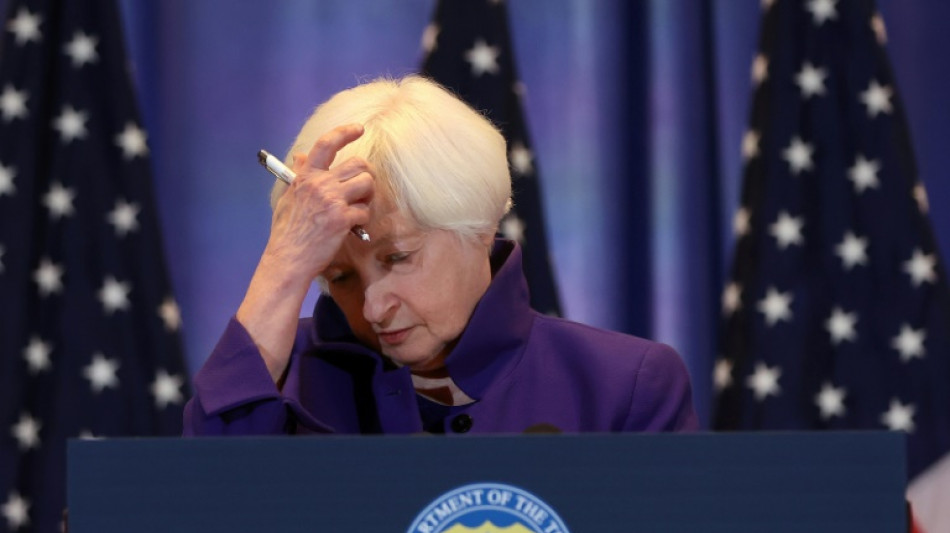
US-China economic flashpoints in Yellen's China trip / Photo: JUSTIN SULLIVAN - GETTY IMAGES NORTH AMERICA/AFP/File

 South Korea team latest to be bussed to wrong Asian Games venue

 Bears thrash Eagles 27-7 as third-string QB Keenum shines

 All Blacks name veteran Taylor captain as Mo'unga seizes 10 jersey

 Race against time as Asian Games cricket quarter-finals washed out

 India turns to corals and seagrass to shield against rising seas

 Manchester City's Premier League charges: What comes next?

 Brazil's cellphone crime: a security nightmare in every pocket

 Russia pummels Kyiv in latest deadly attack

 NFL Giants obtain QB McCarthy from Vikings

 Deal for evicted Spanish pensioner as PM seeks new housing law

 Clippers apologize, warn fans of 'challenges' after Leonard scandal

 Turkish comedian convicted for Erdogan 'insult' freed pending appeal
 Trump announces 'biggest' US steel plant in battleground Iowa

 Olise wonder strike gives Zidane's France win in Belgium

 US stocks fall, bond yields rise as Middle East war drags on

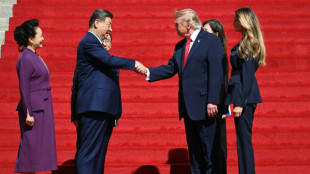 Trump denies offering to sell arms to China's Xi

 Wemby ready for NBA Spurs to move rivals in climb to top

 Ukraine to postpone some spending amid delays in aid: PM

 Tuchel says Czech Republic game 'not yet a must-win'

 MaXhosa puts South Africa on the Paris fashion map

 Rose, Scott among 2027 World Golf Hall of Fame finalists

 Brunson says NBA champion Knicks can't get satisfaction
 France puts out largest wildfire since 1949

 Real Madrid's Perez summoned over Barcelona referee payments comments

 Oil takes off again, Wall Street dips after Trump rejects Iran truce offer

Since US Treasury Secretary Janet Yellen visited Beijing last year, the world's two biggest economies have resumed regular talks and averted major escalations in tensions.
But the countries still trade barbs on economic issues as they battle for superiority in advanced technologies and work to secure critical supply chains.
As Yellen arrives in China on Thursday, what issues does she face?
- Industrial overcapacity -
Washington is wary that cheap Chinese exports could flood global markets, citing green energy sectors like solar and electric vehicles.
The United States is working to build its own supply chains in these areas.
Chinese banks have facilitated major new borrowing for the country's manufacturing sectors, extending it nearly $700 billion in new loans in the third quarter of 2023, from the prior year, said the Atlantic Council. It added this was often at below-market interest rates.
With new factories making products from EVs to batteries, there are fears Beijing could lean on the global market to absorb production that domestic demand cannot absorb.
"That's going to have an impact not only on advanced countries like the United States and (in) Europe, but also on many developing countries," said Asia Society Policy Institute vice president Wendy Cutler.
China has acknowledged risks from overcapacity but it is unclear if Beijing will take concrete steps to address this.
"Beijing and Washington are unlikely to see eye-to-eye on the issues of overcapacity," added Yun Sun, senior fellow at the Stimson Center.
China will see the focus on overcapacity in clean energy as a new US strategy to choke Chinese exports, she added.
- Treatment of businesses -
A third of companies report being treated less favorably by Chinese authorities compared with local competitors, said a business survey released in February by the American Chamber of Commerce in China.
It is a longstanding problem, with firms flagging unfair treatment in market access and regulatory enforcement.
When Yellen visits Guangzhou city in her upcoming trip, she is expected to meet with representatives from US firms to hear their concerns.
In December, she urged Beijing to shift from a state-driven approach in economic policy, which would make China more attractive to foreign companies.
The call comes as China works to attract foreign investment with economic growth set to slow.
Beijing's efforts will likely bear fruit given China's market size, but Bill Bishop, who publishes the Sinocism newsletter, warned that businesses may have "promise fatigue."
There is "a desire to actually see some more concrete and structural actions as opposed to just another set of nicely worded documents and promises from leaders," he said.
- National security -
National security looms large over US-China economic ties too, with Washington pushing a "small yard and high fence" approach that Beijing has warned against.
In February, President Joe Biden issued an executive order aimed at preventing sensitive US personal data from being accessed by countries including China.
Last August, the Treasury was also asked to set up a program monitoring US outbound investments involving China for sensitive sectors -- to prohibit certain transactions or require notifications for them.
These include semiconductors and artificial intelligence, with regulations to come.
Chinese Foreign Minister Wang Yi has since warned that Washington's AI approach could bring mistakes with historic consequences.
National security concerns are also behind efforts to force a divestment of TikTok from Chinese parent company ByteDance, and a probe into internet-connected vehicles.
- 'Friendshoring' and competition -
Another area of tension is Washington's "friendshoring" strategy -- to locate critical supply chains among allies and partners.
This is reflected in policies like the Inflation Reduction Act which includes consumer subsidies for EVs made in North America and involving countries the United States has free trade agreements with.
While Yellen has said the world is big enough for both countries to thrive, Chinese Premier Li Qiang slammed efforts to "de-risk" the economies as a "false proposition."
China's new climate chief Liu Zhenmin recently took aim at measures made in the name of "de-risking," calling them an obstacle to the green transition.
China has hit back as the Biden administration stepped up efforts to restrict Chinese firms' access to advanced semiconductors, saying such moves aim to maintain US supremacy in the field.
Beijing has imposed export controls on metals critical for making semiconductors, while barring the use of US chipmaker Micron's chips from critical infrastructure projects.
Z.Ramadan--SF-PST